

The U.S. Army has renewed interest in new longer-range artillery shells, such as ramjet-powered types, following its axing of plans to buy a next-generation tracked self-propelled 155mm howitzer earlier this year. The service still sees a need for 155mm howitzers with greater reach in future conflicts and is also taking another look at potential options on the market now to succeed its much-upgraded M109-series types.

 www.twz.com
Wheeled and tracked self-propelled howitzers have been seeing very active use in the ongoing conflict in Ukraine. For the Ukrainian military, members of the M109 family and other NATO-standard 155mm types, and ammunition for them, are in extremely high demand. The fighting in that country has underscored the continued value of traditional tube artillery, in general, in higher-end conflicts.
An effort led by BAE offers a low-risk, faster way to upgrade the 155mm/39 M109A7 to meet the firepower and range standards of other advanced armies.

The M109A7 with its shorter L39 gun.
BAE Systems has partnered with the US Army to develop a prototype M109-52 self-propelled howitzer (SPH). This prototype takes the chassis and turret from the M109A7 and combines it with the Rheinmetall L52 155mm cannon. This cannon is the same as mounted on the very successful PzH2000 which has seen considerable service in Ukraine.
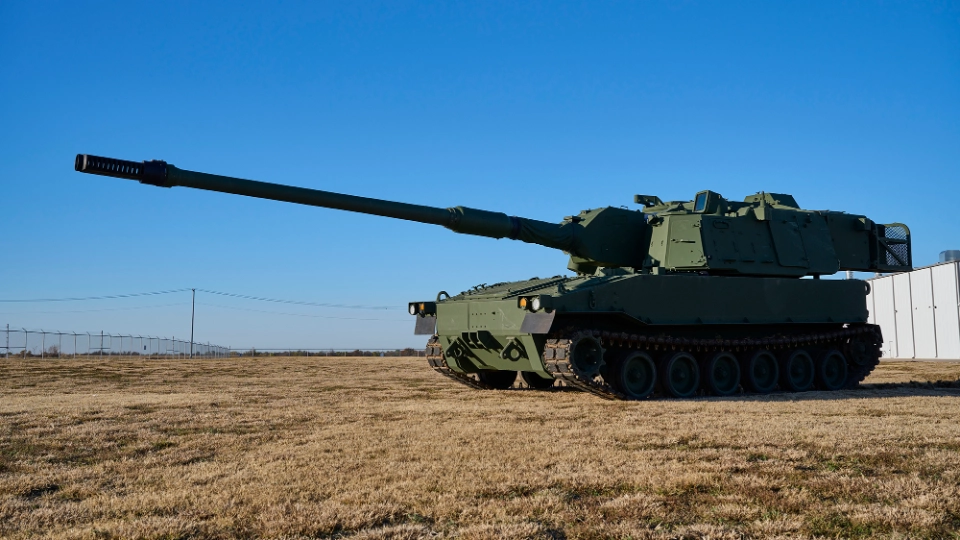
The M109-L52 uses the latest M109A7 chassis, combined with the well-established, globally deployed L52 155mm-calibre howitzer
The advantage of adding the 52-caliber barrel (26 ft+) is that it significantly increases the system’s effective range. With standard shells, the 39-caliber (-20 ft.) can reach 24 km, while the 52-caliber extends that to 36 km. With rocket-assisted projectiles, these ranges are 30 and 67 km, respectively. The longer barrel length allows for a prolonged propellant “burn,” increasing muzzle velocity and range. The L52 is compatible with all NATO-standard ammunition.

 www.overtdefense.com
BAE advertises the M109-52 as a low-risk solution that is also more cost effective than procuring an allied off-the-shelf system. The Army already widely operates the M109A7 which shares a chassis and other components with the new 52 caliber platform. Additionally the purpose of the M109A7 was to integrate the M109A6 Paladin turret with the Bradley chassis to increase capacity and simplify logistics and maintenance. Since the AMPV also shares the Bradley chassis this would mean that all medium weight US Army tracked vehicles would share a common chassis. This would greatly simplify logistics and training.


 thedefensepost.com


 militaryleak.com
The new M109-52 maintains the platform’s four-person crew configuration while focusing modernization efforts on improved firepower rather than a complete redesign, enabling faster deployment and reduced development risk.

By combining an American-built platform with a proven 52-caliber artillery system already used by several NATO allies, the howitzer offers an expedited path to fielding extended-range firepower without compromising logistical familiarity or operational readiness. The M109-52 underscores a broader shift toward enhancing existing combat systems to meet evolving battlefield demands, reinforcing the M109’s long-standing role as the “King of Battle” in modern artillery warfare.
The Army has been funding work on ramjet-powered and other advanced 155mm artillery shells under the Extended Range Artillery Munitions Suite (ERAMS) effort for some time now. Norway’s Nammo, which has been developing a ramjet type in cooperation with Boeing, has said its design could eventually be able to reach targets just over 93 miles (150 kilometers) away, depending on the howitzer used to fire it.
Focus Grows On Longer-Range Artillery Shells After Army Axes Next-Gen Howitzer
Ramjet rounds and other new shells could help the Army squeeze more range out of its existing howitzers as it reassesses its artillery future.
www.twz.com
Wheeled and tracked self-propelled howitzers have been seeing very active use in the ongoing conflict in Ukraine. For the Ukrainian military, members of the M109 family and other NATO-standard 155mm types, and ammunition for them, are in extremely high demand. The fighting in that country has underscored the continued value of traditional tube artillery, in general, in higher-end conflicts.
An effort led by BAE offers a low-risk, faster way to upgrade the 155mm/39 M109A7 to meet the firepower and range standards of other advanced armies.
The M109A7 with its shorter L39 gun.
BAE Systems has partnered with the US Army to develop a prototype M109-52 self-propelled howitzer (SPH). This prototype takes the chassis and turret from the M109A7 and combines it with the Rheinmetall L52 155mm cannon. This cannon is the same as mounted on the very successful PzH2000 which has seen considerable service in Ukraine.
The M109-L52 uses the latest M109A7 chassis, combined with the well-established, globally deployed L52 155mm-calibre howitzer
The advantage of adding the 52-caliber barrel (26 ft+) is that it significantly increases the system’s effective range. With standard shells, the 39-caliber (-20 ft.) can reach 24 km, while the 52-caliber extends that to 36 km. With rocket-assisted projectiles, these ranges are 30 and 67 km, respectively. The longer barrel length allows for a prolonged propellant “burn,” increasing muzzle velocity and range. The L52 is compatible with all NATO-standard ammunition.
BAE and US Army Advance M109-52 Development to Increase Artillery Range
BAE Systems has partnered with the US Army to develop a prototype M109-52 self-propelled howitzer. This prototype takes the chassis and turret from the M109A7 and combines it with the Rheinmetall L52 155mm cannon.
www.overtdefense.com
BAE advertises the M109-52 as a low-risk solution that is also more cost effective than procuring an allied off-the-shelf system. The Army already widely operates the M109A7 which shares a chassis and other components with the new 52 caliber platform. Additionally the purpose of the M109A7 was to integrate the M109A6 Paladin turret with the Bradley chassis to increase capacity and simplify logistics and maintenance. Since the AMPV also shares the Bradley chassis this would mean that all medium weight US Army tracked vehicles would share a common chassis. This would greatly simplify logistics and training.
BAE, US Army Partner to Develop 52-Caliber M109 Paladin Howitzer
BAE Systems has signed a research and development agreement with the US Army for the 52-caliber version of the M109 self-propelled howitzer prototype.
thedefensepost.com
BAE Systems Unveils M109-52 Self-Propelled Howitzer to Boost Long-Range Firepower - MilitaryLeak.COM
BAE Systems has introduced the M109-52 Self-Propelled Howitzer, an upgraded artillery platform designed to enhance long-range precision fires while retaining...
militaryleak.com
The new M109-52 maintains the platform’s four-person crew configuration while focusing modernization efforts on improved firepower rather than a complete redesign, enabling faster deployment and reduced development risk.
By combining an American-built platform with a proven 52-caliber artillery system already used by several NATO allies, the howitzer offers an expedited path to fielding extended-range firepower without compromising logistical familiarity or operational readiness. The M109-52 underscores a broader shift toward enhancing existing combat systems to meet evolving battlefield demands, reinforcing the M109’s long-standing role as the “King of Battle” in modern artillery warfare.
The Army has been funding work on ramjet-powered and other advanced 155mm artillery shells under the Extended Range Artillery Munitions Suite (ERAMS) effort for some time now. Norway’s Nammo, which has been developing a ramjet type in cooperation with Boeing, has said its design could eventually be able to reach targets just over 93 miles (150 kilometers) away, depending on the howitzer used to fire it.
