

shanneba
Professional
It is time to start our next series of historical documents.
We have read the Articles of Association, the Declaration of Independence, the Articles of Confederation, the Treaty of Paris, and the Northwest Ordinance.
This time we will tackle the Constitution.
This will take us a few of months. We hope you will join us each day, Monday through Thursday, and share what you read with your friends. Every American should read the Constitution at least once. Even better – annually.
The Articles of Confederation and Shays' Rebellion
From our study of the Declaration of Independence we should remember that the American Revolution began in 1775 and the Declaration was approved in 1776. Let us add more dates. On November 15, 1777 the Second Continental Congress adopted the Articles of Confederation. It was ratified by all the states by March 1, 1781. This was our nation’s first constitution, and it was a failure.
The Articles joined the thirteen states in a confederation of mutual aid and support. Fearful of replacing one oppressive central government with another, the Articles were deliberately made weak. For any law to be passed 9 out of the 13 states had to approve it. Each state, regardless of size, had one vote. There was no president to enforce the laws. There were no courts to settle disputes between the states. There was no common currency. And Congress had no power to tax. That last is not as pleasant as it sounds. It meant that Congress could not pay its bills.
Without a means of raising revenue, Congress was dependent on the states for money. But the states argued among themselves and refused to support Congress. The national government could not force the states to pay nor enforce any of the laws it passed. The Articles were failing and the country was falling apart even as we were winning the war for independence. And if the states did not stay united, the independence would be short lived. Great Britain or some other European power would be able to pick off the states one by one.
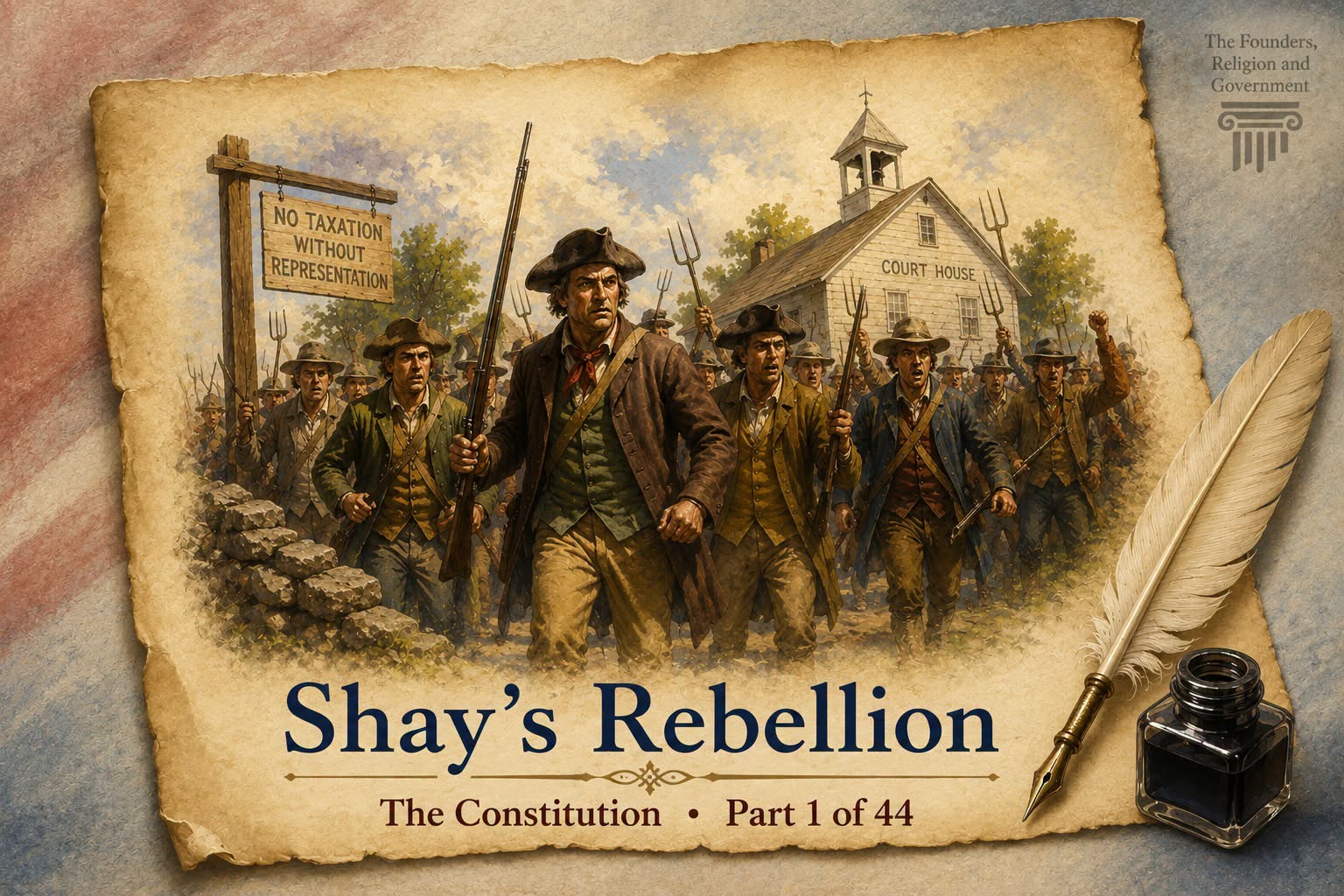
The problem was brought to a head in the fall of 1786 with Shays' Rebellion. Lead by Revolutionary War veteran Daniel Shays, farmers from western Massachusetts revolted against a distant and unresponsive government. This time it was not Parliament but the state legislature in Boston. Many men were in debt and losing their farms. Some were thrown in debtor’s prison. Out of frustration and desperation, these men began repeating the actions of the colonists leading up to the Revolution. While the rebellion was crushed, it did serve as a wake-up call that things were not working.
Twelve of the thirteen states, Rhode Island abstained, decided to meet once again in Philadelphia, this time to fix the ailing Articles. Realizing that they were not workable, the convention instead decided to write a new constitution for the country. Over the course of the next few months, every word and line would be debated, intensely. Over the course of several months, we will read every word they wrote.
More US History from David Barton

 wallbuilders.com
We have read the Articles of Association, the Declaration of Independence, the Articles of Confederation, the Treaty of Paris, and the Northwest Ordinance.
This time we will tackle the Constitution.
This will take us a few of months. We hope you will join us each day, Monday through Thursday, and share what you read with your friends. Every American should read the Constitution at least once. Even better – annually.
The Articles of Confederation and Shays' Rebellion
From our study of the Declaration of Independence we should remember that the American Revolution began in 1775 and the Declaration was approved in 1776. Let us add more dates. On November 15, 1777 the Second Continental Congress adopted the Articles of Confederation. It was ratified by all the states by March 1, 1781. This was our nation’s first constitution, and it was a failure.
The Articles joined the thirteen states in a confederation of mutual aid and support. Fearful of replacing one oppressive central government with another, the Articles were deliberately made weak. For any law to be passed 9 out of the 13 states had to approve it. Each state, regardless of size, had one vote. There was no president to enforce the laws. There were no courts to settle disputes between the states. There was no common currency. And Congress had no power to tax. That last is not as pleasant as it sounds. It meant that Congress could not pay its bills.
Without a means of raising revenue, Congress was dependent on the states for money. But the states argued among themselves and refused to support Congress. The national government could not force the states to pay nor enforce any of the laws it passed. The Articles were failing and the country was falling apart even as we were winning the war for independence. And if the states did not stay united, the independence would be short lived. Great Britain or some other European power would be able to pick off the states one by one.
The problem was brought to a head in the fall of 1786 with Shays' Rebellion. Lead by Revolutionary War veteran Daniel Shays, farmers from western Massachusetts revolted against a distant and unresponsive government. This time it was not Parliament but the state legislature in Boston. Many men were in debt and losing their farms. Some were thrown in debtor’s prison. Out of frustration and desperation, these men began repeating the actions of the colonists leading up to the Revolution. While the rebellion was crushed, it did serve as a wake-up call that things were not working.
Twelve of the thirteen states, Rhode Island abstained, decided to meet once again in Philadelphia, this time to fix the ailing Articles. Realizing that they were not workable, the convention instead decided to write a new constitution for the country. Over the course of the next few months, every word and line would be debated, intensely. Over the course of several months, we will read every word they wrote.
More US History from David Barton
Preserve America's Heritage: Education, Resources and Events
At WallBuilders, we help Americans celebrate and safeguard the authentic history of our nation through education, resources, and more.
wallbuilders.com