

The advent of tank warfare during World War I introduced a totally new battlefield threat to the infantryman. The first operational tank was fielded by the British during the Battle of the Somme in September 1916, and the French developed their own tanks in the spring of 1917. Although slow- moving and plagued by mechanical difficulties, the tanks were relatively safe from rifle and machine-gun fire and struck fear into the average German soldier.
But, the Germans soon concluded that a large-bore rifle firing a high-velocity cartridge would be able to penetrate the armor of these early armored vehicles.
 www.americanrifleman.org
On Nov. 2, 1918, the U.S. Army evaluated a prototype magazine-fed, bolt-action .50-cal. rifle designed by Winchester, dubbed the “Model 1918 .50-Cal. High-Power Bolt-Action Swivel Gun.” It might have had some application as an anti-tank rifle, but further development was dropped with the ending of the war. The gun was subsequently used primarily to test the early .50-cal. cartridges being developed for the M2 Browning heavy machine gun.
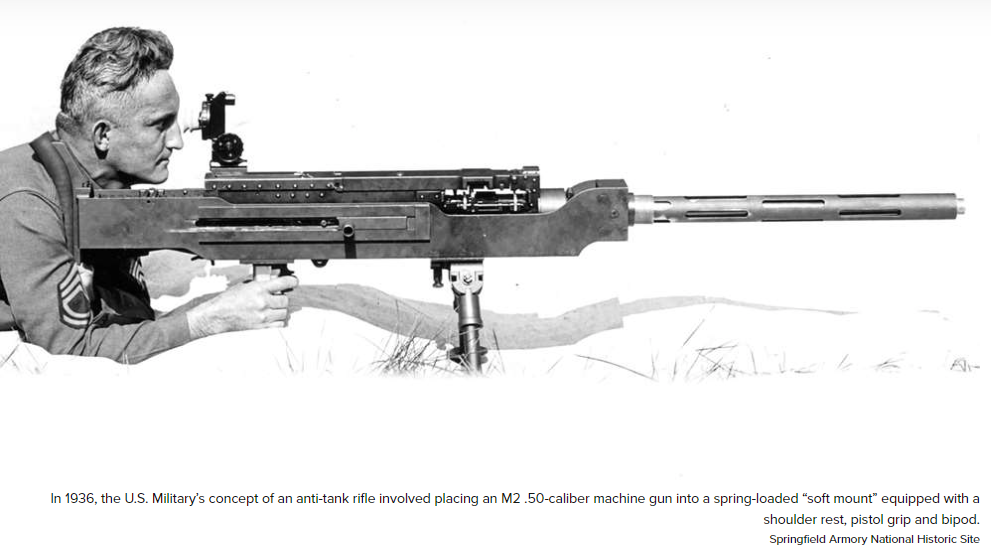
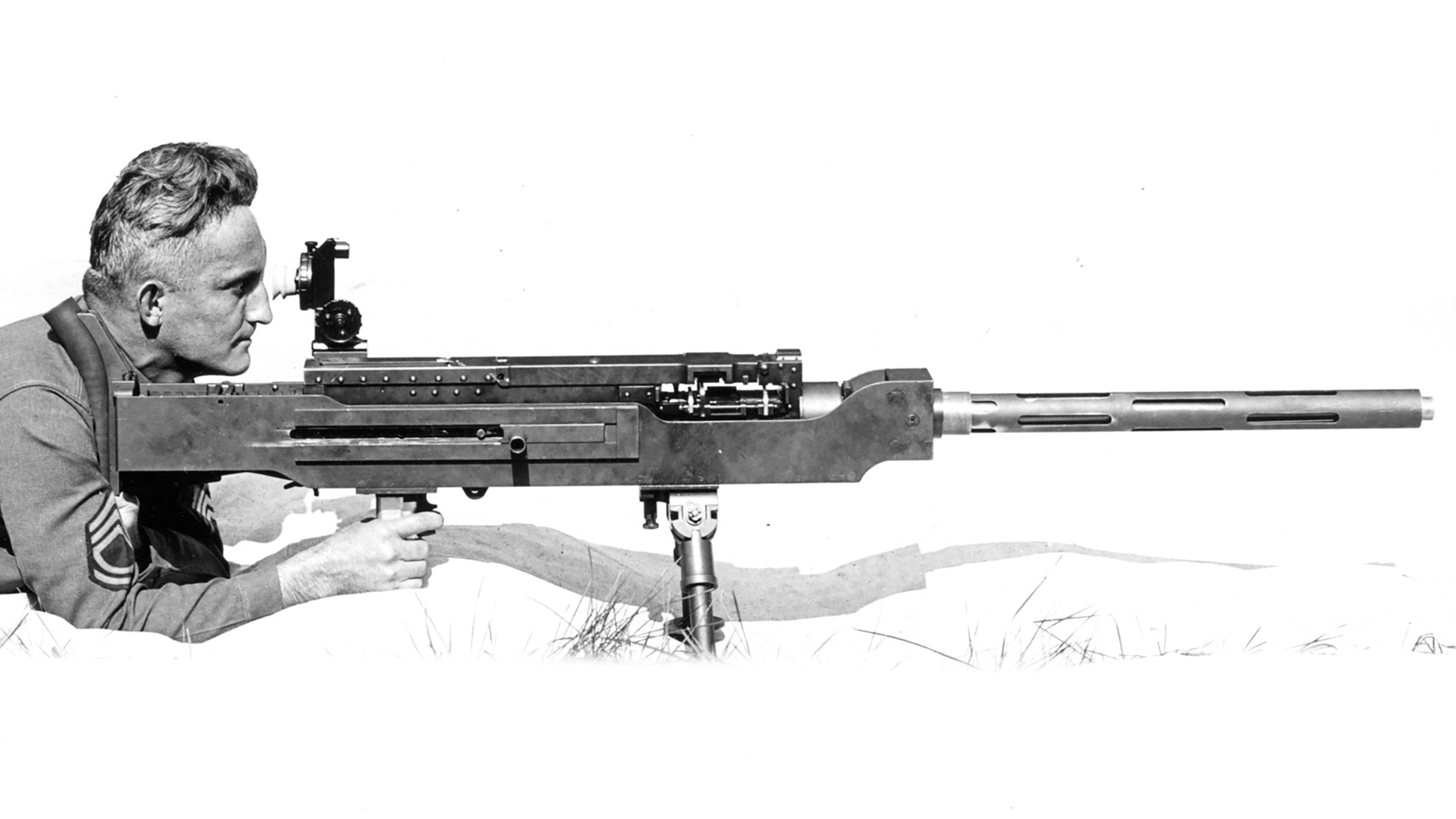
In the late 1930s, with war looming on the horizon, U.S. Army Ordnance embarked on the development of an anti-tank version of the Browning .50-caliber machine gun. This was to be accomplished by equipping the machine gun with a pistol grip, bipod and shoulder stock, which would eliminate the need for the heavy tripod.
The gun was designated as an “Anti-Mechanization Weapon.” Since full-automatic fire from a gun of this configuration would be uncontrollable, as well as unnecessary, the experimental .50-caliber anti-tank gun was capable of semi-automatic fire only
But, the Germans soon concluded that a large-bore rifle firing a high-velocity cartridge would be able to penetrate the armor of these early armored vehicles.
An Official Journal Of The NRA | The Short Life of America’s Anti-Tank Rifles
At the dawn of mechanized warfare, the U.S. Military contended with the reality that infantrymen would need an effective arm to defeat tanks. Their idea? Bring more gun.
On Nov. 2, 1918, the U.S. Army evaluated a prototype magazine-fed, bolt-action .50-cal. rifle designed by Winchester, dubbed the “Model 1918 .50-Cal. High-Power Bolt-Action Swivel Gun.” It might have had some application as an anti-tank rifle, but further development was dropped with the ending of the war. The gun was subsequently used primarily to test the early .50-cal. cartridges being developed for the M2 Browning heavy machine gun.
In the late 1930s, with war looming on the horizon, U.S. Army Ordnance embarked on the development of an anti-tank version of the Browning .50-caliber machine gun. This was to be accomplished by equipping the machine gun with a pistol grip, bipod and shoulder stock, which would eliminate the need for the heavy tripod.
The gun was designated as an “Anti-Mechanization Weapon.” Since full-automatic fire from a gun of this configuration would be uncontrollable, as well as unnecessary, the experimental .50-caliber anti-tank gun was capable of semi-automatic fire only


