testtest

1911 TRP CC - Full length guide rod odd behavior

I installed a full length guide rod in my commander TRP and I’ve noticed there is a small movement like a 1/64 inch back to front in the slide.

With the standard guide rod that came in the pistol the slide has no slip movement at all.

I can’t seem to find where the looseness is coming from. Any suggestions?

BTW I went back to the original guide rod.
 
I installed a full length guide rod in my commander TRP and I’ve noticed there is a small movement like a 1/64 inch back to front in the slide.

With the standard guide rod that came in the pistol the slide has no slip movement at all.

I can’t seem to find where the looseness is coming from. Any suggestions?

BTW I went back to the original guide rod.
Weird, never was a fan of the full length guide rod, what brand is it and did you try contacting the guide rods customer support to see what they have to say
 
I installed a full length guide rod in my commander TRP and I’ve noticed there is a small movement like a 1/64 inch back to front in the slide.

With the standard guide rod that came in the pistol the slide has no slip movement at all.

I can’t seem to find where the looseness is coming from. Any suggestions?

BTW I went back to the original guide rod.
If you don't mind answering my questions, mebbe I can help... Or at least give it the ol' college try.

First questions: To help understand the nature of the issue: Are you saying that the slide has 1/64" of free travel with the full length guide rod after the pistol is in full lock up? If so, can the free travel be induced by merely shaking the gun, or do you have to apply a slight amount of rearward tension to the slide? And also, to be clear, the free travel is NOT present at all when the standard GI guide rod is installed, correct?
 
Weird, never was a fan of the full length guide rod, what brand is it and did you try contacting the guide rods customer support to see what they have to say
MY TRPCC is an exceptionally well made and reliable pistol and is my EDC. I shoot the heck out of it and it runs. SA put extra care into making it work that way and that is reflected in the price. Introduction of an after market internal part like a full length guide rod goes outside design parameters the engineers at SA were working with. I have to believe they considered putting in a full length guide rod and decided against it. I cannot think of any functional advantage from replacing the guide rod, which I suspect in your case is out of spec. My recommendation is put the original guide rod back in and see how it runs.
 
MY TRPCC is an exceptionally well made and reliable pistol and is my EDC. I shoot the heck out of it and it runs. SA put extra care into making it work that way and that is reflected in the price. Introduction of an after market internal part like a full length guide rod goes outside design parameters the engineers at SA were working with. I have to believe they considered putting in a full length guide rod and decided against it. I cannot think of any functional advantage from replacing the guide rod, which I suspect in your case is out of spec. My recommendation is put the original guide rod back in and see how it runs.
I can't say that I disagree with ya, Hayes. The current crop of 1911s put out by Springfield Armory offer an extremely solid value and their quality (in my opinion) is consistent and solid.

If you look closely at the last statement in @EmberTRPCC 's post, you'll see that he has already followed your recommended course of action.

I'd still like to help him diagnose WHY his aftermarket FLGR is out of spec if possible, and only if @EmberTRPCC is interested in pursuing the matter.
 
What does the rear of the full length guide rod look like compared to the stock one?

Wilson Bullet proof

1777546777052.png


Wilson Full length

1777546891534.png


That difference may allow the barrel link to be in a slightly different position when the slide is fully forward.
 
What does the rear of the full length guide rod look like compared to the stock one?

Wilson Bullet proof

View attachment 109352

Wilson Full length

View attachment 109353

That difference may allow the barrel link to be in a slightly different position when the slide is fully forward.
Precisely where I'm "headed" with my line of questioning. A guide rod head that is not quite a correct fit will leave a slight amount of space for the slide stop pin, when inserted through the bottom link hole, to allow the barrel and slide to move just a little bit. A proper fit of the rear face of the guide rod head will allow the action spring (aka recoil spring) to maintain pressure against the link in the "locked up" position, preventing the slight amount of back and forth movement of the slide and barrel. An improper fit will leave a small gap between the rear face of the guide rod head and the link, allowing a small amount of movement of the slide and barrel.
 
Weird, never was a fan of the full length guide rod, what brand is it and did you try contacting the guide rods customer support to see what they have to say
It's a Wilson Combat andI have but a great idea. Thanks
If you don't mind answering my questions, mebbe I can help... Or at least give it the ol' college try.

First questions: To help understand the nature of the issue: Are you saying that the slide has 1/64" of free travel with the full length guide rod after the pistol is in full lock up? If so, can the free travel be induced by merely shaking the gun, or do you have to apply a slight amount of rearward tension to the slide? And also, to be clear, the free travel is NOT present at all when the standard GI guide rod is installed, correct?
If you don't mind answering my questions, mebbe I can help... Or at least give it the ol' college try.

First questions: To help understand the nature of the issue: Are you saying that the slide has 1/64" of free travel with the full length guide rod after the pistol is in full lock up? If so, can the free travel be induced by merely shaking the gun, or do you have to apply a slight amount of rearward tension to the slide? And also, to be clear, the free travel is NOT present at all when the standard GI guide rod is installed, correct?
When in full lock up with the standard guide rod there is no movement, it is very tight even when I put slight pressure on it. With the full guide rod the movement is only apparent with the slight pressure rearward. Thanks
 

Attachments

  • Wilson Combat.jpeg
    Wilson Combat.jpeg
    2.3 MB · Views: 9
If you don't mind answering my questions, mebbe I can help... Or at least give it the ol' college try.

First questions: To help understand the nature of the issue: Are you saying that the slide has 1/64" of free travel with the full length guide rod after the pistol is in full lock up? If so, can the free travel be induced by merely shaking the gun, or do you have to apply a slight amount of rearward tension to the slide? And also, to be clear, the free travel is NOT present at all when the standard GI guide rod is installed, correct?
MY TRPCC is an exceptionally well made and reliable pistol and is my EDC. I shoot the heck out of it and it runs. SA put extra care into making it work that way and that is reflected in the price. Introduction of an after market internal part like a full length guide rod goes outside design parameters the engineers at SA were working with. I have to believe they considered putting in a full length guide rod and decided against it. I cannot think of any functional advantage from replacing the guide rod, which I suspect in your case is out of spec. My recommendation is put the original guide rod back in and see how it runs.
Thanks, I did go back to the original.
 
I can't say that I disagree with ya, Hayes. The current crop of 1911s put out by Springfield Armory offer an extremely solid value and their quality (in my opinion) is consistent and solid.

If you look closely at the last statement in @EmberTRPCC 's post, you'll see that he has already followed your recommended course of action.

I'd still like to help him diagnose WHY his aftermarket FLGR is out of spec if possible, and only if @EmberTRPCC is interested in pursuing the matter.
Thanks RG. It's just weird and weird makes me want to figure it out.
 
This may be a bit late, and a bit of a stupid question, but did you get the new guide rod fitted to the gun? What you describe, and long ago experiences, suggest the rod needs to be fitted to the gun. I dunno.....

Sorry for the intrusion
No problem. First, let's determine if fitment of the guide rod head is the cause / issue.

I'm going to try to show how to check the fitment of the guide rod head and compare fitment of the original GI style guide rod head to the fitment of the new full length guide rod head with a few pictures and narrative. I can't fully illustrate because I don't have but two hands and one of them is required to hold my phone to take the pictures, but I'll try to explain. I'm going to post a series of responses, one picture in each, so please "hold your fire" until I finish...

IMG_7722.jpeg

First of all, you must field strip the gun (which you obviously know how to do in order to have swapped the guide rods). Second, you must do this check for BOTH guide rods in order to compare.

Once you've field stripped the gun, set the frame aside, along with the frame, the action spring, barrel bushing, and end cap. You will need only the slide, the barrel, the guide rod, and the slide stop to do this check.

Step one, invert the slide and insert the barrel as seen in the picture. Set whichever guide rod on top of the barrel as if it were "installed" and in lockup postion. Set the barrel link vertical (as shown) and insert the pin of the slide stop through it, once again, in full lockup position against the barrel feet. That's the setup. Be careful not to drop your slide onto a hard surface as this is a sort of precarious handful. You can lightly clamp the inverted slide into a padded vise if you want a little more secure hold on things. Don't crank the vise down too tight and overly squeeze that slide, however!!!
 
Here's the check:

IMG_7724.jpeg


Use your thumb to firmly press the guide rod head back against its "seat" at the base of the barrel lug to simulate the tension which the action spring would apply. At the same time, try to move the slide stop forward / backward. If the rear of the guide rod head is a good fit, the slide stop pin and barrel link should be firmly captured and allow very little "slop" in terms of forward / rearward movement. If the guide rod head fitment is off, the barrel link and slide stop pin will not be as securely captured, allowing for greater movement of the barrel link despite your thumb firmly pressing the guide rod head into its "seat".

This is a bit awkward to do just by hand. In order for the test to be valid, you must keep the shank of the guide rod parallel with the barrel while simultaneously applying the rearward pressure to the guide rod head. You can use cardboard shims between the guide rod and the barrel and secure them together in parallel with each other using rubber bands. Using this contrivance, you can just lay the inverted slide onto a padded surface and you'll then have both hands free to jiggle things while applying the necessary thumb pressure.

Once you do this for both guide rods and compare the amount of "slop" each allows, you'll then know whether or not the new full length guide rod needs a little fitting done.
 
DONE. Now y'all can fire away.

@EmberTRPCC - - Once you've done this check for both guide rods, let us know what you observe. Hopefully, this will account for the "free movement" which you see when the new full length guide rod is installed. If so, then it is a fitment issue, not a full length vs GI guide rod issue, and the fix is pretty straightforward if you can handle a file reasonably well.

I hope that my pictures plus instructions are understandable. If not, please feel free to ask questions or for further clarification.
 
Last edited:
I've run into both types of 1911's.
I've seldom (I think maybe never, I just can't remember for certain) had to worry about the fitment of the guide rod head, but it is a Real Thing which gets discussed in 1911 'smithing texts and courses. I am usually going the opposite direction (swapping a full length guide rod out and a GI guide rod in) and have not encountered the issue, but it is something that I've learned to check / watch out for. The other issue in a Commander length (4.25" barrel) or shorter system when swapping ACTION SPRINGS (which often happens when swapping guide rod systems) is spring "stacking". It seldom occurs with the 4.25" barrels (unless one tries to put in a full govt length spring into a commander), but can readily occur in 4.0" or shorter systems.

The one BIG RULE OF THUMB when changing out ANY part on a 1911 is that no part is guaranteed to "drop in" without fitment issues, no matter what the maker of the part might claim. Buyer beware.
 
DONE. Now y'all can fire away.

@EmberTRPCC - - Once you've done this check for both guide rods, let us know what you observe. Hopefully, this will account for the "free movement" which you see when the new full length guide rod is installed. If so, then it is a fitment issue, not a full length vs GI guide rod issue, and the fix is pretty straightforward if you can handle a file reasonably well.

I hope that my pictures plus instructions are understandable. If not, please feel free to ask questions or for further clarification.
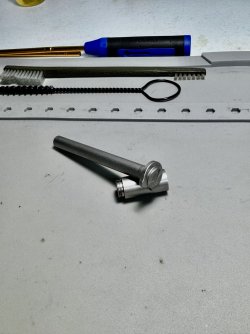
RG your test was perfect! That was it. The FLGR had just a bit of play in it as opposed to the the original guide rod. I do believe that you solved my Dilemma. Thank you. so much. And to all that chimed in it was much appreciated.
 

Attachments

  • 2 guide rods.jpeg
    2 guide rods.jpeg
    2.5 MB · Views: 9
RG your test was perfect! That was it. The FLGR had just a bit of play in it as opposed to the the original guide rod. I do believe that you solved my Dilemma. Thank you. so much. And to all that chimed in it was much appreciated.
I'm glad that was the answer, because if it wasn't, finding the correct cause without gun-in-hand would be much more difficult.

I see in your photo that the FLGR does have a relief slot already cut for clearance of the barrel link. So.... you have about three choices (maybe more, but these are the three which readily come to mind): 1) Since it's difficult (short of TIG welding and re-cutting the clearance) to add material BACK to the rear face of the FLGR, you can just live with the play that it allows. As long as the forward "slop" isn't great enough to initiate unlocking, it should not be a safety nor functional issue. OR 2) Do as you've already done and stay with the GI guide rod system (my personal favorite, but you do you), OR 3) go looking for a FLGR that doesn't have the pre-cut clearance for the barrel link. One with a rear face like in the picture @shanneba posted above would be ideal. Install said guide rod and do any needed file work to get ONLY the needed amount of clearance (if any).
 
Last edited:
Back
Top