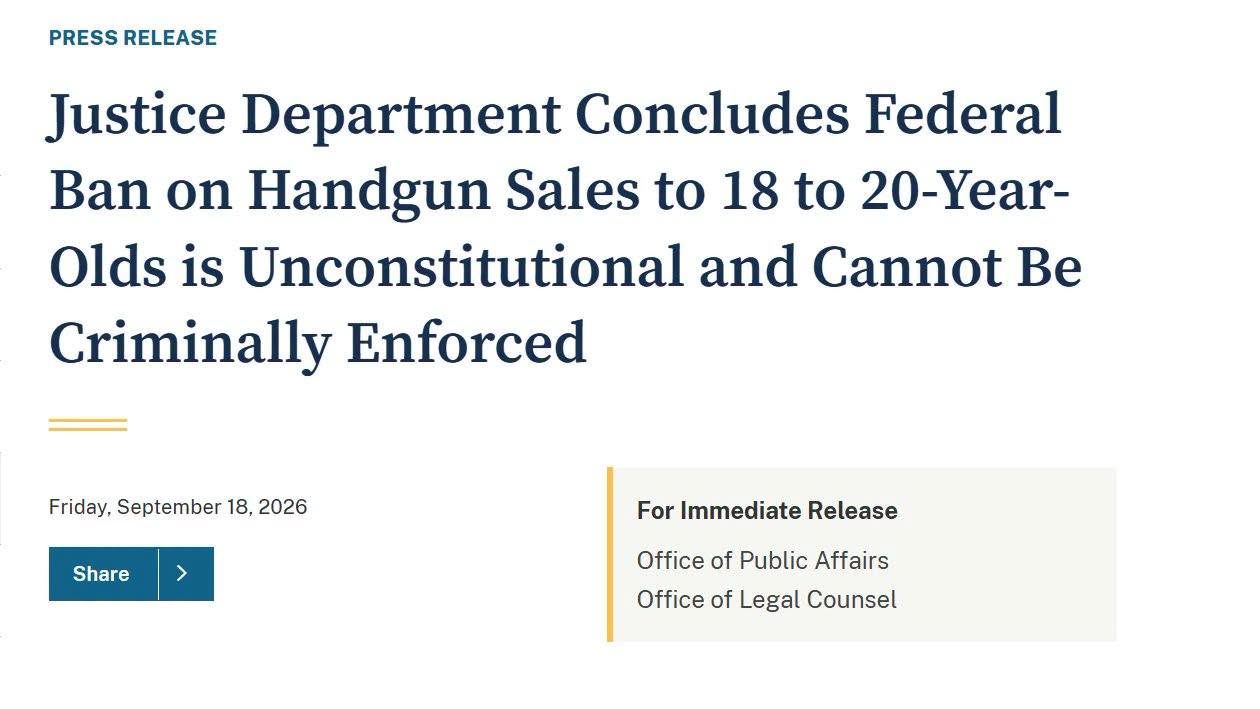
Some of the recent 2A rulings that helped.
New York State Rifle & Pistol Association v. Bruen (2022).
In Bruen, the Supreme Court held that New York’s “proper cause” requirement for a concealed-carry license violated the Second Amendment. Justice Thomas’s majority opinion rejected interest-balancing / “means-end” tests and instead
required courts to decide Second Amendment challenges by looking first at the Amendment’s text and then at whether a modern gun restriction is consistent with the nation’s historical tradition of firearm regulation (primarily around 1791 and 1868). The opinion itself surveys English common law, colonial practice, founding-era statutes, and 19th-century sources.
That “text, history, and tradition” framework has been applied in later cases, including:United States v. Rahimi (2024)
United States v. Hemani (June 2026)
Wolford v. Lopez (June 2026)
The 2008 decision in District of Columbia v. Heller also relied heavily on historical sources, but Bruen is the recent ruling that made historical analysis the required test for virtually all subsequent Second Amendment cases.
Now imagine a law that required every able bodied man from 16 to 45 to own an AR15
 The Militia Act of 1792, Passed May 8, 1792, providing federal standards for the organization of the Militia.
Be it enacted by the Senate and House of Representatives of the United States of America, in Congress assembled, That each and every able-bodied male citizen of the respective States, resident therein, who is or shall be of age of eighteen years, and under the age of forty-five years (except as is herein after excepted) shall severally and respectively be enrolled in the militia, by the Captain or Commanding Officer of the company, within whose bounds such citizen shall reside, and that within twelve months after the passing of this Act. And it shall at all time hereafter be the duty of every such Captain or Commanding Officer of a company, to enroll every such citizen as aforesaid, and also those who shall, from time to time, arrive at the age of 18 years, or being at the age of 18 years, and under the age of 45 years (except as before excepted) shall come to reside within his bounds; and shall without delay notify such citizen of the said enrollment, by the proper non-commissioned Officer of the company, by whom such notice may be proved.
That every citizen, so enrolled and notified, shall, within six months thereafter, provide himself with a good musket or firelock, a sufficient bayonet and belt, two spare flints, and a knapsack, a pouch, with a box therein, to contain not less than twenty four cartridges, suited to the bore of his musket or firelock, each cartridge to contain a proper quantity of powder and ball; or with a good rifle, knapsack, shot-pouch, and powder-horn, twenty balls suited to the bore of his rifle, and a quarter of a pound of powder; and shall appear so armed, accoutred and provided, when called out to exercise or into service