testtest

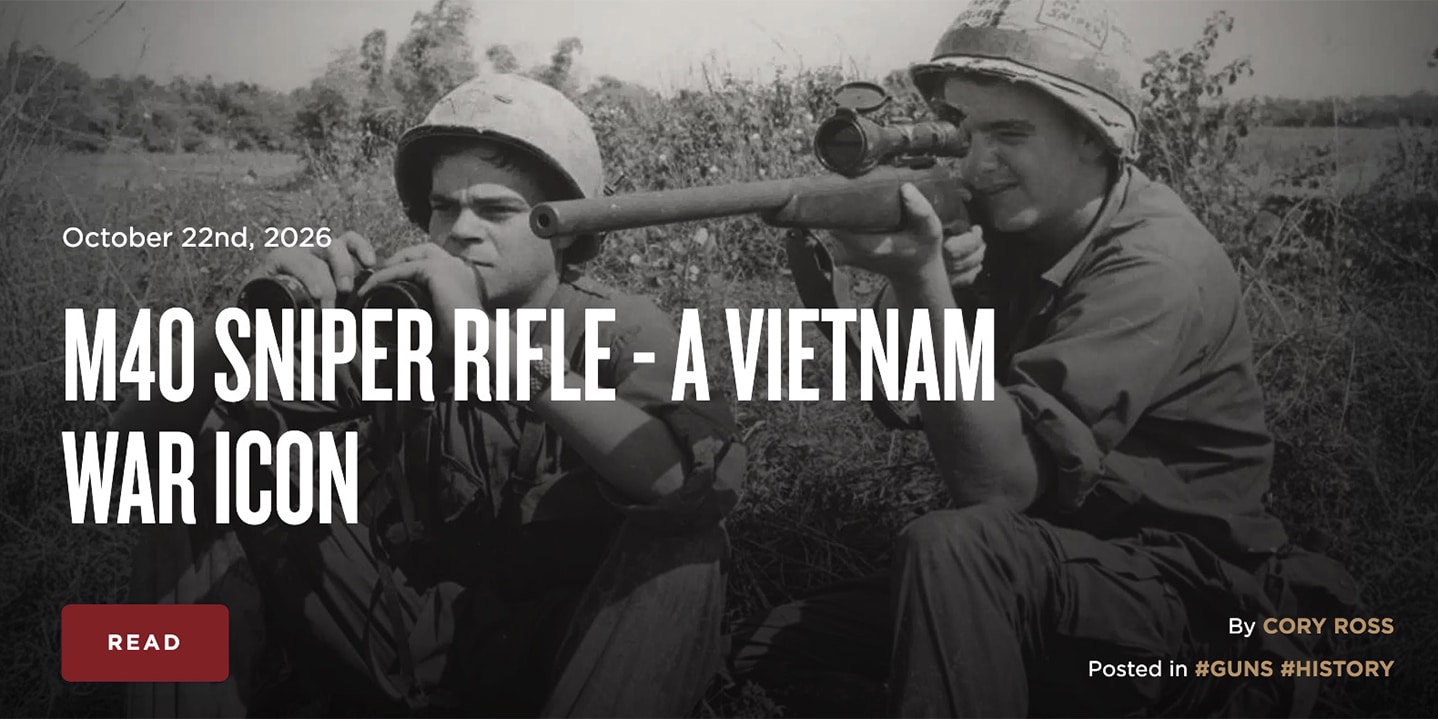
America's Bolt Action in Vietnam

One of the best purchases I ever made, was buying an Iron Brigade Armory Chandler M40 Sniper Rifle in the early 2000's. It was hand built by an U.S.M.C. MOS 2112 Armor. I will never be able to get the most out of this rifle like an experienced military trained sniper would. It's a true 1,000 yard .308 rifle. Guaranteed 1/2 MOA or better accuracy out of box, using match ammunition. It's not a light weight rifle, weighing in at 17 pounds unloaded.
 
Daddy was NRT (Navy Rifle Team). I was raised shooting rifles from the age of six (1962). I have always favored a bot-action .30-'06. The 150-155 grain Sierra Spitzers have always been a winner. Accomplished marksmen can pick the eyes out of a squirrel's eye at 800 yards. (My daddy was especially adept at this.)

"Short actions" aren't that darned special.
 
I was one of the designated snipers on our department SWAT team. Our rifles were the bull barrel Remington 700's in .308 and .223. Still very accurate.
I understand why the US Armed Forces abandoned the .30-'06 in 1957, but the '06 had the reach. Daddy hunted with a self-loading Remington with a 22" barrel fitted with a Leupold Gold Ring scope until he passed in September of 1975.

I learned at the knees of the very best.

Those were, indeed, the days brother.
 
Although a lot of folks use Remington 700 bolt action rifles and think they are great, I’d take a Winchester M70 any day over the Remington 700, and twice over on Saturday and Sundays.

Let me explain the advantages a Winchester Model 70 has:

* Reciever is about 3 times stiffer.

* Longer and better shaped bolt handle; makes operation easier when a
scope's mounted.

* More reliable feeding from the magazine.

* Magazine holds one more round; five total.

* Firing pin assembly easily removed from bolt without tools.

* `Safer' safety; the firing pin is locked, not the trigger.

* More reliable extractor; less prone to breaking. Can be replaced
without a special tool; use a paper clip or even a mechanical pencil.

* Flat sides and bottom parts hold bedding more consistant promoting
better accuracy.

* Tang is very solid; won't bend from over torquing the rear stock screw.

* Thicker recoil lug that's intregal with reciever; won't bend forward
when really heavy loads are used.

* Typically better accuracy in calibers larger than .270.

* Stock less likely to split near trigger should rear stock screw be
tightened too much.

* Less case rim damage from extractor during loading or unloading; makes
cases easier to put in shell holder for reloading.

* Easier to rebarrel; no extra parts to line up as the barrel's screwed in.

IYKYK.
 
During my HB .308 building era I built up three rifles, one on a M70 action & the last two on Rem700 actions.

They all shoot fine.

The M70 project was a bit more problematic due to the lower aftermarket support for the M70 compared to the M700's.

The difference between the two M700's was I went with a M16 extractor on one, and the other was a stock M700 extractor.

That being said and being a very long time M700 owner/operator I've never had any of the issues outlined above on any M700.

I have one other HB .308 M700 VLS but it's all stock aside from a trigger change. No issues with it either.

My .02
 
Sounds like we have a bunch of real gunners here, kudos. I do like the Winchesters also, especially the .270, but unfortunately, you have to use the tools the department supplies. I could still put two .223 rounds inside a nickel at 100 yards back in the way back machine.
 
We trained around the magic triangle to put a target down on a single shot. Frontal shots through the brain stem were considered to be the most certain for immediate neutralization. So, that's what we practiced...
 
Back
Top