

From rounding up the earliest recruits at Tun Tavern to carrying out a secret mission to save the country, Samuel Nicholas left his indelible mark on American history—and the heritage of the Marine Corps.
On 10 November 1775, Congress resolved to establish the Continental Marines. More specifically, Congress decided “that two Battalions of marines be raised, consisting of one Colonel, two Lieutenant Colonels, two Majors, and other officers as usual in other regiments.” Before commissioning the enumerated field-grade ranks, Congress approached Nicholas, who had no prior military service, about a commission as Captain of Marines. He accepted—and became the first officer of the Continental Marines on 28 November 1775.
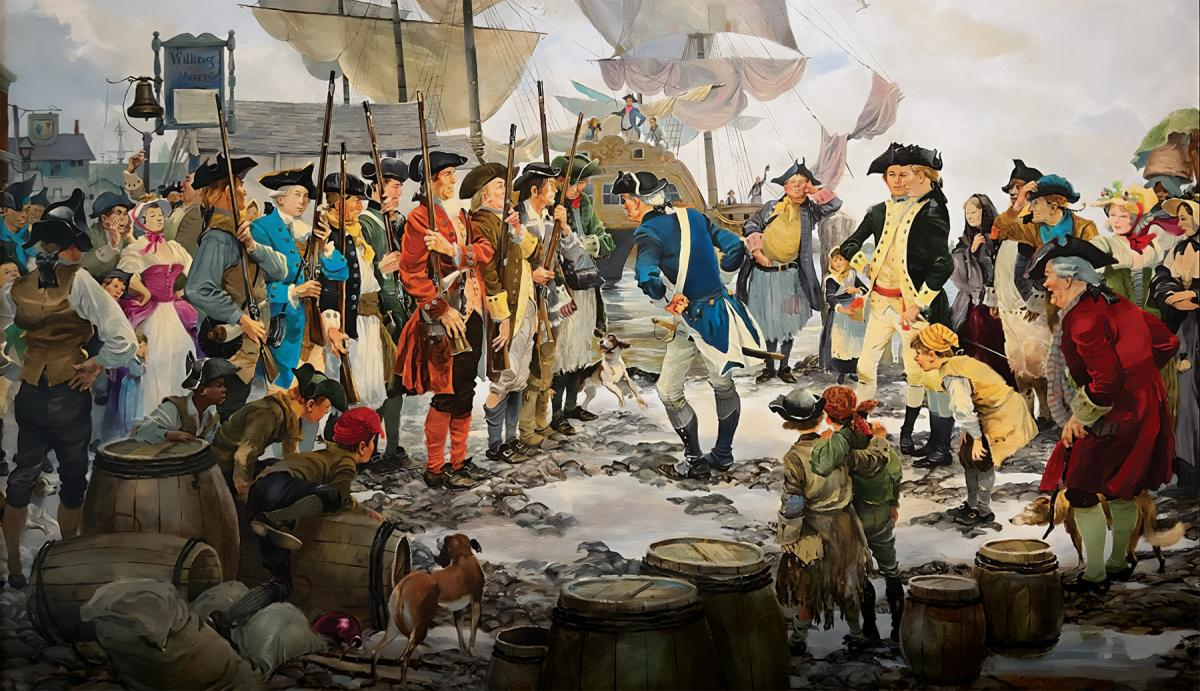
Near Tun Tavern along the colonial Philadelphia waterfront, volunteers congregate to join the nascent Continental Marines in Charles Waterhouse’s painting The First Recruits, December 1775. Captain Samuel Nicholas and Lieutenant Matthew Parke are depicted in the green cutaway coats and white breeches on the right.
On the night of 11 September 1781, Continental Marine Major Samuel Nicholas departed Philadelphia for a secret mission to Boston with Tench Francis, a Philadelphia merchant who had been trying to dispel accusations of British loyalty since the start of the Revolutionary War. Less than a week earlier, French Admiral Comte de Grasse had defeated the British at the Battle of Virginia Capes, and General George Washington’s army had been marching toward Yorktown for the last two weeks. The war was nearing its climax.
As the first Marine officer, Nicholas set precedents and established milestones for the service, all of which led to his secret adventure. However, this mission would prove to be the most impactful of Nicholas’ Revolutionary War exploits.
On 10 November 1775, Congress resolved to establish the Continental Marines. More specifically, Congress decided “that two Battalions of marines be raised, consisting of one Colonel, two Lieutenant Colonels, two Majors, and other officers as usual in other regiments.” Before commissioning the enumerated field-grade ranks, Congress approached Nicholas, who had no prior military service, about a commission as Captain of Marines. He accepted—and became the first officer of the Continental Marines on 28 November 1775.
Near Tun Tavern along the colonial Philadelphia waterfront, volunteers congregate to join the nascent Continental Marines in Charles Waterhouse’s painting The First Recruits, December 1775. Captain Samuel Nicholas and Lieutenant Matthew Parke are depicted in the green cutaway coats and white breeches on the right.
On the night of 11 September 1781, Continental Marine Major Samuel Nicholas departed Philadelphia for a secret mission to Boston with Tench Francis, a Philadelphia merchant who had been trying to dispel accusations of British loyalty since the start of the Revolutionary War. Less than a week earlier, French Admiral Comte de Grasse had defeated the British at the Battle of Virginia Capes, and General George Washington’s army had been marching toward Yorktown for the last two weeks. The war was nearing its climax.
As the first Marine officer, Nicholas set precedents and established milestones for the service, all of which led to his secret adventure. However, this mission would prove to be the most impactful of Nicholas’ Revolutionary War exploits.