testtest

Discussion: Ayoob: Should You Always Get Off the X?

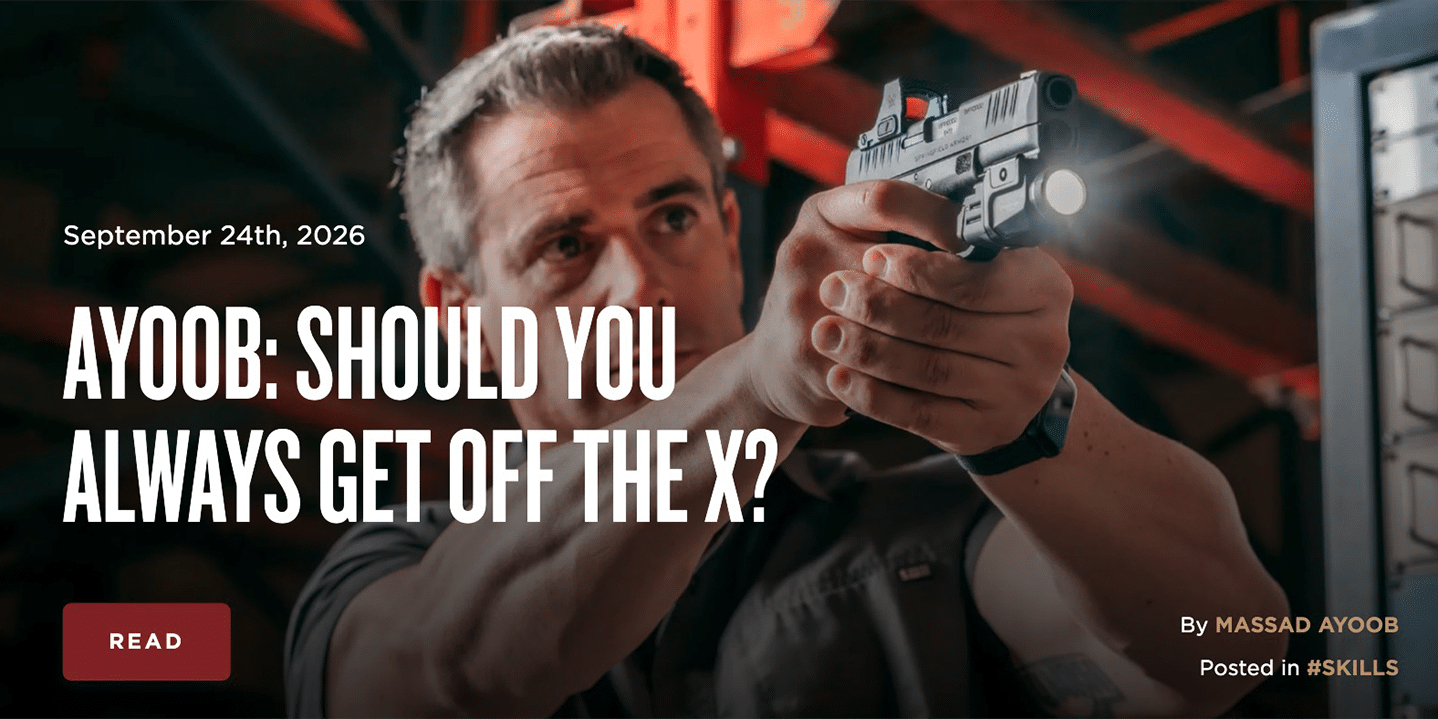
Hello all, here is today's article posted on TheArmoryLife.com. It is titled “Ayoob: Should You Always Get Off the X?” and can be found at https://www.thearmorylife.com/get-off-the-x-massad-ayoob/.

This immediately reminded me of the scene in "The Good, the Bad, and the Ugly," when Eli Wallach's character "Tuco" was in the bathtub. Jack Elam's character catches Tuco in an apparent "got the drop on him" moment and commences to monologue about it. Tuco shoots him with a revolver he's got under the surface of the dirty water in the tub and then quips, "When you have to shoot, shoot. Don't talk."

Tuco had no way to get off the X, but he still won the encounter.

Caveat: There are some continuity issues in the film that impact the realism of the scene, but if his pistol was a sealed cartridge model, it's plausible. If it was cap and ball (more accurate for the time period and the Colt 1851 Navy Percussion revolver Tuco was using), Elam would have won the day.
 
Great brake down and good info. I see a lot of info regarding similar scenarios and I think back to my younger days. When I was finishing up my career I was a training officer but nothing like the ones who share there there knowledge with us and I am glad they do. I do notice that not much info is given to those who are the soft targets which are seniors many with mobility issues. When I was a lot younger my teacher taught don't fight to win fight to end. My wife and I are old and disabled,me with a cane and sometimes crutches and my wife is on a oxygen concentrator. So we can't flee and I have our house set up for defense of what little we have and when we are out headed to a appointment my wife knows what we will do to maintain our safety. Now days break ins or home invasions has increased especially for seniors because of the drugs that may be in the house. Most seniors don't have alarm systems but one can improvise. My son and daughter have helped with ideas to improve our safety,yes we are very lucky. So we expendables must improvise and learn from a few experts who do think about us once in a while. oldsheepdog still barking. .
 
confucius need gun.jpg


For me, if I see a nutjob or danger...I turn and run. If I can't, then that's what the guns are for if my life is in jeopardy.
 
Situational awareness is the key. My philosophy as a 30-year LEO vet, shoot if you have no choice, avoidance if possible. Over the years, I have had to draw but still avoided a shoot, (and some where I had to shoot). Given the two prongs of 1. liberal prosecutors looking to hang cops or shooters, and 2. the litigious nature of society today. Even the lowliest, homeless POS you drop on the street will have so-called relatives crawling out of the woodwork looking to sue you. Save your butt by all means but as it's said, the best gunfight you ever get in is one you don't have to.
 
Situational awareness is the key. My philosophy as a 30-year LEO vet, shoot if you have no choice, avoidance if possible.

I think this says it best.

As a civilian, you're not under any legal duty to be a hero and thus FOFO. Law enforcement is a different animal.

Statistically, I would submit all of us are more likely to die in an auto accident than be involved in a gunfight.
Thus, practice avoidance first, second and only draw and shoot as an absolute last resort.
 
I think this says it best.

As a civilian, you're not under any legal duty to be a hero and thus FOFO. Law enforcement is a different animal.

Statistically, I would submit all of us are more likely to die in an auto accident than be involved in a gunfight.
Thus, practice avoidance first, second and only draw and shoot as an absolute last resort.
".... all of us are more likely ..."
but SOME of us are STILL gonna be "those other guys" that get in a gunfight .... So be prepared.
 
Hi,

Sure, we train to "get off the X" as well as moving while shooting. Especially if you're in the open, you don't want to be a stationary target so we get off the X at the draw and while performing a slidelock reload. I think my instructors do a pretty good job at mixing the scenarios, using different courses of action, different cover/concealment, multiple targets, shoot/no-shoot situations, etc. They try to put lots of tools in our tool box. The more you know...


Thank you for your indulgence,

BassCliff
 
Hello all, here is today's article posted on TheArmoryLife.com. It is titled “Ayoob: Should You Always Get Off the X?” and can be found at https://www.thearmorylife.com/get-off-the-x-massad-ayoob/.

Survivors of multiple encounters have information that is absolutely invaluable for training others to survive deadly encounters. It's unfortunate the public today despises LEO that have armed encounters. Several years ago a Seattle officer was involved in two absolutely justifiable shootings. The public demanded the department "fix that problem". Today's solution in liberal jurisdictions seems to always demand de-escalation, even if a gang is beating down a single officer.
 
This immediately reminded me of the scene in "The Good, the Bad, and the Ugly," when Eli Wallach's character "Tuco" was in the bathtub. Jack Elam's character catches Tuco in an apparent "got the drop on him" moment and commences to monologue about it. Tuco shoots him with a revolver he's got under the surface of the dirty water in the tub and then quips, "When you have to shoot, shoot. Don't talk."

Tuco had no way to get off the X, but he still won the encounter.

Caveat: There are some continuity issues in the film that impact the realism of the scene, but if his pistol was a sealed cartridge model, it's plausible. If it was cap and ball (more accurate for the time period and the Colt 1851 Navy Percussion revolver Tuco was using), Elam would have won the day.
Maybe not, normally when you load a black powder revolver you use what was called "bear grease" over the end of the cylinder and over the caps. This sealed the cylinder against "gang fires"(more than one cylinder bore going off at the same time) and against environmental issues, like rain. It also lubed the ball as it went down the barrel.
 
Getting off the X is not in my play book. I must use a cane or better yet a "rollator" to walk more than 1 or 2 steps. And I move rather slowly, especially with the cane. Thanks to my bad back which several back surgeons have looked at and told me that I'm not going to get better with surgery. Might even get worse. So I take the weakest pain pills that let me move at all and get by the best I can. Being 70 doesn't help either LOL. But I still carry everywhere I legally can. The article also said that the sudden appearance of a concealed gun can sometimes slow down a "bad' guy. Hope I never have to put that to the test. Hopefully a "bad" guy will also see me as to old to be a threat.
 
My agency teaches get off the x
As far as leaving cover, of course we're taught to not leave cover
But we're taught to pop out form a different place in that same cover
So for the car example, if we start shooting over the hood, then duck down for safety, we're comgn out the front, or even under the car.
If we're being say a corner, or any tall object, if we start standing up, and duck back to reload or just becuase of incoming fire, then when we pop back out, we're popping out kneeling
 
very good advice, however as mentioned, each situation is different, as well as our age and ease of movement.

i don't know what i'll be doing..

i just hope i never have to draw my weapon.

but it'll be there if needed.
 
Speed, power, and accuracy come together to win the fight. It will probably be over in 3 seconds.

Most officers in an OIS are within 3 feet of cover; moving to cover can be a good thing but you have to build that into training.

In the current Florida LEO qualification course officers are required to take a lateral step at most of the stages, breaking the habit of standing flat footed. The concept being you don't just stand there presenting a target during a gunfight. I have been running these drills on my range for years and have found moving does not appreciably slow you down.

In defensive shooting, by definition the aggressor acts first, and you must react to him. Keeping in mind John Boyd's OODA loop, your opponent wants you to stand still so he can shoot you. Moving can re-set his Observe, Orient, Decide, and Act sequence just enough to give you the edge.

I have used shoot and move scenarios in my intermediate and advanced courses. But you move to improve your position and cover. Rule of thumb, if you have good cover and can fight from there, keep it. If you don't have good cover and can improve it, move.
 
Hi,

Sure, we train to "get off the X" as well as moving while shooting. Especially if you're in the open, you don't want to be a stationary target so we get off the X at the draw and while performing a slidelock reload. I think my instructors do a pretty good job at mixing the scenarios, using different courses of action, different cover/concealment, multiple targets, shoot/no-shoot situations, etc. They try to put lots of tools in our tool box. The more you know...


Thank you for your indulgence,

BassCliff
The thing that is missing in training is consequences. No one is shorting back and you are not thinking “what’s going to happen if I kill this guy”. Talking from personal experience, pulling your gun on someone in real life is totally different than training and it’s amazing how many things run through your mind - or certainly did in my case.
 
Back
Top