testtest

February 24, 1991, Gulf War ground offensive begins

shanneba

Professional
After six weeks of intensive bombing against Iraq and its armed forces, U.S.-led coalition forces launch a ground invasion of Kuwait and Iraq.

On August 2, 1990, Iraq invaded Kuwait, its tiny oil-rich neighbor, and within hours had occupied most strategic positions in the country. One week later, Operation Desert Shield, the American defense of Saudi Arabia, began as U.S. forces massed in the Persian Gulf. Three months later, the United Nations Security Council passed a resolution authorizing the use of force against Iraq if it failed to withdraw from Kuwait by January 15, 1991.

At 4:30 p.m. EST on January 16, 1991, Operation Desert Storm, a massive U.S.-led offensive against Iraq, began as the first fighter aircraft were launched from Saudi Arabia and off U.S. and British aircraft carriers in the Persian Gulf. All evening, aircraft from the U.S.-led military coalition pounded targets in and around Baghdad as the world watched the events transpire in television footage transmitted live via satellite from Baghdad and elsewhere.

Operation Desert Storm was conducted by an international coalition under the command of U.S. General Norman Schwarzkopf and featured forces from 32 nations, including Britain, Egypt, France, Saudi Arabia, and Kuwait.

 
Thanks for posting. I was an MP working out of KKMC that night. Things changed from SNAFU (situation normal all fouled up) to TARFU (things are really fouled up) Not long after, I got reassigned to CID on a Protection Mission for Major General (later LTG) Pagonis who eventually took over for Schwarzkopf. You know youve got a good leader when you want to go to work...
 
Thanks for posting. I was an MP working out of KKMC that night. Things changed from SNAFU (situation normal all fouled up) to TARFU (things are really fouled up) Not long after, I got reassigned to CID on a Protection Mission for Major General (later LTG) Pagonis who eventually took over for Schwarzkopf. You know youve got a good leader when you want to go to work...
I worked on Schwarzkopf's detail in the U.S. in Tampa and MacDill. Later shot sporting clays with him. Friends of mine deployed with him on his close protection detail. I tried to deploy with the detail but they were not deploying reserve agents and sent me to Georgia instead. Schwartzkopf was a force of nature. Tommy Franks was as well but outwardly more reserved. We sent great leaders to the Middle East.
 
Thanks for posting. I was an MP working out of KKMC that night. Things changed from SNAFU (situation normal all fouled up) to TARFU (things are really fouled up) Not long after, I got reassigned to CID on a Protection Mission for Major General (later LTG) Pagonis who eventually took over for Schwarzkopf. You know youve got a good leader when you want to go to work...
Gen. Joseph Hoar, USMC took over from Schwarzkopf, not Pagonis. Pagonis was Schwarzkopf's J-4 logistician who was hired by Sears where his "just in time logistics" concept failed miserably.
 
Also the 100 hour ground war moniker was a political propaganda effort. It was a war from the start of Desert Shield in 1990 to the cease fire. Coalition service members in ground and aviation units were conducting recon, shaping ops early on. Lives were lost and outside of a few historians and the soldiers themselves they never got the attention they deserved.
 
Gen. Joseph Hoar, USMC took over from Schwarzkopf, not Pagonis. Pagonis was Schwarzkopf's J-4 logistician who was hired by Sears where his "just in time logistics" concept failed miserably.
Sorry I misspoke I never met Gen Hoar; but we of course heard of him. Im not even sure I ever saw him. I did "meet" Gen Franks and a few others, which is to say I was at a couple conferences where they all attended. I did get to hang out with their details even a General with a French Foreign Legion security detail.
 
1771961079208.png


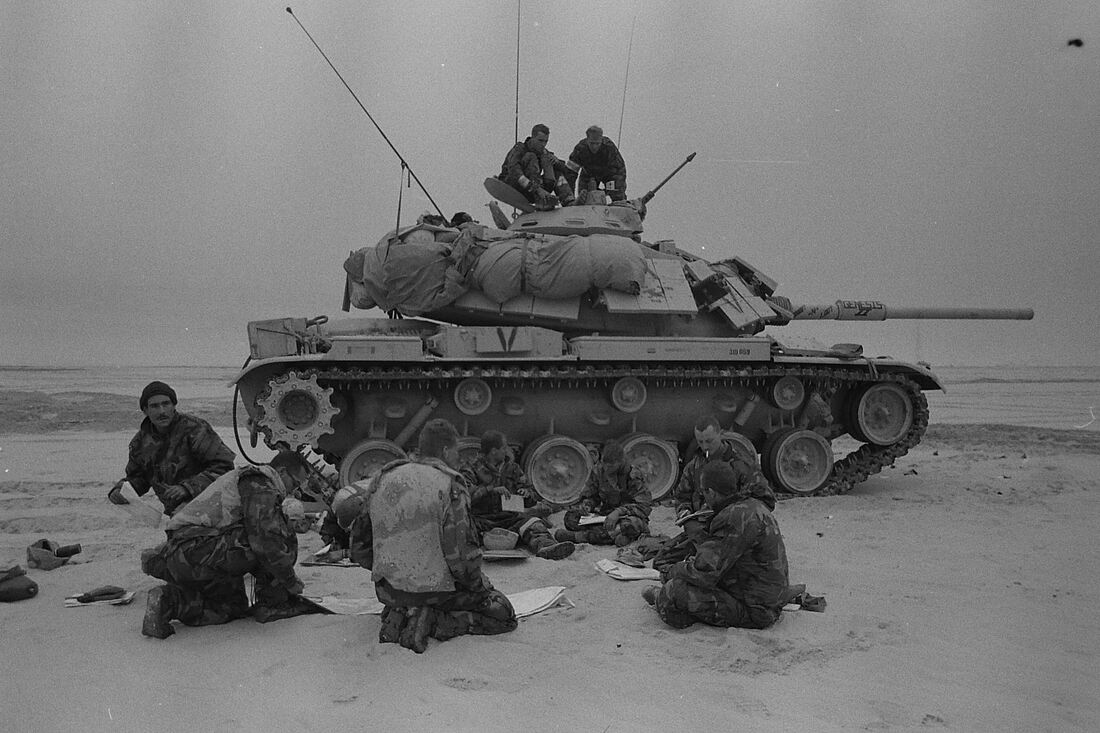
Even the USMC M60A3s did well.

1771961035226.png
 
I remember lots of MOPP time and scrambling into a shelter when we got a SCUD Alert, then finding pieces of the SCUD or Patriot scattered in the desert and I remember the unit from Pa that suffered casualties when the debris landed on top of them

I remember T rations being like a restaurant meal instead of MREs. I remember the phone center. I remember long convoys from the port to an Air Force base where we slept over night in real apartments and ate steaks in an air conditioned mess hall

and I remember the Dear John letter
 

1771980268793.png


Map of the ground assault..

1771980554671.png
 
Last edited:
wow has it been that long ago?
it was over before it started for my community of H2s at the time
makes me feel old
our H2 det was scheduled to deploy to the arabain gulf for actions stations
but the OIC of the det that was going to patrol the Caribbean was senior in rank to my OIC and he pulled rank
so his det got all our NEW TOOLS and and we got thier old stuff :ROFLMAO:
we got to spend the gulf war patrolling the gulf of Mexico and living large on an old knox class frigate ( knox frigates were prohibited from crossing the pond due to age etc)

while they got deployed to a shiiiittt show deployment on a FFG and didnt see any action,
old boy thought for sure he was going to make CDR... get some combat flying hours....NOPE NADA they got stuck in the MED.:ROFLMAO:
 
Taken from a historical site

January 1991. Saudi Arabia.
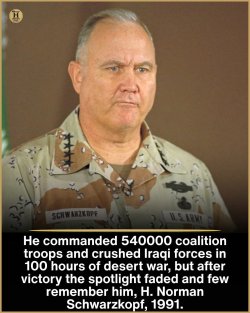
General H. Norman Schwarzkopf stood before a coalition force of 540000 troops from multiple nations. Iraq had invaded Kuwait. The world was watching.
The air campaign began first. Weeks of precision strikes. Then came the ground assault.
Schwarzkopf executed what became known as the left hook. Armored divisions swung wide through the desert, striking Iraqi forces from the flank and rear. Massive coordination. Air power. Artillery. Rapid maneuver.
In just 100 hours of ground combat, Iraqi defenses collapsed. Tens of thousands of enemy soldiers surrendered. Kuwait was liberated. Coalition casualties were far lower than expected.
The speed stunned military analysts.
Schwarzkopf became the face of the war. Calm press briefings. Clear maps. Direct language. For a brief moment, he was 1 of the most recognized military leaders in the world.
But modern fame fades quickly.
After the war, he retired in 1991. He chose not to seek political office. He did not chase prolonged media attention. The next conflicts, the next crises, pushed Desert Storm into the background.
He had previously served in Vietnam, where he was wounded in combat and earned valor awards for leading troops under fire. Desert Storm, however, defined his legacy.
He d**d in 2012 at 78 years old.
A commander who directed half a million troops.
A general who executed 1 of the fastest major ground campaigns in modern history.
Today, many remember the war.
Fewer remember the man who led it.
Story based on historical records. This post is for educational purposes.
 

Attachments

  • FB_IMG_1771987550491.jpg
    FB_IMG_1771987550491.jpg
    108.6 KB · Views: 4
Back
Top