

During World War II, a small force of German U-Boats (Gruppe Monsun) operated in the Indian and Pacific Oceans, to disrupt trade routes to Europe and to exchange personnel, technology, and precious raw material with their ally Japan. Their main operating base was the Japanese held base of Penang (Malaysia). A second base was established at Kobe and small repair bases were located at Singapore, and Batavia (nowJakarta) and Surabaya in the now Indonesia.
 lawrencepaterson.com
 uboat.net
These Oceans were the only place where German and Japanese forces fought in the same theater. The Indian Ocean was the only place where German and Japanese forces fought in the same theatre. Arrangements were made to avoid incidents between U-boats and Japanese submarines, attacks on other submarines were strictly forbidden. Italian submarines also traveled to the Far East to transport materials.
uboat.net
Japan was interested in exchanging military technology with Germany. Japanese submarines designed for the vast distances of the Pacific were more capable transports than the compact German U-boats which were designed for operations around coastal Europe.
Large Italian submarines which had proved ineffective for convoy attacks, were converted seven Italian submarines operating from BETASOM (an Italian WW2 established at Bordeaux) into "transport submarines" in order to exchange rare or irreplaceable trade goods with Japan. Italian submarine transports (so-called Merkator boats) were assigned mainly to transport duties and carried stores for the Monsun bases in the Far East.
Japan’s entry into the war in 1941 led to the capture of European South-east Asian colonies such as British Malaya and the Dutch East Indies. In May and June 1942, Japanese submarines began operating in the Indian Ocean and had engaged British forces in Madagascar. The British had invaded the Vichy-controlled island in order to prevent it from falling into Japanese hands.
Penang a former British seaplane station on the west coast of the Malayan Peninsula, was chosen for the main operating base for German and Italien submarines.
uboat.net
uboat.net
uboat.net
The refueling difficulties incurred by Gruppe Monsun show just how complicated and hazardous mid-ocean replenishment could be. In the plan, two mid-ocean replenishments were necessary. The first replenishment (I) was scheduled to be conducted by U-462, a Type XIV U-tanker at a location east of St. Paul’s Rock, off the Brazilian coast in the South Atlantic. The group would then sail to Mauritius in the Indian Ocean for a second replenishment by a surface tanker (II). Thereafter, they were to take up offensive operations in the Arabian Sea (III), before sailing to the U-boat base in Penang (IV) for replenishment. From then on, they were to be based in Penang, where they could sortie against Allied shipping in the Indian Ocean.
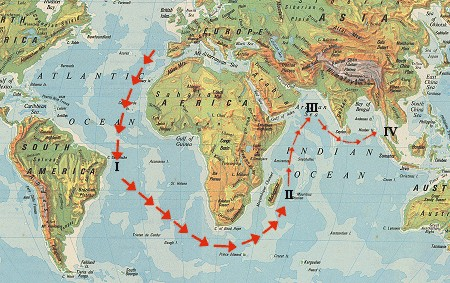
The original plan for Gruppe Monsun :-
I - 1st refueling point by Type XIV U-462, off the Brazilian coast
II - 2nd refueling point by a surface tanker, off Mauritius
IIII - Offensive operations in the Arabian Sea
IV - Sail to Penang for station in the Far East
 forum.germandaggers.com
The Complete History of the Monsun Gruppe - 41 boats sent, 4 Came Home.
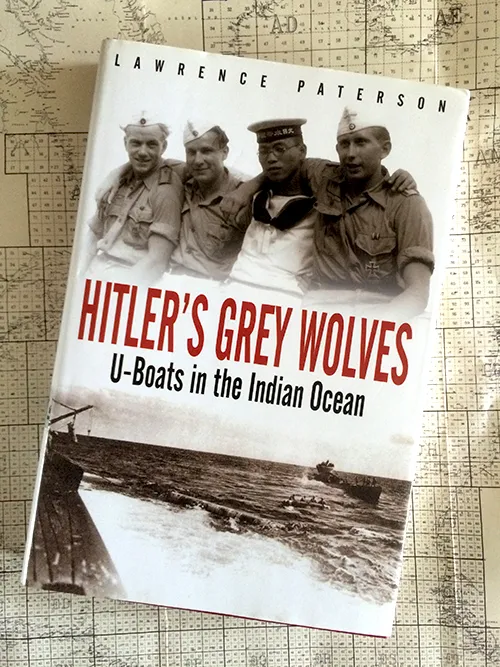
Hitler’s Grey Wolves (2004) – Lawrence Paterson
lawrencepaterson.com
uboat.net - U-boat Operations- The Monsun U-boats
The U-boat War in World War Two (Kriegsmarine, 1939-1945) and World War One (Kaiserliche Marine, 1914-1918) and the Allied efforts to counter the threat. Over 40.000 pages on the officers, the boats, technology and the Allied efforts to counter the U-boat threat.
These Oceans were the only place where German and Japanese forces fought in the same theater. The Indian Ocean was the only place where German and Japanese forces fought in the same theatre. Arrangements were made to avoid incidents between U-boats and Japanese submarines, attacks on other submarines were strictly forbidden. Italian submarines also traveled to the Far East to transport materials.
uboat.net - U-boat Operations- The Monsun U-boats - 1. Introduction
The U-boat War in World War Two (Kriegsmarine, 1939-1945) and World War One (Kaiserliche Marine, 1914-1918) and the Allied efforts to counter the threat. Over 40.000 pages on the officers, the boats, technology and the Allied efforts to counter the U-boat threat.
Japan was interested in exchanging military technology with Germany. Japanese submarines designed for the vast distances of the Pacific were more capable transports than the compact German U-boats which were designed for operations around coastal Europe.
Large Italian submarines which had proved ineffective for convoy attacks, were converted seven Italian submarines operating from BETASOM (an Italian WW2 established at Bordeaux) into "transport submarines" in order to exchange rare or irreplaceable trade goods with Japan. Italian submarine transports (so-called Merkator boats) were assigned mainly to transport duties and carried stores for the Monsun bases in the Far East.
Japan’s entry into the war in 1941 led to the capture of European South-east Asian colonies such as British Malaya and the Dutch East Indies. In May and June 1942, Japanese submarines began operating in the Indian Ocean and had engaged British forces in Madagascar. The British had invaded the Vichy-controlled island in order to prevent it from falling into Japanese hands.
Penang a former British seaplane station on the west coast of the Malayan Peninsula, was chosen for the main operating base for German and Italien submarines.
uboat.net - U-boat Operations- The Monsun U-boats - 2. Pre-Monsun Boats
The U-boat War in World War Two (Kriegsmarine, 1939-1945) and World War One (Kaiserliche Marine, 1914-1918) and the Allied efforts to counter the threat. Over 40.000 pages on the officers, the boats, technology and the Allied efforts to counter the U-boat threat.
Early submarine patrols to Penang
- Japanese submarine I-30 sailed 22 August 1942 carrying German torpedoes, Torpedo Data Computer, search RADAR, Metox, hydrophone array, 50 Enigma machines and 240 Bolde SONAR countermeasure charges. She struck a mine and sank off Singapore on 13 October 1942.
- Tazzoli sailed in a cargo configuration on 21 May 1943 and was sunk by aircraft in the Bay of Biscay.
- Barbarigo sailed in a cargo configuration on 17 June 1943 and was sunk by aircraft in the Bay of Biscay.
- Cappellini sailed in a cargo configuration on 11 May 1943 with 160 tons of mercury, aluminum, welding steel, 20mm guns, ammunition, bomb prototypes, bombsights and tank blueprints; she reached Singapore on 13 July 1943.
- U-511 sailed on 10 May 1943 and sank the 7,200-ton American Liberty Ship Samuel Heintzelman before reaching Penang on 17 July 1943.
- Giuliani sailed in a cargo configuration on 16 May 1943 and reached Singapore on 1 August 1943.
- U-178 sailed on 28 March 1943 and sank the 6,600-ton Dutch freighter Salabangka, the 2,700-ton Norwegian freighter Breiviken, the 6,700-ton British freighter City of Canton, the 7,200-ton American Liberty ship Robert Bacon and the 4,800-ton Greek freighters Michael Livanos and Mary Livanos before reaching Penang on 27 August 1943.
- Torelli sailed in a cargo configuration on 18 June 1943 and reached Penang on 27 August 1943.
uboat.net - U-boat Operations- The Monsun U-boats - 3. Monsun boats
The U-boat War in World War Two (Kriegsmarine, 1939-1945) and World War One (Kaiserliche Marine, 1914-1918) and the Allied efforts to counter the threat. Over 40.000 pages on the officers, the boats, technology and the Allied efforts to counter the U-boat threat.
uboat.net - U-boat Operations- The Monsun U-boats - 4. Evacuation
The U-boat War in World War Two (Kriegsmarine, 1939-1945) and World War One (Kaiserliche Marine, 1914-1918) and the Allied efforts to counter the threat. Over 40.000 pages on the officers, the boats, technology and the Allied efforts to counter the U-boat threat.
The refueling difficulties incurred by Gruppe Monsun show just how complicated and hazardous mid-ocean replenishment could be. In the plan, two mid-ocean replenishments were necessary. The first replenishment (I) was scheduled to be conducted by U-462, a Type XIV U-tanker at a location east of St. Paul’s Rock, off the Brazilian coast in the South Atlantic. The group would then sail to Mauritius in the Indian Ocean for a second replenishment by a surface tanker (II). Thereafter, they were to take up offensive operations in the Arabian Sea (III), before sailing to the U-boat base in Penang (IV) for replenishment. From then on, they were to be based in Penang, where they could sortie against Allied shipping in the Indian Ocean.
The original plan for Gruppe Monsun :-
I - 1st refueling point by Type XIV U-462, off the Brazilian coast
II - 2nd refueling point by a surface tanker, off Mauritius
IIII - Offensive operations in the Arabian Sea
IV - Sail to Penang for station in the Far East
The Monsun U-Boats: WW2 German Submarines In Asia - Your new forums
The Complete History of the Monsun Gruppe - 41 boats sent, 4 Came Home.


