

shanneba
Professional
on Aug 13, 2001, the experimental Helios Prototype—a solar-powered, remotely-piloted aircraft developed under NASA's ERAST program—reached an altitude of 96,863 feet (29,524 m), achieving a world altitude record for sustained horizontal flight by a winged, propeller-driven aircraft.
The mission to reach and sustain flight at 100,000 feet in 2001 required use of all 14 motors and minimal ballast to save weight, with the aircraft weighing in at only a little more than 1,600 lbs. The four-day mission above 50,000 feet envisioned for the Helios Prototype in 2003 will see only eight motors powering the craft and the addition of the regenerative energy storage system now in development. The system will increase the Helios Prototype’s flight weight to a little over 2,000 lbs. Fewer motors are needed for the long-endurance mission due to the lesser altitude requirements, and the excess electrical energy generated by the solar arrays during the daytime will be diverted to the hydrogen-oxygen fuel cell energy storage system, which will release the electricity to power the Helios after dark.

 www.nasa.gov
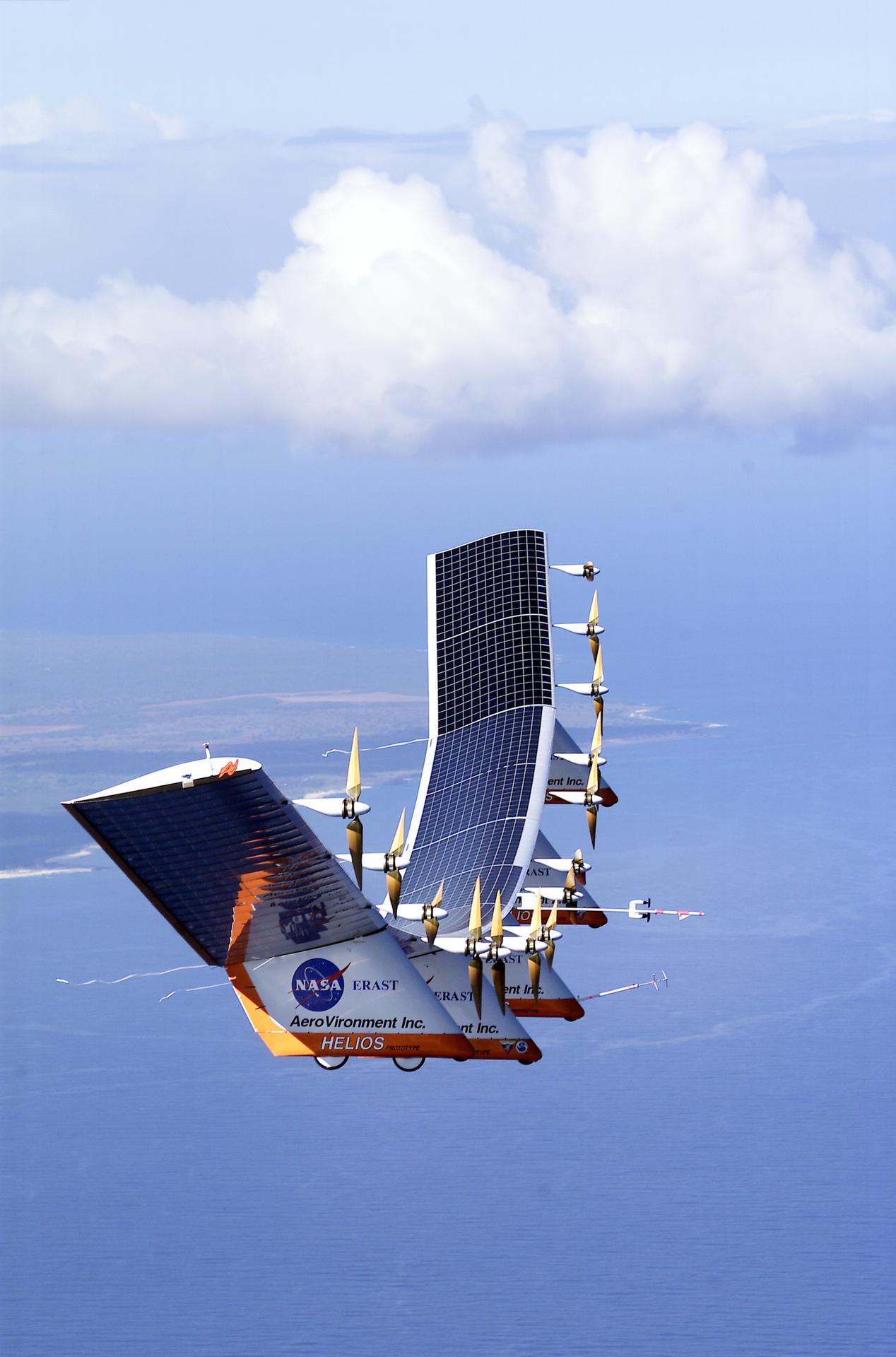
The mission to reach and sustain flight at 100,000 feet in 2001 required use of all 14 motors and minimal ballast to save weight, with the aircraft weighing in at only a little more than 1,600 lbs. The four-day mission above 50,000 feet envisioned for the Helios Prototype in 2003 will see only eight motors powering the craft and the addition of the regenerative energy storage system now in development. The system will increase the Helios Prototype’s flight weight to a little over 2,000 lbs. Fewer motors are needed for the long-endurance mission due to the lesser altitude requirements, and the excess electrical energy generated by the solar arrays during the daytime will be diverted to the hydrogen-oxygen fuel cell energy storage system, which will release the electricity to power the Helios after dark.
Helios Prototype Flying Wing - NASA
As a follow-on to the Centurion (and earlier Pathfinder and Pathfinder-Plus) aircraft, the solar-powered Helios Prototype is the latest and largest example of a slow-flying ultralight flying wing designed for long-duration, high-altitude Earth science or telecommunications relay missions in the...
www.nasa.gov


