

The Allies were eager to breach the German border defenses, cross the Rhine and push into the Reich, but barring the way was the Rur and the woodland south of Aachen.
Stretching from mid-September 1944 to mid-December 1945, the Hürtgen Forest Campaign was part of a drive by Lt. Gen. Courtney Hodges’ U.S. First Army to cross the Rur River and capture its vital dams.
The aim was an attack on the Aachen-Cologne axis, designed to close on the Rhine, as a first step toward the envelopment of Germany’s Ruhr Valley. The fighting was bitter because the two dams within the forest controlled the level of the Rur flowing north, and the Allies could not launch a broad assault across the Cologne plain to the Rhine as long as the enemy could threaten to flood them out.

The attack corridor was narrow and ill-suited to large-scale maneuvering. Yet Hodges and VII Corps commander Maj. Gen. J. Lawton Collins decided it was necessary to clear the Hürtgen Forest.

Four compact woodland tracts formed the Hürtgen, 11 miles long and 5 miles wide in all.
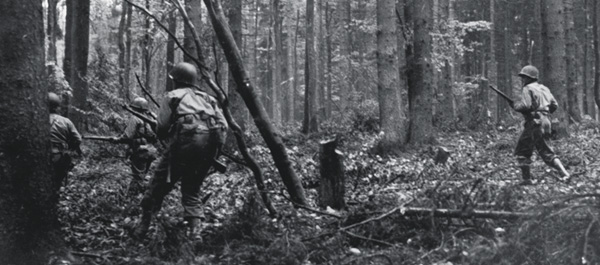
For generations, forest masters had meticulously pruned undergrowth and managed logging, leaving perfectly aligned firs as straight and regular as soldiers on parade, in what one visitor called “a picture forest.” But some of its acreage grew wild, particularly along creek beds and in the deep ravines where even at midday sunlight penetrated only as a dim rumor. Here was the Grimm forest primeval, a place of shades. “I never saw a wood so thick with trees as the Hürtgen,” a GI later wrote. “It turned out to be the worst place of any.”

 www.militarytimes.com

 www.historynet.com
Stretching from mid-September 1944 to mid-December 1945, the Hürtgen Forest Campaign was part of a drive by Lt. Gen. Courtney Hodges’ U.S. First Army to cross the Rur River and capture its vital dams.
The aim was an attack on the Aachen-Cologne axis, designed to close on the Rhine, as a first step toward the envelopment of Germany’s Ruhr Valley. The fighting was bitter because the two dams within the forest controlled the level of the Rur flowing north, and the Allies could not launch a broad assault across the Cologne plain to the Rhine as long as the enemy could threaten to flood them out.
The attack corridor was narrow and ill-suited to large-scale maneuvering. Yet Hodges and VII Corps commander Maj. Gen. J. Lawton Collins decided it was necessary to clear the Hürtgen Forest.
Four compact woodland tracts formed the Hürtgen, 11 miles long and 5 miles wide in all.
For generations, forest masters had meticulously pruned undergrowth and managed logging, leaving perfectly aligned firs as straight and regular as soldiers on parade, in what one visitor called “a picture forest.” But some of its acreage grew wild, particularly along creek beds and in the deep ravines where even at midday sunlight penetrated only as a dim rumor. Here was the Grimm forest primeval, a place of shades. “I never saw a wood so thick with trees as the Hürtgen,” a GI later wrote. “It turned out to be the worst place of any.”
How the Battle of Hurtgen Forest became one of the biggest US losses
By the night of Nov. 20, the U.S. rifle companies alone had lost more than 40% of their strength.
www.militarytimes.com
Book Excerpt: The Hürtgen Forest, 1944 / The Worst Place of Any
A chilling excerpt from the final book in Rick Atkinson's Liberation Trilogy.
www.historynet.com


