

shanneba
Professional
At 55, Maj. John W. “Jack” Hession fired a record Wimbledon score in West Texas, a high point in one of the longest careers in U.S. rifle competition.
Around 1906, he bought a Springfield Model 1903, serial number 264631, chambered in .30-’06 Sprg., and topped it with a J. Stevens Co. scope. It grouped well enough that he took it to England for the London 1908 Olympic Games, where the rifle events were fired at Bisley. He entered two of them, 300-meter free rifle in three positions and 1,000-yard free rifle, finishing outside the medals in both.
Back home, the wins came quickly. Hession took the Grand Aggregate at Camp Perry in 1908 and returned the following year to set a world record at 800 yards, a performance that landed on the front page of the Piqua Leader-Dispatch. Forest and Stream later reported a run of 67 consecutive bullseyes at that distance. He won the Marine Corps Cup in 1913. During U.S. tryouts held in France in 1918 for the Inter-Allied rifle competition, he finished 63 points ahead of the runner-up.
By 1940 he was with Winchester, and that year his old Springfield went to war without him. After Dunkirk left British civilians short of arms, C. Suydam Cutting organized the American Committee for Defense of British Homes to gather guns from American owners, and Hession shipped his prize rifle across the Atlantic. In all, NRA sent more than 7,000 privately owned firearms to England. Plates added to the stock listed his best-known wins. One on the fore-end told whoever received it that “the return of this rifle after Germany is defeated would be deeply appreciated.”
Britain honored the request. The rifle came home after the war and is now part of the NRA National Firearms Museum collection in Fairfax, Virginia.
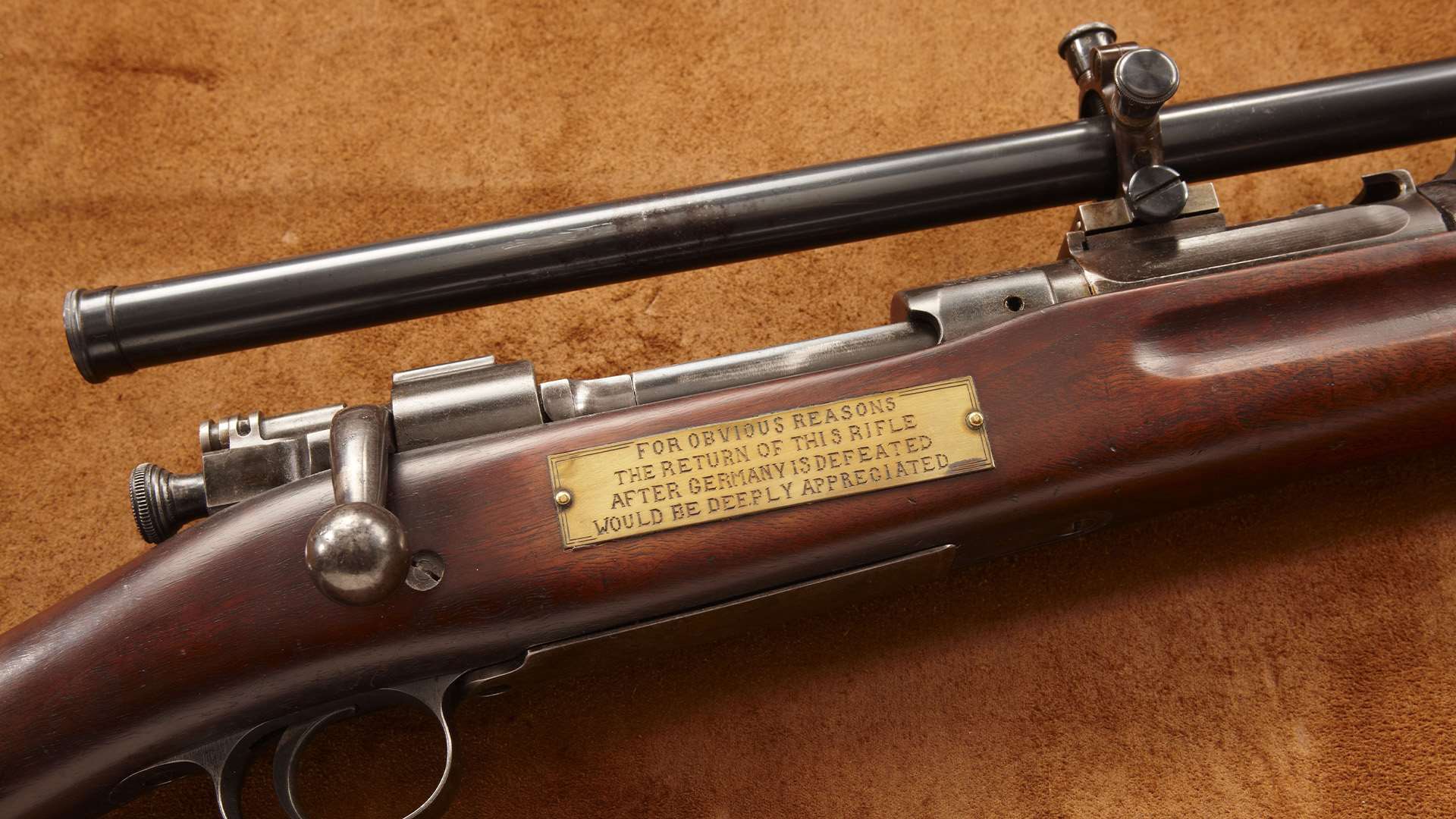
Hession had this brass plate fixed to the stock of his scoped Springfield Model 1903, serial number 264631, before sending the rifle to England in 1940 to help arm British civilians. The Springfield came back to him after the war and is now part of the NRA National Firearms Museum collection. (Photo by NRA National Firearms Museum)
 www.ssusa.org
Around 1906, he bought a Springfield Model 1903, serial number 264631, chambered in .30-’06 Sprg., and topped it with a J. Stevens Co. scope. It grouped well enough that he took it to England for the London 1908 Olympic Games, where the rifle events were fired at Bisley. He entered two of them, 300-meter free rifle in three positions and 1,000-yard free rifle, finishing outside the medals in both.
Back home, the wins came quickly. Hession took the Grand Aggregate at Camp Perry in 1908 and returned the following year to set a world record at 800 yards, a performance that landed on the front page of the Piqua Leader-Dispatch. Forest and Stream later reported a run of 67 consecutive bullseyes at that distance. He won the Marine Corps Cup in 1913. During U.S. tryouts held in France in 1918 for the Inter-Allied rifle competition, he finished 63 points ahead of the runner-up.
By 1940 he was with Winchester, and that year his old Springfield went to war without him. After Dunkirk left British civilians short of arms, C. Suydam Cutting organized the American Committee for Defense of British Homes to gather guns from American owners, and Hession shipped his prize rifle across the Atlantic. In all, NRA sent more than 7,000 privately owned firearms to England. Plates added to the stock listed his best-known wins. One on the fore-end told whoever received it that “the return of this rifle after Germany is defeated would be deeply appreciated.”
Britain honored the request. The rifle came home after the war and is now part of the NRA National Firearms Museum collection in Fairfax, Virginia.
Hession had this brass plate fixed to the stock of his scoped Springfield Model 1903, serial number 264631, before sending the rifle to England in 1940 to help arm British civilians. The Springfield came back to him after the war and is now part of the NRA National Firearms Museum collection. (Photo by NRA National Firearms Museum)
An NRA Shooting Sports Journal | Jack Hession: A Wimbledon Record and a Rifle Sent to Britain
At 55, Maj. Jack Hession fired a record Wimbledon score in 1932. A look at his long-range career and the Springfield he sent to Britain in 1940.
