
Hello all, here is today's article posted on TheArmoryLife.com. It is titled “M10 Booker: Not Your Daddy's Light Tank” and can be found at https://www.thearmorylife.com/m10-booker/.
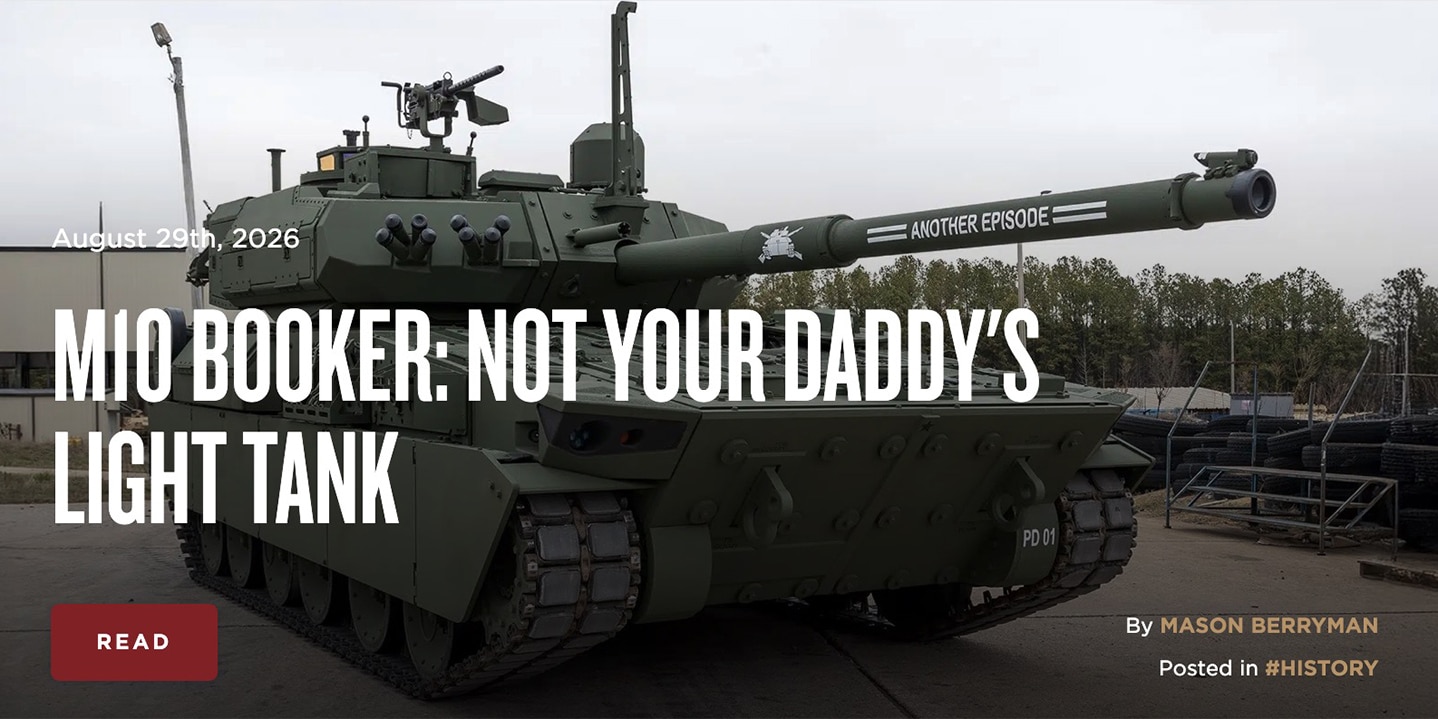



 militaryleak.com

So, since the M10 Booker weighs roughly the same as the latest M2A4 Bradley perhaps we should stop using the Bradley IFV?
The M10 Booker weighs roughly 38 to 42 tons (base weight around 38 tons), which is comparable to or slightly heavier than modern upgraded variants of the M2/M3 Bradley Infantry Fighting Vehicle, which range up to roughly 40 tons depending on the add-on armor package.
Weight Comparison Details
The author claims that the Booker has sluggish mobility when it has a more powerful engine (800 hp) than the M2A4 with a 675 hp engine, so those Bradley's must also have mobility issues.
- M10 Booker: Base weight is about 38 tons, reaching up to 42 tons fully loaded.
- M2/M3 Bradley IFV: Older Gulf War-era base variants weighed around 30 tons, but newer versions (like the M2A4) have grown to approximately 40 tons due to survivability and electronics upgrades.
- Context: While the M10 Booker is often compared to lighter vehicles or referred to as a light tank for infantry support, its combat weight places it in the same weight class as a modern Bradley IFV and older main battle tanks.
One excuse ginned up on the M10 it was too heavy for the bridges at Ft. Campbell. Eight of the eleven bridges at Ft. Campbell could not support the weight of the M10 Booker. There was no problem accessing the training area on the three that could handle it.
The real problem were the Base personnel (CO, etc.) that told the crews to drive the M10 Booker on bridges that they weren't rated for the M10 Booker weight, nor the M2 Bradley.
Also, various detractor plus this author incorrectly labels the M10 a "Light Tank". According to product manager Lt. Col. Pete George, the M10 is defined as an "armored infantry support vehicle".
Other detractors say the M10's 105mm is too light. In Ukraine old M2ODS Bradley's have been knocking out Russian tanks (T-55-T90) with it's 25mm gun while using Shoot & Skoot tactics.
And the Leopard 1 tanks in Ukraine using With modern Armour-Piercing Fin-Stabilized Discarding Sabot (APFSDS) rounds—such as the DM63—the 105mm gun can penetrate the armor of older Soviet-era tanks (like the T-55 and T-62) and strike the side, rear, or weak spots of more common Russian main battle tanks like the T-72.
And a 105mm round is more cost effective than an expensive guided missile like the Javelin.
The proposed XM30 Mechanized Infantry Combat Vehicle (MICV), to replace the M2 Bradley) has an expected combat weight in the 40 to 55 ton range (scaling towards roughly 55 tons for its fully outfitted limit) with a 50mm gun.
More M10 Booker info here on previous posts...
M10 Booker Mobile Protective Firepower MPF light tank data
M10 Booker Mobile Protective Firepower MPF 105mm light tank United States GDLS technical data fact sheet pictures videowww.armyrecognition.com
General Dynamics Land Systems announces that it has delivered the first M10 Booker Combat Vehicles to the U.S. Army. The M10 Booker is a new assault vehicle for the Army’s Infantry Brigade Combat Teams (IBCTs).
General Dynamics Land Systems Delivers First M10 Booker Combat Vehicles to US Army - MilitaryLeak.COM
General Dynamics Land Systems announces that it has delivered the first M10 Booker Combat Vehicles to the U.S. Army. The M10 Booker is a new assault vehicle


