testtest

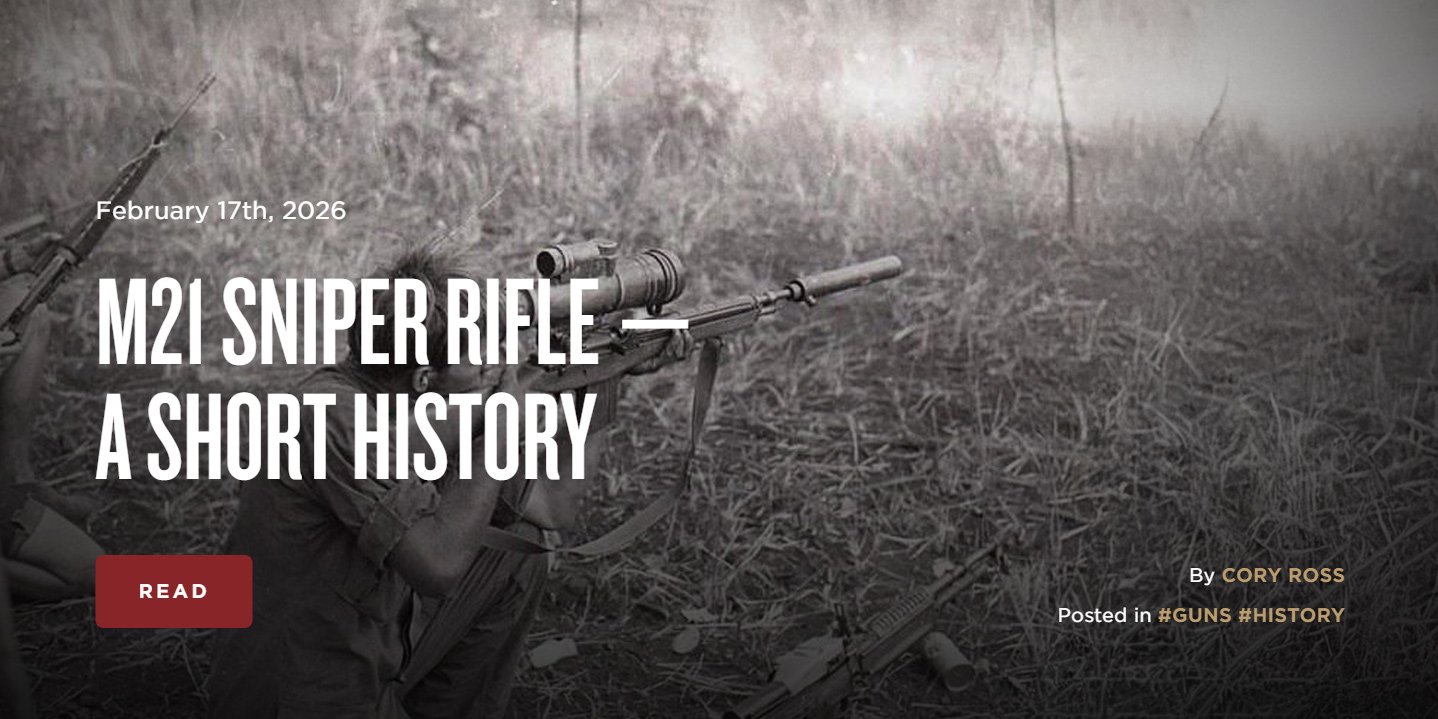
M21 Sniper Rifle — A Short History

My M21A5 Crazy Horse

IMG_3494.JPG
 
Quang Nam Province, 1970, just north of the Que Son Mountains. Marine M40 sniper rifle with Redfield 3x9.

sniper.jpg


M14 fitted with Starlight Scope. To my knowledge this is not an accurized M21.

tumblr_my4m8jvNWP1qivon6o1_500.JPG
 
When I was in the ARMY, the MPs didnt have snipers; but on protective details somebody always had a M21 with the Leatherwood ART scope. They werent in the M24 class; but I wouldnt have wanted to be in the cross hairs
 
Got attached to M-14 as it issued for security details while in the Navy. Bought the civilian model many moons ago and dropped onto an Arch Angel stock system, but it has the standard barrel. Eyeballing one in Creedmoor for upgrading and return the 308 back to standard format as it is really a 1.5-2 moa at best. Always thought the M-14 has a thing for bridging the old to new in it's time and a charm all to itself.
 
Forty years ago, while on a USN TAD, I visited the Old Town Armory in Alexandria, Va. They more or less specialized in FFL III automatic weapons, and they had what they called an M14D sniper rifle for sale - for $3,000, plus the $300 FFL tax. Although I can't remember all of the details, I do remember it had a scope and a leather cheekpiece. Would this have been an M21, or just a cobbled together rifle?
 
You cant talk about the M21 without talking about the Leatherwood ART scope. The ART was an amazing concept for its time. Judging range followed by holdover are perhaps the most important parts of putting shots on a target at an unknown range. The ART took that judging and holdover out of the equation. The ART reticle had conventional crosshairs with the addition of two additional horizontal stadia lines. The shooter simply adjusted the power of the scope to bracket the target's beltline with the top of his head. Adjusting the power used a cam system that changed the angle of the scope to adjust for holdover.

The ART was as "simple" as that. Today we have Mil Dots and ask a soldier to find a nearby object of known height, then count how many Mil Dots cover that object, and then do "simple" trigonometry to determine the distance AND then factor in the holdover from a chart. Im fairness the glass on modern scopes is much better than 1960 optics and the ART made you shoot at whatever power the scope dialed for that range but it was FAST
 

ART Sniper Profiles

Rene Macare (173d Airborne)


x"

[td]The ART scope technology was born out of necessity in the early years of the Vietnam War. Enemy snipers were killing American servicemen, but the US Army was not adequately equipped to deal with the problem. The initial solution was to send newly trained snipers into battlefield service as soon as possible. However, sniper training at that time was a lengthy process that required long hours on the range teaching recruits to estimate distance and to use the proper amount of “hold-over” (aiming high to compensate for bullet drop) in order to make successful first round hits. The Army decided to implement a new approach to training and sniping based on Jim Leatherwood’s scope design.


Sniper School training with ART and XM21

With the ART scope, snipers did not need to know the exact distance to the target for bullet drop compensation. Rather, snipers improved first round hit percentages by framing the target within the reticle. Once the target was framed within the reticle, the Leatherwood Auto Ranging Telescope had already compensated for the bullet drop. This lead to the phrase “Frame, Aim, Fire!”


Rene Macare Squad on Patrol Vietnam

Throughout the Vietnam War, several legendary snipers used the Leatherwood ART to great success in combating the guerrilla warfare tactics employed by the Viet Cong.
 
Last edited:
Back
Top