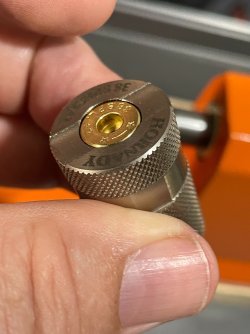
I purchased some new Starline 38 Special brass and it arrived on my doorstep yesterday. While some reloaders might simply chortle with glee and immediately start stuffing them with primers, powder and bullets, I like to take my time and make certain that each case is "up to snuff" despite being brand spanking new. I've learned over the years that the extra time and effort expended "up front" is more than repaid upon the second and following reloading of said cartridge cases.
As I started processing these new cases, it occurred to me that it might be useful to others here (who might be new to reloading or maybe just contemplating getting into it) to go over the process I follow. I will go over my process using 38 Special as a specific example, but everything here applies to any straight-walled revolver cartridge case.
First of all, note that this is my process for straight walled REVOLVER cartridge cases. I do different types of ammunition cases a bit differently. The process needs to "fit" the case type and usage. So what are my concerns for brand NEW virgin brass cases for revolver cartridges?
1). I want to make certain that each and every case is within a certain case length window. The SAAMI maximum allowable length for a 38 Special cartridge case is 1.155", and the recommended trim length AFTER RESIZING is 1.145". My nominal target case length (for 38 Special) is therefore 1.145". I will tolerate cases that are as "short" as 1.140". My objective is to get a batch of cases all within 1.140" to 1.145" in length. Cases less than 1.140" are set aside since I can't make them longer. Cases longer than 1.145" are trimmed to that length. MY RATIONALE: I am very picky about a minimal but uniform case mouth flare in preparation for bullet seating, AND I'm also very picky about having a uniform and neat crimp on each round loaded. To accomplish these objectives, one must have a very uniform length for each and every case. Cases having a length which fall outside of my desired "window" of 1.140" to 1.145" will not "fit" my flaring die adjustment nor my crimp die adjustment. ALSO, revolver bullets (cast and jacketed) typically have a built-in crimp groove, so require a very uniform seating depth in order to crimp properly into that groove, which in turn necessitates a limited case length window to fit my seating die adjustment.
2) Note that case trimming to fit my target length window is pretty much a one-and-done operation. Cartridges operating at typical revolver pressure levels typically do not stretch and grow in length with each firing. If one measures the length of a revolver cartridge case after sizing (or when new as I'm documenting here), the case will be longer than after it is fired. Upon firing, the case will typically "lose" .002" to .004" of its length. Upon being resized, the case will return to being very close to its pre-firing length. My experience has been that, once I've performed a very careful initial trim-to-length operation, my revolver cartridge cases will "die" from case mouth cracks after repeated firing / sizing / flaring / crimping before I ever have to worry about trimming again.
3) By being very careful and picky about initial cartridge case length, I am able to set my dies (case mouth expansion, aka flaring, / bullet seating / crimping) once and forget about it. I use the Hornady die locking rings so that my die adjustments stay put no matter how many times I thread them into / out of my press.
Here are pictures as I step through my process:
1) Measure each case to determine its initial "as is" length. New virgin brass cases are already sized to SAAMI spec, so they can go right from the bag / box into my calipers. If the cases are from once-fired factory ammo, they must be resized before taking initial measurement.

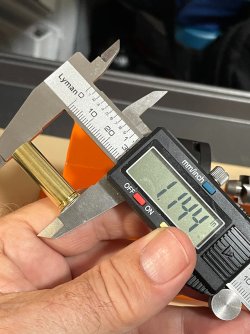
2) Cases which yield an initial measurement within my target window of 1.140" to 1.145" are simply lightly chamfered inside and outside the case mouth, and they're "done", ready to load. Cases which are below 1.140" in length are set aside for other usage.

3) Cases which measure OVER 1.145" in length are trimmed, then chamfered and deburred. That makes the "too long" cases fit within my target case length window, and also ready to load.
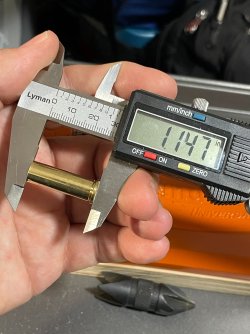
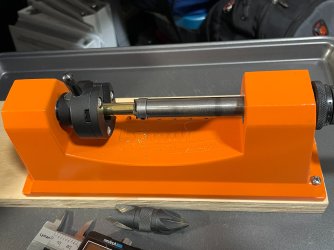
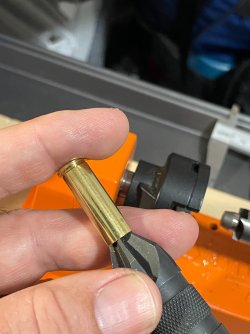
4) Also note that even though the brass might be new virgin cases, the mouths of the cases might be dinged or out of round. In some instances, I might have to run such cases partially into an expander die and then back into a resizer die to iron out the dings, especially if the case requires a trim, or if the chamfer / debur tool cannot get even contact for the full circumference of the case mouth.
That's it! My brand new "ready-to-load" brass is now TRULY ready-to-reload.
I follow the exact same process for once-fired cases derived from shooting factory ammo. The only additional up-front steps are to deprime, clean, and resize the cases before entering this same uniforming-of-case-length process.
This whole entire rig-ma-role is necessary because manufacturers of brass cases do not tightly control case lengths. If the new cartridge cases are under SAAMI max length, then they are considered "good enough" and into the hopper they go. As a reloader, I require greater uniformity.
As I started processing these new cases, it occurred to me that it might be useful to others here (who might be new to reloading or maybe just contemplating getting into it) to go over the process I follow. I will go over my process using 38 Special as a specific example, but everything here applies to any straight-walled revolver cartridge case.
First of all, note that this is my process for straight walled REVOLVER cartridge cases. I do different types of ammunition cases a bit differently. The process needs to "fit" the case type and usage. So what are my concerns for brand NEW virgin brass cases for revolver cartridges?
1). I want to make certain that each and every case is within a certain case length window. The SAAMI maximum allowable length for a 38 Special cartridge case is 1.155", and the recommended trim length AFTER RESIZING is 1.145". My nominal target case length (for 38 Special) is therefore 1.145". I will tolerate cases that are as "short" as 1.140". My objective is to get a batch of cases all within 1.140" to 1.145" in length. Cases less than 1.140" are set aside since I can't make them longer. Cases longer than 1.145" are trimmed to that length. MY RATIONALE: I am very picky about a minimal but uniform case mouth flare in preparation for bullet seating, AND I'm also very picky about having a uniform and neat crimp on each round loaded. To accomplish these objectives, one must have a very uniform length for each and every case. Cases having a length which fall outside of my desired "window" of 1.140" to 1.145" will not "fit" my flaring die adjustment nor my crimp die adjustment. ALSO, revolver bullets (cast and jacketed) typically have a built-in crimp groove, so require a very uniform seating depth in order to crimp properly into that groove, which in turn necessitates a limited case length window to fit my seating die adjustment.
2) Note that case trimming to fit my target length window is pretty much a one-and-done operation. Cartridges operating at typical revolver pressure levels typically do not stretch and grow in length with each firing. If one measures the length of a revolver cartridge case after sizing (or when new as I'm documenting here), the case will be longer than after it is fired. Upon firing, the case will typically "lose" .002" to .004" of its length. Upon being resized, the case will return to being very close to its pre-firing length. My experience has been that, once I've performed a very careful initial trim-to-length operation, my revolver cartridge cases will "die" from case mouth cracks after repeated firing / sizing / flaring / crimping before I ever have to worry about trimming again.
3) By being very careful and picky about initial cartridge case length, I am able to set my dies (case mouth expansion, aka flaring, / bullet seating / crimping) once and forget about it. I use the Hornady die locking rings so that my die adjustments stay put no matter how many times I thread them into / out of my press.
Here are pictures as I step through my process:
1) Measure each case to determine its initial "as is" length. New virgin brass cases are already sized to SAAMI spec, so they can go right from the bag / box into my calipers. If the cases are from once-fired factory ammo, they must be resized before taking initial measurement.
2) Cases which yield an initial measurement within my target window of 1.140" to 1.145" are simply lightly chamfered inside and outside the case mouth, and they're "done", ready to load. Cases which are below 1.140" in length are set aside for other usage.
3) Cases which measure OVER 1.145" in length are trimmed, then chamfered and deburred. That makes the "too long" cases fit within my target case length window, and also ready to load.
4) Also note that even though the brass might be new virgin cases, the mouths of the cases might be dinged or out of round. In some instances, I might have to run such cases partially into an expander die and then back into a resizer die to iron out the dings, especially if the case requires a trim, or if the chamfer / debur tool cannot get even contact for the full circumference of the case mouth.
That's it! My brand new "ready-to-load" brass is now TRULY ready-to-reload.
I follow the exact same process for once-fired cases derived from shooting factory ammo. The only additional up-front steps are to deprime, clean, and resize the cases before entering this same uniforming-of-case-length process.
This whole entire rig-ma-role is necessary because manufacturers of brass cases do not tightly control case lengths. If the new cartridge cases are under SAAMI max length, then they are considered "good enough" and into the hopper they go. As a reloader, I require greater uniformity.
Last edited: