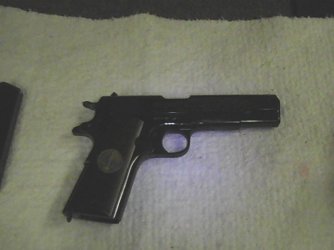
testtest

Springfield Operator .45 recoil spring(s)

(New guy here... this might get a little long...)

Recently purchased a new SA 1911 Operator AOS, .45 w/4.25" barrel and I'm finding the recoil spring is VERY stiff. I realize that new fire arms have a break in period, but I'm having difficulty finding factory information on a spring tension number in lbs. The only info has been vague and varying... "14-20 lbs"...

Q: Is there a recommended manufacturer of OEM type recoil springs that fit this weapon with varying tension springs?
(SA doesn't seem to want to include this info in their specs)

Would like to find the "happy medium" that allows for full "return to battery ".
(Ammo is "factory" in all cases,, between 185gr and 230gr)

Thanks!
 
both my sa 1911s were stiff out of the box.
the ronin smoothed out
and the operator took a bit more rounds
it is still stiff , but not un likeable
tons of springs out there to try, i just never have
 
Thanks Senior! Seems we have a couple things in common,,, Ret EOC (Seabees) ,, also A&P mech 35+ yrs (now retired)
i still have my a&p license, although planes are far and few in between now.

i run up the airport and turn a wrench now and then to stay fresh as a burrito fart

thank you for your service in the best branch... i ran into a 92 year old retiree yesterday, he was a card. he made me laugh, usually retirees around here are ARMY,
he said he felt lucky finding a sailor to bs with.
 
(New guy here... this might get a little long...)

Recently purchased a new SA 1911 Operator AOS, .45 w/4.25" barrel and I'm finding the recoil spring is VERY stiff. I realize that new fire arms have a break in period, but I'm having difficulty finding factory information on a spring tension number in lbs. The only info has been vague and varying... "14-20 lbs"...

Q: Is there a recommended manufacturer of OEM type recoil springs that fit this weapon with varying tension springs?
(SA doesn't seem to want to include this info in their specs)

Would like to find the "happy medium" that allows for full "return to battery ".
(Ammo is "factory" in all cases,, between 185gr and 230gr)

Thanks!
Once you get some rounds through the gun, spring will lessen up some, on a regular commander length 1911, if I remember right the spring weight is 20#, you don’t want a to weak a spring in any 1911 due to frame battering may occur. On my Kimber Custom carry which is similar to a commander and your pistol, it has the 20# spring, on a full size 9mm 1911 you want a 12# spring and on a full size 1911 in .45, factory is 16#, these are just for reference for you
 
Last edited:
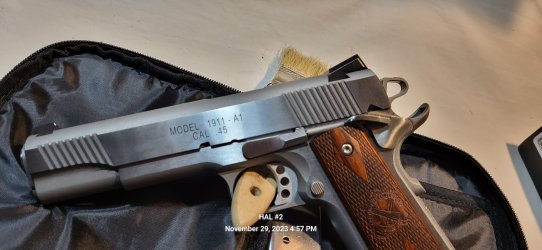
i left out this loaded ss model was smooth and smooth right out of the box,
but it has the bull barrel and screws me up after shooting the other 1911s with the "normal" take down
 

Attachments

  • 1911 45 loaded springfield (7).jpg
    1911 45 loaded springfield (7).jpg
    1 MB · Views: 37
i still have my a&p license, although planes are far and few in between now.

i run up the airport and turn a wrench now and then to stay fresh as a burrito fart

thank you for your service in the best branch... i ran into a 92 year old retiree yesterday, he was a card. he made me laugh, usually retirees around here are ARMY,
he said he felt lucky finding a sailor to bs with.
Guess I'm handicapped then,,, started in Army Aviation (late 77).. Rotary wing,, Cobras and Chinooks. I'm presently mid-East Coast FL (from CO). Not much around here except AF & SpaceForce,,, bleh!
Be safe Brother!
 
not a SA, but this 1967 1911 is butter smooth
since day one, i got in in 2008 new in the box, at an old lgs.
its amazing, so much so my wife called it hers :ROFLMAO:
 

Attachments

  • 1967 model 1911 colt04.jpg
    1967 model 1911 colt04.jpg
    37.6 KB · Views: 38
These guns are made to handle full power service loads. They can be stiff. If you lighten the springs and shoot heavy loads, you get excessive wear on the gun.

A few things that may help. Shoot it with factory loads and it will "shoot in" after a while. Use a full hand grip on top of the slide when racking the slide instead of the pinch method and it is easier. Stand bladed to the target. With one hand on the grip and one on the top of the slide, push into the center with both arms to double the power to work the action. After you break the gun down and clean it, use gun grease on the rails, that will ease things a bit as well.
 
These guns are made to handle full power service loads. They can be stiff. If you lighten the springs and shoot heavy loads, you get excessive wear on the gun.

A few things that may help. Shoot it with factory loads and it will "shoot in" after a while. Use a full hand grip on top of the slide when racking the slide instead of the pinch method and it is easier. Stand bladed to the target. With one hand on the grip and one on the top of the slide, push into the center with both arms to double the power to work the action. After you break the gun down and clean it, use gun grease on the rails, that will ease things a bit as well.
And I forgot to mention, if you cock the hammer manually first it eases racking the slide because you are not fighting the hammer spring as well as the recoil spring. Be safe in all this and good luck with it
 
(New guy here... this might get a little long...)

Recently purchased a new SA 1911 Operator AOS, .45 w/4.25" barrel and I'm finding the recoil spring is VERY stiff. I realize that new fire arms have a break in period, but I'm having difficulty finding factory information on a spring tension number in lbs. The only info has been vague and varying... "14-20 lbs"...

Q: Is there a recommended manufacturer of OEM type recoil springs that fit this weapon with varying tension springs?
(SA doesn't seem to want to include this info in their specs)

Would like to find the "happy medium" that allows for full "return to battery ".
(Ammo is "factory" in all cases,, between 185gr and 230gr)

Thanks!
Factory-standard recoil spring weights for a 1911 Commander (4.25-inch barrel) vary by caliber. The most common standard weights are:
  • .45 ACP: 16 to 18 lbs.
  • 9mm Luger / .38 Super: 14 lbs.
  • .40 S&W: 19 lbs.
These springs are specially sized for the Commander's shorter slide and compression tunnel and are not interchangeable with full-size (Government) 1911 springs.

Caliber Details & Upgrades
  • .45 ACP: The original factory-standard is typically 16 or 18 lbs., but many shooters bump up to 18 to 20 lbs. when running heavy duty or +P (higher pressure) defensive ammunition to prevent the slide from bottoming out against the frame.
  • 9mm Luger & .38 Super: Factory-standard is usually 14 lbs. However, many manufacturers ship 9mm Commander 1911s with 16 lbs. springs to ensure flawless cycling across a wider variety of standard and target loads.
  • .40 S&W: The factory-standard is a heavier 19 lbs. to manage the sharper, higher-pressure recoil impulse of the round.
Selecting the Right Weight

The rule of thumb is to use the heaviest spring that allows the pistol to cycle flawlessly. You can gauge this by looking at where your empty casings eject. Ideally, casings should land about 3 to 6 feet away. If the brass is just trickling out or the gun fails to go completely into battery, the spring is too heavy. If the casings are launching 10+ feet away or the gun feels excessively battered, you likely need a heavier spring.

If you share the specific brand/model of your 1911 Commander, along with the type of ammo you primarily shoot (e.g., target loads, standard defense, or +P), I can recommend the optimal spring weight for your setup.
 
Factory-standard recoil spring weights for a 1911 Commander (4.25-inch barrel) vary by caliber. The most common standard weights are:
  • .45 ACP: 16 to 18 lbs.
  • 9mm Luger / .38 Super: 14 lbs.
  • .40 S&W: 19 lbs.
These springs are specially sized for the Commander's shorter slide and compression tunnel and are not interchangeable with full-size (Government) 1911 springs.

Caliber Details & Upgrades
  • .45 ACP: The original factory-standard is typically 16 or 18 lbs., but many shooters bump up to 18 to 20 lbs. when running heavy duty or +P (higher pressure) defensive ammunition to prevent the slide from bottoming out against the frame.
  • 9mm Luger & .38 Super: Factory-standard is usually 14 lbs. However, many manufacturers ship 9mm Commander 1911s with 16 lbs. springs to ensure flawless cycling across a wider variety of standard and target loads.
  • .40 S&W: The factory-standard is a heavier 19 lbs. to manage the sharper, higher-pressure recoil impulse of the round.
Selecting the Right Weight

The rule of thumb is to use the heaviest spring that allows the pistol to cycle flawlessly. You can gauge this by looking at where your empty casings eject. Ideally, casings should land about 3 to 6 feet away. If the brass is just trickling out or the gun fails to go completely into battery, the spring is too heavy. If the casings are launching 10+ feet away or the gun feels excessively battered, you likely need a heavier spring.

If you share the specific brand/model of your 1911 Commander, along with the type of ammo you primarily shoot (e.g., target loads, standard defense, or +P), I can recommend the optimal spring weight for your setup.
~thank you!
 
Factory-standard recoil spring weights for a 1911 Commander (4.25-inch barrel) vary by caliber. The most common standard weights are:
  • .45 ACP: 16 to 18 lbs.
  • 9mm Luger / .38 Super: 14 lbs.
  • .40 S&W: 19 lbs.
These springs are specially sized for the Commander's shorter slide and compression tunnel and are not interchangeable with full-size (Government) 1911 springs.

Caliber Details & Upgrades
  • .45 ACP: The original factory-standard is typically 16 or 18 lbs., but many shooters bump up to 18 to 20 lbs. when running heavy duty or +P (higher pressure) defensive ammunition to prevent the slide from bottoming out against the frame.
  • 9mm Luger & .38 Super: Factory-standard is usually 14 lbs. However, many manufacturers ship 9mm Commander 1911s with 16 lbs. springs to ensure flawless cycling across a wider variety of standard and target loads.
  • .40 S&W: The factory-standard is a heavier 19 lbs. to manage the sharper, higher-pressure recoil impulse of the round.
Selecting the Right Weight

The rule of thumb is to use the heaviest spring that allows the pistol to cycle flawlessly. You can gauge this by looking at where your empty casings eject. Ideally, casings should land about 3 to 6 feet away. If the brass is just trickling out or the gun fails to go completely into battery, the spring is too heavy. If the casings are launching 10+ feet away or the gun feels excessively battered, you likely need a heavier spring.

If you share the specific brand/model of your 1911 Commander, along with the type of ammo you primarily shoot (e.g., target loads, standard defense, or +P), I can recommend the optimal spring weight for your setup.
". If the casings are launching 10+ feet away or the gun feels excessively battered, you likely need a heavier spring."
reminded me of the time the HOT 45 brass ejected, at my wife and went right down the front of her shirt
i heard a EEEWWWWOOOOWW over my ear muffs

the landing zone up there is perfect description thanks
 
I'm a firm believer in both Wolff and Wilson Combat springs.
In both my Kimbers I'm running the Wilson flat recoil springs with the correct sized (for the spring) government recoil guide rod.
The Kimber .45 is a 20# flat spring.
The Kimber Rapide 10mm is a 26# flat recoil spring.
I have also went with extra power firing pin springs due to using extra power recoil springs.
The Kimber .45 was running a 20# standard coil Wolff spring.
The Kimber Rapide 10mm was running a 20# Wolff standard coil spring.
The 26# Wilson flat coil spring on the 10mm made a huge difference in the amount of recoil.
Believe it or not, both of these flat coil recoil springs made a difference over the standard coil springs. I'm not sure why the 20# springs acted differently but the Wilson flat spring did.
It's obvious that there would be a difference between the 20# and 26# springs due to the spring power factor.
Between both the 20# springs, the impulse between the flat version and the round standard recoil spring was noticeably smoother with the Wilson flat spring. I'm sold!
 
Back
Top