

USS Cleveland’s powerful guns and advanced radar helped secure Allied Pacific victories.
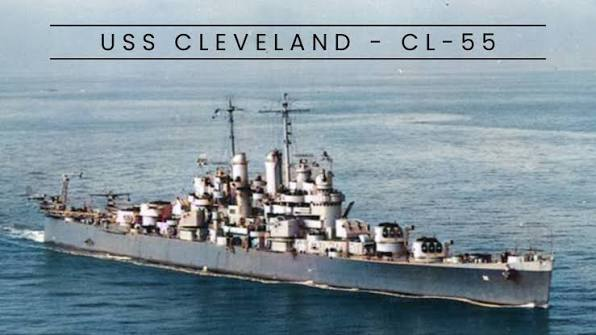
The Cleveland was just an inch over 610 feet in length, with a beam of 66 feet, 6 inches; a draft of 20 feet; and a fully loaded displacement of 11,890 tons. Her four steam turbines put out 100,000 shaft horsepower, driving four screws and giving the ship a speed of 33 knots. The complement comprised 992 officers and enlisted sailors. She was protected by 5 inches of belt armor, with 6 inches in her barbettes. Her gunhouses had 6 inches of armor on the sides and 3 inches on the roofs.
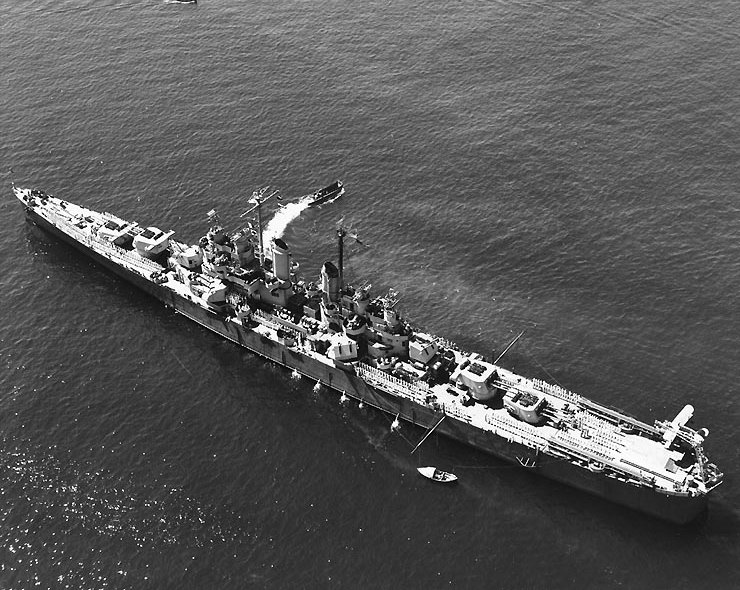
Designed to be mass produced, her final form incorporated lessons learned early in World War II. Her primary mission was to escort the fast carriers. Her main battery consisted of 12 6-inch/47-caliber Mk 16 rapid-fire guns in 4 triple turrets, arranged along the centerline, 2 forward and 2 aft. These guns fired 10 rounds per minute and could use a super-heavy armor-piercing (AP) round—with almost twice the penetrating performance of older AP rounds—or a high-explosive Mk 34 shell with a top secret variable-time (VT) proximity fuze.
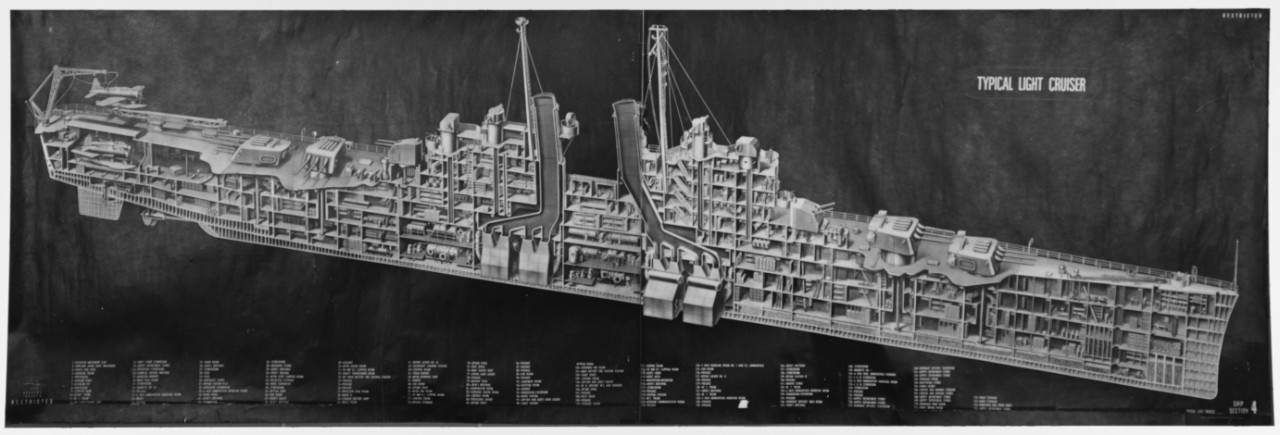
In a significant departure from the preceding Brooklyn class, the Cleveland had a vastly improved antiaircraft battery, consisting of 12 5-inch/38 dual-purpose guns arranged in twin-mount groups of 3 fore and aft, 4 40-mm Bofors twin mounts, and 15 single Oerlikon 20-mm guns mounted on the main deck and superstructure. The radar-assisted Mk 37 Gunnery Fire Control System managed the main and secondary batteries.
The catapults for two Curtiss SO3C Seamew floatplanes were positioned on either side of the stern, with a hangar space between them below deck.
The Cleveland was just an inch over 610 feet in length, with a beam of 66 feet, 6 inches; a draft of 20 feet; and a fully loaded displacement of 11,890 tons. Her four steam turbines put out 100,000 shaft horsepower, driving four screws and giving the ship a speed of 33 knots. The complement comprised 992 officers and enlisted sailors. She was protected by 5 inches of belt armor, with 6 inches in her barbettes. Her gunhouses had 6 inches of armor on the sides and 3 inches on the roofs.
Designed to be mass produced, her final form incorporated lessons learned early in World War II. Her primary mission was to escort the fast carriers. Her main battery consisted of 12 6-inch/47-caliber Mk 16 rapid-fire guns in 4 triple turrets, arranged along the centerline, 2 forward and 2 aft. These guns fired 10 rounds per minute and could use a super-heavy armor-piercing (AP) round—with almost twice the penetrating performance of older AP rounds—or a high-explosive Mk 34 shell with a top secret variable-time (VT) proximity fuze.
In a significant departure from the preceding Brooklyn class, the Cleveland had a vastly improved antiaircraft battery, consisting of 12 5-inch/38 dual-purpose guns arranged in twin-mount groups of 3 fore and aft, 4 40-mm Bofors twin mounts, and 15 single Oerlikon 20-mm guns mounted on the main deck and superstructure. The radar-assisted Mk 37 Gunnery Fire Control System managed the main and secondary batteries.
The catapults for two Curtiss SO3C Seamew floatplanes were positioned on either side of the stern, with a hangar space between them below deck.