
testtest

The F-14 Tomcat- Still the Coolest Thing with Wings

Talyn

Emissary
Founding Member

The F-14 Tomcat

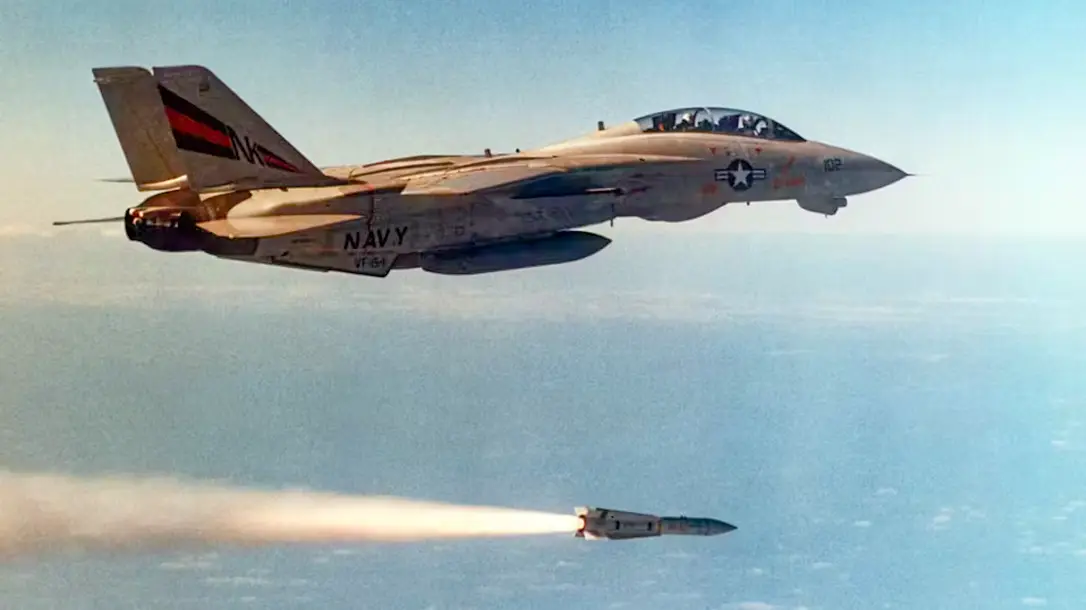
The Gruman F-14 Tomcat was more than just another jet in a line of military aircraft. It was an icon of the skies. Its unmistakable silhouette, twin tails, and sweeping wings made it a jet that everyone recognized. In its heyday, it was the absolute symbol of American air power and superiority. Its legend is so storied that Hollywood latched onto it and gave us Top Gun.

1781910404262.png


Born in the 1960s, the F-14 was the answer to a new need for Naval fleet defense. They needed an aircraft capable of fighter operations and of protecting carrier battle groups from long-range Soviet bombers armed with anti-ship missiles. After all testing was completed and submissions were evaluated, the Grumman Aerospace F-14 won the contract.

1781910541341.png


Construction began, and the first Tomcat hit the skies in 1970. It was an exceptional aircraft with a unique variable-sweep wing design. The wings automatically adjusted depending on speed and flight conditions. At low speeds, the wings extended outward to provide greater lift and maneuverability. At high speeds, they swept back to reduce drag and improve performance. This gave the Tomcat excellent handling across a wide range of flight conditions.

1781910618988.png


While its Mach 2 speed was impressive, the Tomcat had more than just brawn. The aircraft was fitted with a cutting-edge AWG-9 radar, which could track multiple targets at extremely long ranges. When it came time to fight, the Tomcat had serious teeth. Combined with its advanced radar, the F-14 could engage enemy aircraft from over 100 miles away. In short, they could destroy targets that they could not even see with the naked eye.

The Tomcat officially retired from U.S. Navy service in 2006 after more than 30 years of operation.

1781910678364.png


The F-14 Tomcat is now relegated to museums and mothball aircraft storage facilities. Once the symbol of American power, it is now a page in aviation history.
 
to me those are way better than the 18's, 15's, 16's and all others! they might have a little less speed, but can go easily twice as far as many others.

The 14 and 15 were pretty much stablemates so far as speed goes. The 16 and 18 are both slower.

Here's the most ironic thing. Our Tomcats never achieved a Phoenix kill outside of target drones. The two times our guys launched one, they both failed. Sparrows, and Sidewinders, and the Vulcan, were the money makers for us.

The Islamic Republic of Iran however, had more luck. They even depleted their supply of AIM-54s to the point they experimented with air launched HAWK missiles as a replacement. I don't have any documentation of either thier success, or failure.

But the one truly documented thing is, the Iraqi Air Force was white knuckle scared of the Iranian Tomcats. When they switched on the radar, the Iraqis high tailed it.
 
Another bit of history about 14, the Marine Corps initially was a partner in the program.

From its beginning the Tomcat had the ability to drop bombs, hence the Corps interest. But more on its air to ground abilities later.

With the cost issues as the bird neared its introduction into service, the Marines backed out, and bought more Phantoms.

When I was stationed at MCAS Beaufort I got a daily reminder of how close we came, all the hangars there were of the same type as at NAS Miramar, F14 hangars.

And another aside, Navy Tomcats didn't carry bombs operationally until we went to Bosnia in the early 90s. And at that time their targets were painted by Hornets. The LANTIRN pod for the 14 came later.
 
If you get really deep into the Tomcats history, you'll find another reason to dislike Dick Cheney.

I can't prove it, but if you look at the Tomcat program in relation to him, it was everything he could do to try to kill Grumman. It got so bad they merged with Northrop.

#e//, the Tomcat contract was even written in such a way as to punish Grumman for anything.

My take on it leads me to believe that Grumman didn't make any kind of profit on the production of the aircraft.

The other irony of the type was the TF30 engine. You want to talk about a soup sandwich........

It was only supposed to be a stopgap until the proper power plant was developed. As with so many other things, Congress stepped in, and no proper replacement was funded. The TF30 was a powerful, but over problematic engine. They had the habit of shedding compressor blades, stalling at high AOAs, being temperamental in general. Don't get me wrong, when they worked, they were a sight to behold, but when they didn't, birds, and crews were lost. The best fix they came up with was to wrap the compressor section in armor to keep a blade separation from causing the loss of the aircraft.

Believe me, if you want a research project that'll really open your eyes, deep dive into the Tomcats history.
 
Also why the 18 came to be is someone in the govt had stock in that company. The 18 is only faster than the 14, but inferior in every other way!

Actually, after the fall of the Warsaw Pact & subsequently the Soviet Union & GW #1, the Bush #1 admin concluded that any future needs would be in the littoral so the long-range F-14 and A-6 went away, and we got the short-ranged F/A-18 models, as well as the LCS disasters.

Until the last ~10-15 years the Tyranny of Distance was forgotten.


Last edited:
I beg to differ, the 18 was good at everything, but great at nothing.

I know because I supported them, they're late 70s, early 80s technology, your cellphone is more capable than a legacy model Hornets flight control computer.

With the swan song of the Intruder, and the outright death of the A12, the Tomcat was all that was left. And even it's full capabilities were grudgingly accepted because the E & F Hornets weren't anything but hopefuls at the time.

The E & F Hornets are a every bad compromise you could imagine in a combat aircraft.

But, as I'll be shown here, I don't anything about what I'm talking about.

Carry on....
 
Back
Top