

The fall of “Fortress Singapore” on Feb. 15, 1942, following a blistering 70-day campaign across the Malayan peninsula, is one such analytically confusing — yet hugely consequential — moment in military history. Indeed, as a crestfallen Prime Minister Winston Churchill would later acknowledge, it constituted, without the shadow of a doubt in his mind, “the worst disaster and largest capitulation in British history.” For the weary, embattled people of the British Isles tuning into their wireless stations in the winter of 1942, however, it was also one of its most inexplicable. Indeed, how could such a large and seemingly well-provisioned force collapse in a mere ten weeks, and in so doing surrender Britain’s great imperial bastion, the waterways of Southeast Asia, and the resource-rich jungles of Malaya to a numerically inferior “army of clever gangsters?”

 warontherocks.com
Editor’s note: This is part of a running series of essays by Iskander Rehman, entitled “Applied History,” which seeks, through the study of the history of strategy and military operations, to better illuminate contemporary defense challenges.
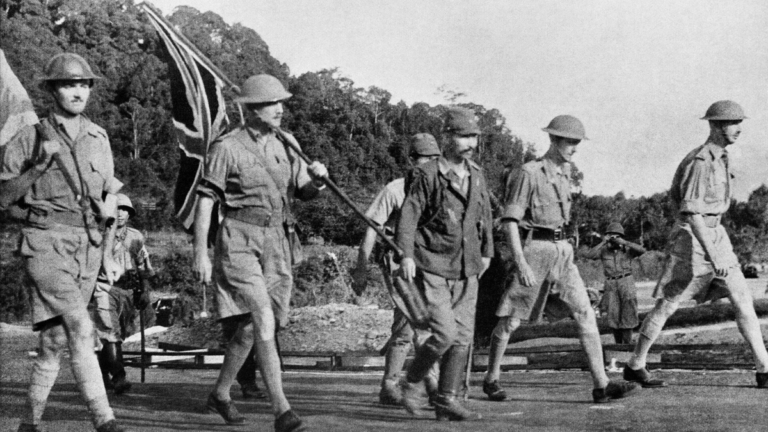
The Fall of Fortress Singapore: Three Lessons from the Collapse of Britain’s Great Asian Bastion
Editor’s note: This is part of a running series of essays by Iskander Rehman, entitled “Applied History,” which seeks, through the study of the history of
Editor’s note: This is part of a running series of essays by Iskander Rehman, entitled “Applied History,” which seeks, through the study of the history of strategy and military operations, to better illuminate contemporary defense challenges.
The fall of Singapore on February 15 stupefied the Prime Minister. How came 100,000 men … to hold up their hands to inferior numbers of Japanese? Though his mind had been gradually prepared for its fall, the surrender of the fortress stunned him. He felt it was a disgrace. It left a scar on his mind. One evening, months later, when he was sitting in his bathroom enveloped in a towel, he stopped drying himself and gloomily surveyed the floor: “I cannot get over Singapore,” he said sadly.
– Lord Charles Moran, Winston Churchill’s personal physician, writing in his personal memoirs, in the 1960s.
