

A good focused and informative article from Dabbs, with some extra perspective info added in my the ____ / ____ insert.
The SIG Sauer M7 Spear was a pretty big deal. Uncle Sam formally deployed the M16 rifle in 1964. Previously, American grunts had wielded the M14 and the M1 Garand before that—both full-sized battle rifles firing powerful cartridges the size of your index finger. The M16 represented a sea change in infantry combat.
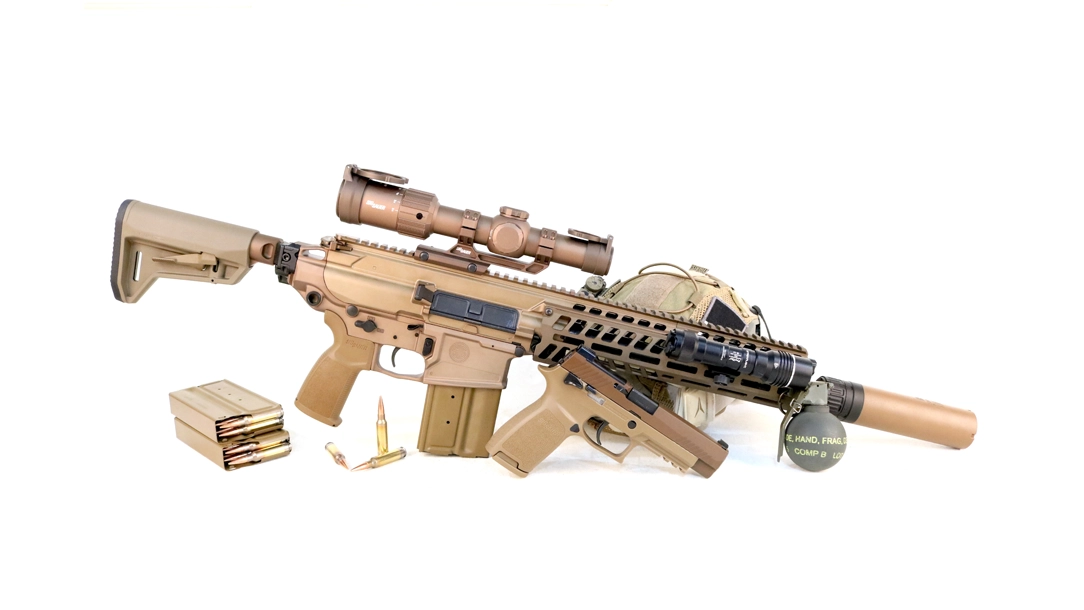
 athlonoutdoors.com
After a few well-publicized battlefield failures, there were calls to bin the new “poodle popper” in favor of a proper man’s gun. However, folks warmed to the idea of a lightweight, selective-fire assault rifle firing zippy little high-velocity rounds.
The US Army switching back adopting the version with the chrome-lined bore and using the proper powder in the 5.56 rounds the way the USAF originally did didn’t hurt the reputation recovery either. The entire planet eventually adopted similar weapons, even the AK74 was an attempt to emulate performance.
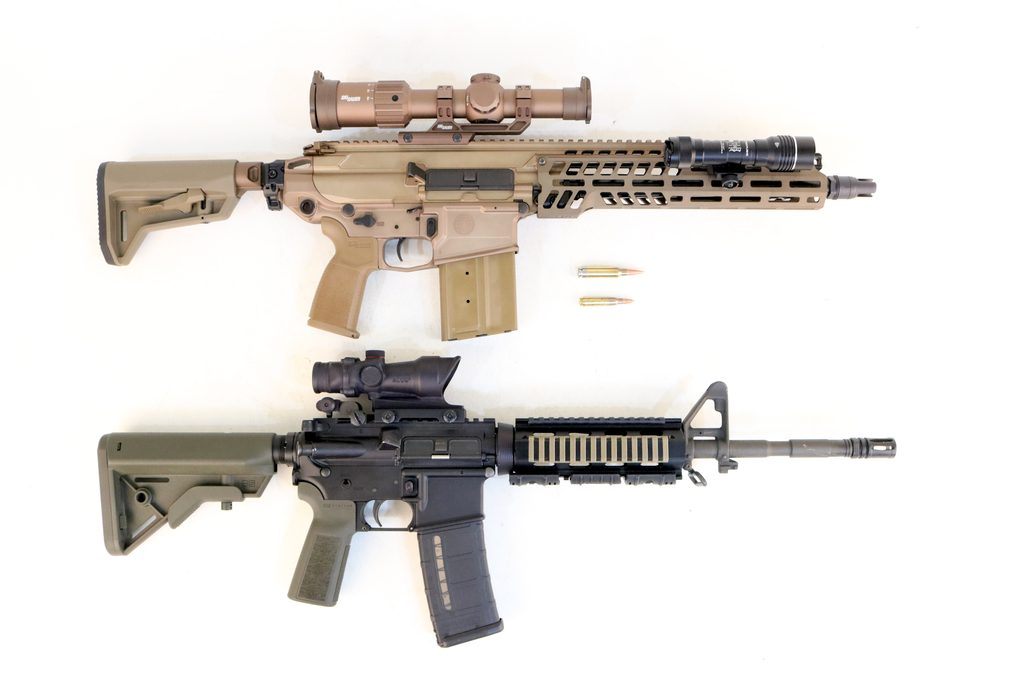
Eventually, the world shifted yet again. In Afghanistan, short-barreled M4 carbines often lacked the reach to engage insurgents armed with heavier weapons at long ranges. Additionally, our near-peer adversaries began fielding body armor on a ubiquitous scale. Those lightweight 5.56mm bullets were not up to the task. After sixty-one years, it was time for a change.
The objective was to simultaneously develop replacements for both the M16/M4 rifle and the M249 Squad Automatic Weapon. Anything was on the table, to include a new cartridge firing a 6.8 EPR projectile. After an exhaustive competitive shoot-off, SIG Sauer took both prizes. The rifle became the M7. The belt-fed machinegun was the M250. Both weapons fired a radically-advanced high-pressure hybrid 6.8x51mm round.
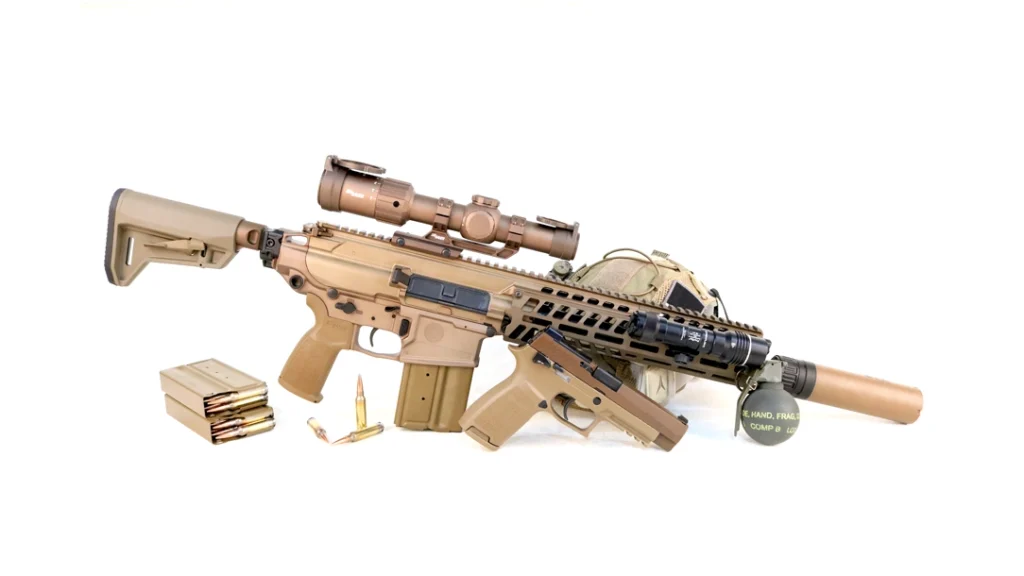
SIG Sauer claims that the 6.8x51mm cartridge has performance superior to the 6.5 Creedmoor, with 6 to 9 feet less bullet drop at 1,000 yards. They also claim 20–25% greater energy on target. The military uses several different loads. The XM1186 General Purpose round packs a 113-grain bullet. The XM1184 fires a 155-grain open-tip match projectile. These cartridges have the potential to transform infantry combat.
The 6.8x51mm Common Cartridge sports the same overall length as the legacy 7.62x51mm, so it fits into existing .308 magazines. What makes the round so unusual is its chamber pressures. Traditional 7.62x51mm produces around 60,000 psi. The new 6.8x51mm runs 20,000 psi higher.
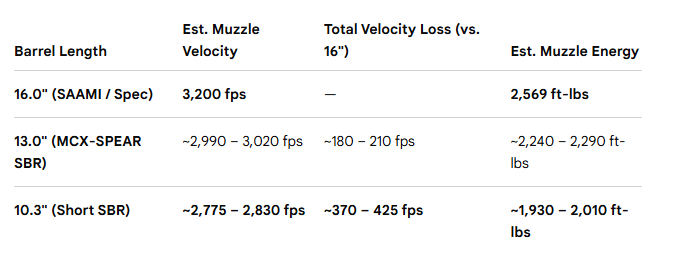
When coupled with a 113-grain bullet, this round clocks 3,200 fps out of a rifle-length barrel (NOTE: in a 16" barrel). Drop that tube down to 13 inches on the M7, and you still get 3,000 fps. These are the same sorts of velocities that the long-barreled M16 produced with a 62-grain projectile. Traditional brass cartridge cases wouldn’t cut it. As a result, SIG developed a hybrid case with a stainless steel base and a brass cartridge body.
---------------
NOTE: The newer M8 has a 10.3" barrel...
Published factory and test ballistics specifically for 6.8x51mm (.277 Fury) in a 10.3-inch barrel are scarce because factory rifles like the SIG MCX-SPEAR and military M7 are typically configured with 13-inch or 16-inch barrels, while 10.3-inch barrels are common in 5.56 NATO or 6.8 SPC (6.8x43mm).
Capable of muzzle velocities in excess of 3,000 FPS with a 113gr bullet out of a 16” barrel, the MCX-SPEAR rifle is achieving the Army’s goal of advanced performance while also exceeding the requirements for durability.
What to Expect From 6.8x51mm in a ~10.3-Inch Barrel
Because the 6.8×51mm operates at roughly 80,000 PSI with slow-burning rifle powders designed to push heavier-for-caliber bullets, cutting 5.7 inches off the barrel loses roughly 65 to 75 fps per inch in the 10- to 16-inch window:
Dropping from a 16-inch barrel to a 10.3-inch barrel with the 113-grain 6.8×51mm (.277 SIG Fury) hybrid load results in an estimated velocity loss of 370 to 425 fps, bringing muzzle velocity down from 3,200 fps (16 inch) to roughly 2,775–2,830 fps.
Blast & Wear: Because a significant portion of the 80,000 PSI powder charge is still burning at 10.3 inches, muzzle blast, flash, and baffle erosion increase dramatically compared to a 16-inch barrel.
--------------
The SIG Sauer M7 Spear was a pretty big deal. Uncle Sam formally deployed the M16 rifle in 1964. Previously, American grunts had wielded the M14 and the M1 Garand before that—both full-sized battle rifles firing powerful cartridges the size of your index finger. The M16 represented a sea change in infantry combat.
The SIG M7 Spear - Battle Rifle Redux
Athlon Outdoors Exclusive Firearm Updates, Reviews & News
athlonoutdoors.com
After a few well-publicized battlefield failures, there were calls to bin the new “poodle popper” in favor of a proper man’s gun. However, folks warmed to the idea of a lightweight, selective-fire assault rifle firing zippy little high-velocity rounds.
The US Army switching back adopting the version with the chrome-lined bore and using the proper powder in the 5.56 rounds the way the USAF originally did didn’t hurt the reputation recovery either. The entire planet eventually adopted similar weapons, even the AK74 was an attempt to emulate performance.
Eventually, the world shifted yet again. In Afghanistan, short-barreled M4 carbines often lacked the reach to engage insurgents armed with heavier weapons at long ranges. Additionally, our near-peer adversaries began fielding body armor on a ubiquitous scale. Those lightweight 5.56mm bullets were not up to the task. After sixty-one years, it was time for a change.
The objective was to simultaneously develop replacements for both the M16/M4 rifle and the M249 Squad Automatic Weapon. Anything was on the table, to include a new cartridge firing a 6.8 EPR projectile. After an exhaustive competitive shoot-off, SIG Sauer took both prizes. The rifle became the M7. The belt-fed machinegun was the M250. Both weapons fired a radically-advanced high-pressure hybrid 6.8x51mm round.
SIG Sauer claims that the 6.8x51mm cartridge has performance superior to the 6.5 Creedmoor, with 6 to 9 feet less bullet drop at 1,000 yards. They also claim 20–25% greater energy on target. The military uses several different loads. The XM1186 General Purpose round packs a 113-grain bullet. The XM1184 fires a 155-grain open-tip match projectile. These cartridges have the potential to transform infantry combat.
The 6.8x51mm Common Cartridge sports the same overall length as the legacy 7.62x51mm, so it fits into existing .308 magazines. What makes the round so unusual is its chamber pressures. Traditional 7.62x51mm produces around 60,000 psi. The new 6.8x51mm runs 20,000 psi higher.
When coupled with a 113-grain bullet, this round clocks 3,200 fps out of a rifle-length barrel (NOTE: in a 16" barrel). Drop that tube down to 13 inches on the M7, and you still get 3,000 fps. These are the same sorts of velocities that the long-barreled M16 produced with a 62-grain projectile. Traditional brass cartridge cases wouldn’t cut it. As a result, SIG developed a hybrid case with a stainless steel base and a brass cartridge body.
---------------
NOTE: The newer M8 has a 10.3" barrel...
Published factory and test ballistics specifically for 6.8x51mm (.277 Fury) in a 10.3-inch barrel are scarce because factory rifles like the SIG MCX-SPEAR and military M7 are typically configured with 13-inch or 16-inch barrels, while 10.3-inch barrels are common in 5.56 NATO or 6.8 SPC (6.8x43mm).
Capable of muzzle velocities in excess of 3,000 FPS with a 113gr bullet out of a 16” barrel, the MCX-SPEAR rifle is achieving the Army’s goal of advanced performance while also exceeding the requirements for durability.
What to Expect From 6.8x51mm in a ~10.3-Inch Barrel
- Significant Velocity Loss: 6.8x51mm relies on high chamber pressure (up to ~80,000 psi) and slow-to-medium burning powders to reach ~2,750–3,200 fps from 13–16+ inch barrels depending on bullet weight (e.g., 113 gr to 155 gr). Cutting down to ~10.3 inches leaves far less barrel length for gas expansion, reducing muzzle velocity well below 16-inch benchmarks (often by several hundred fps depending on load and powder burn rate).
- Severe Muzzle Blast, Flash, and Recoil: Burning a high-pressure, large-capacity magnum-class charge in a 10.3-inch tube produces heavy unburned powder, loud concussion, and sharp recoil.
Because the 6.8×51mm operates at roughly 80,000 PSI with slow-burning rifle powders designed to push heavier-for-caliber bullets, cutting 5.7 inches off the barrel loses roughly 65 to 75 fps per inch in the 10- to 16-inch window:
Dropping from a 16-inch barrel to a 10.3-inch barrel with the 113-grain 6.8×51mm (.277 SIG Fury) hybrid load results in an estimated velocity loss of 370 to 425 fps, bringing muzzle velocity down from 3,200 fps (16 inch) to roughly 2,775–2,830 fps.
Blast & Wear: Because a significant portion of the 80,000 PSI powder charge is still burning at 10.3 inches, muzzle blast, flash, and baffle erosion increase dramatically compared to a 16-inch barrel.
--------------
Last edited:
