

The Lockheed AH-56A Cheyenne was more advanced than today’s AH-64 Apache, but it never went in production. Here’s why.
The Lockheed AH-56 Cheyenne was a groundbreaking but ultimately canceled prototype attack helicopter developed for the U.S. Army in the late 1960s.It was designed as a dedicated, high-speed compound helicopter under the Army’s Advanced Aerial Fire Support System (AAFSS) program, aiming to provide superior close air support, escort, and fire support compared to armed UH-1 Huey gunships used in Vietnam.
Design and Innovations
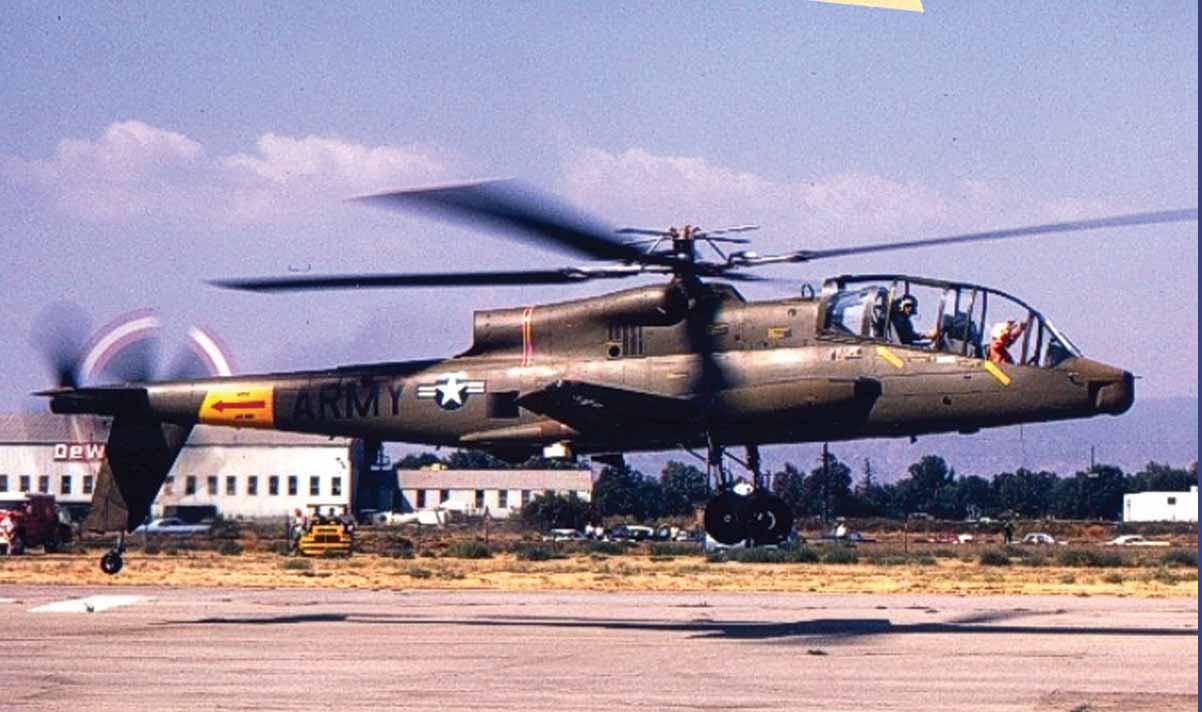
The Cheyenne featured a unique compound helicopter configuration:
• Four-bladed rigid (hingeless) main rotor for better maneuverability and reduced weight.
• Low-mounted stub wings (about 26 ft 8 in / 8.1 m span) that provided additional lift in forward flight.
• Rear pusher propeller (three-bladed) driven by the same engine, allowing it to function more like a fixed-wing aircraft at high speeds, unloading the rotor.
• Single General Electric T64-GE-16 turboshaft engine (around 3,425–3,925 shp).
• Tandem two-crew cockpit (pilot and gunner), retractable landing gear for clearance of a belly turret, and advanced avionics including a helmet-mounted sight, night vision, laser rangefinder, and fire-control computer.
This setup enabled exceptional performance for the era, with the wings and propeller handling much of the lift and thrust in high-speed flight (rotor providing as little as 20% of lift at speed).

What Went Wrong with the AH-56A Cheyenne Attack Helicopter
Ahead of its time in performance and design, the Lockheed AH-56 seemed like a promising attack helicopter for the United States Army during the Vietnam
 theaviationist.com

Lockheed AH-56 Cheyenne - Wikipedia
AH-56 Cheyenne - The Army Historical Foundation
The Army set 24 November 1964 as the deadline for proposal submission and expected to determine a winner and award a contract by 1 November 1965. Twelve companies submitted proposals for the AAFSS, but the Army realized that it would need an interim measure to fill the immediate need for an...
 armyhistory.org
Armament
• Nose turret: 40 mm XM129 grenade launcher or 7.62 mm minigun.
• Belly turret: 30 mm XM140 cannon.
• Six wing hardpoints for TOW anti-tank missiles, 2.75-inch rockets, or other ordnance.
It featured sophisticated fire-control systems, including swiveling gunner stations linked to turrets.
When the program was cancelled in 1972, reasons stated included the inadequate night and all-weather capabilities as well as the aircraft being too large. The smaller AH-1 Cobra was now a proven alternative and much more affordable, though with inferior performance in many areas. By now most of the systems and avionics on the Cheyenne were becoming rapidly obsolete, and further improvements only meant ballooning costs once again. The Army initiated the AHH (Advanced Attack Helicopter) program just days after cancellation of the AH-56, the program eventually resulting in the AH-64 Apache attack helicopter.
There are four surviving examples of the original ten Cheyenne helicopters produced: one on display and one in storage at Fort Novosel, Alabama at the United States Army Aviation Museum, one at Fort Johnson, Louisiana, and one at Fort Campbell, Kentucky.


