testtest

You Need to Zero Your Pistol Redd Dot...But at What Distance?

Talyn

Emissary
Founding Member
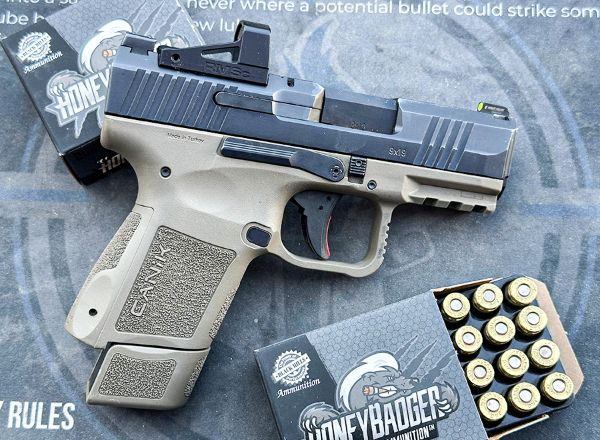
With every gun maker in the world producing handguns to accept optics and there being more optic makers than you can easily count or name, the question becomes, at what distance should I zero the optic on my pistol?


1770164801246.png
 
I figure that the distance my pistol dot is zeroed at is of less importance than my ability to put the first shot in a 4" circle.

Thinking along those lines, it would make sense to me to zero it at the furthest distance I may encounter in a given situation. In our house, there isn't going to be anyplace where we would need to shoot beyond 25'. Nightstand pistols are zeroed at 25'.

Outside, I wouldn't expect a threat to be much beyond 30' by the time I have my weapon cleared to shoot. In our church sanctuary, a shot between 60'-75' could be required. Different tools for different jobs. Same required result, 4" circle.

Each scenario I list has a different gun prepared for it. They all have a redundant laser on them. I don't expect to get a second chance. I am using every option available to me to make the first shot the last one required to end the threat.

Regardless, unless I practice and train to reach that required end, no amount of equipment will overcome a self-imposed handicap. Just because the gun can doesn't guarantee I will.

 
Respectfully some spend WAY to much thought process into worrying about what range to zero pistol optics it’s not a PPC revolver nor is it an issue like mechanical offset in an AR when we had to mount stiff in the carrying handle

Whether you zero at 7 yards, or 10 yards it’s less than an inch difference at 25 yards.

Whats more of an issue is how still you can or can’t hold the freaking gun when you pull the trigger. If you can’t shoot one hole groups at 5/7 yards the distance you zero isn’t your make or break.
 
I too use a 10yd (30') zero to sight my red dot in. 9mm, 124gr bullet and hand loaded. At a velocity of just over 1100'/sec that puts my round at almost exactly the same elevation at 50yds as it is at 10yds. Nowhere in the 50yds does the round rise more than 1" above the line of sight. My thinking is if my target is anywhere between me and 50yds, I don't have to give a lot of thought to elevation. And it doesn't drop more than 1" below the line of sight until about 65yds. Now, I don't ever intend to join in a gun fight if the bad guy is more than 50yds from me, cause I never learned to shoot over my shoulder at a dead run!!!! :)
 
I like to think... what would I use the gun for and at what distance.

For my Echelon 4.0c comp it is my CCW, when the SHTF I probably won't be aiming at 3 to 5 yards. But if the self-defense is a little further then I think about 10 yards for the green dot.

Now for my full-size Echelon that I use for steel plate challenge competition shooting. I use a bigger green dot picture and zero the green dot at 20 yards, which is about the center range of the plates.

JMO.
 
I would say it depends on your gun and cartridge but with a Red Dot Ive reached out to well beyond 100m on human size targets (out to 200m using 357Sig and a 5" barrel).

The big issue is having Iron sights that CO-Witness with the Red Dot, usually this means "suppressor height" sights. If youre using the higher sights, align the dot with your sights and you should be good to go
 
I would say it depends on your gun and cartridge but with a Red Dot Ive reached out to well beyond 100m on human size targets (out to 200m using 357Sig and a 5" barrel).

The big issue is having Iron sights that CO-Witness with the Red Dot, usually this means "suppressor height" sights. If youre using the higher sights, align the dot with your sights and you should be good to go
Co-witness is massively overrated. If that’s your thing, fine, but with the right training you can easily manage without.
 
Back
Top