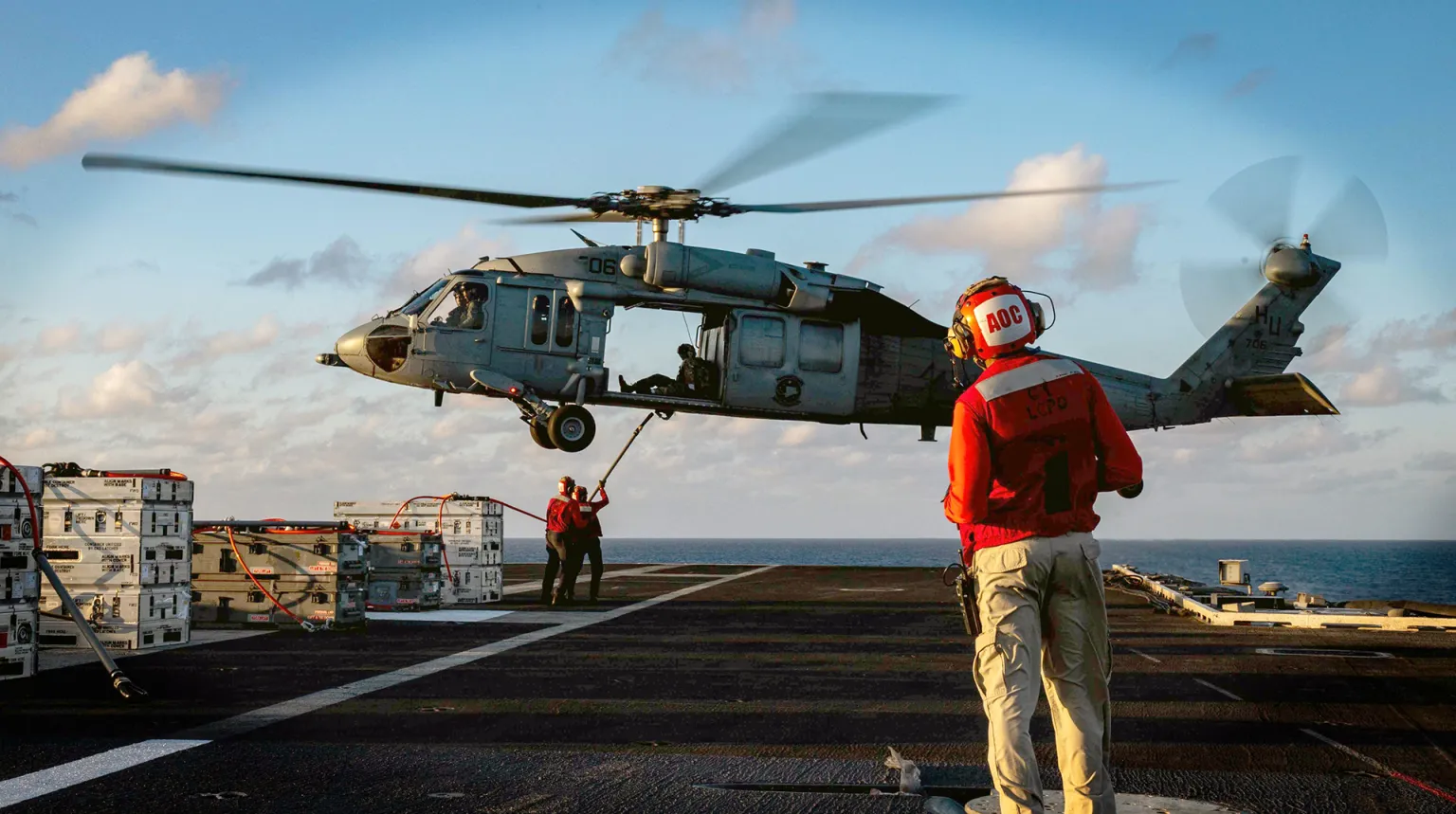
testtest

How a Navy aircraft carrier ended up short on food in a war zone

Talyn

Emissary
Founding Member
NOTE: Hope some in Fed.gov is writting some "lessons-learned" based on recent events in the arm-pit of the world.
_______________________

Iranian attacks on U.S. logistics hubs that usually supply ships in the Persian Gulf have forced the Navy to bring in supplies from thousands of miles away.

Aircraft carriers at sea typically need to be resupplied every three to six days, depending on the pace of operations.

For years, the U.S. military has been able to resupply its ships operating in the Middle East from ports and stockpiles within the Persian Gulf, said retired Navy Capt. Bradley Martin, a senior policy researcher with the RAND Corporation.

Iranian missile and drone attacks on a major U.S. base in Bahrain and a port in the United Arab Emirates have forced the Navy to bring supplies for warships like the Lincoln from locations such as Diego Garcia and Singapore, trips that can force resupply ships to sail more than 4,000 miles.

“Thus, resupply had to come from ports outside the Gulf – Diego Garcia and even as far as Singapore or through the Suez Canal – which of course meant that deliveries were bound to be delayed,” Martin said. “The distance problems were likely exacerbated by insufficient numbers of combat logistics force ships (aka UNREP) and the need for combatants supporting operations to move and reposition.”
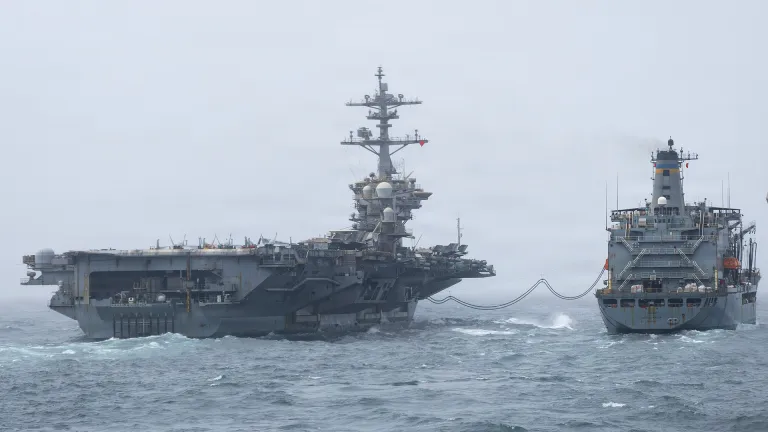
1787431808925.png

The aircraft carrier USS Abraham Lincoln conducts a replenishment-at-sea with fleet replenishment oiler USNS Henry J. Kaiser
on, Aug. 16, 2026. Navy photo.


1787431489718.png
 
I had three years with the Navy and USMC in a multi-service capacity and am a graduate of the USMC Command and Staff college, but will only comment from an Army perspective.

1. Logistics doctrine in the Gulf War should have been known prior to deployment of shortcomings and possible interdiction by enemy forces. Fact: an Iraqi Scud hit within the perimeter of a large logistics base during combat operations. (Side note: even excluding the air campaign, it was not a 100 hour war as most believe.) Units had to be resupplied and replacements absorbed like in other conflicts. If we don't take into account the threat we will have problems.
2. Air defense has been shoved aside from shortly after the Gulf War. Army installations have been hit in Kuwait and elsewhere. I'm sure a public analysis is out there somewhere, but we should know how many missiles/drones were engages and how many hit.
3. As far as Army posts in the region fingers have pointed at sheer incompetence of the leadership at the installations. I personally don't know, but the ones who publish pieces on it have good credibility. We could probably use fewer Green Bean coffee shops and more ADA. It's like allowing service members to have their cell phones in theater which can be geotagged - we don't take this stuff seriously.
 
I had three years with the Navy and USMC in a multi-service capacity and am a graduate of the USMC Command and Staff college, but will only comment from an Army perspective.

1. Logistics doctrine in the Gulf War should have been known prior to deployment of shortcomings and possible interdiction by enemy forces. Fact: an Iraqi Scud hit within the perimeter of a large logistics base during combat operations. (Side note: even excluding the air campaign, it was not a 100 hour war as most believe.) Units had to be resupplied and replacements absorbed like in other conflicts. If we don't take into account the threat we will have problems.
2. Air defense has been shoved aside from shortly after the Gulf War. Army installations have been hit in Kuwait and elsewhere. I'm sure a public analysis is out there somewhere, but we should know how many missiles/drones were engages and how many hit.
3. As far as Army posts in the region fingers have pointed at sheer incompetence of the leadership at the installations. I personally don't know, but the ones who publish pieces on it have good credibility. We could probably use fewer Green Bean coffee shops and more ADA. It's like allowing service members to have their cell phones in theater which can be geotagged - we don't take this stuff seriously.
yup
DOD already knew from the never ending sand box war and gulf ONE what the logistics were going to be
thats why we have HUGE cargo planes, c5s etc and pre-positioned ships in the region with non perishable type stores
i think DOW sec didnt listen, or let the logicians have a word , between the air force and the navy the logistics is figured and sorted already.. we even have a whole command that manages all the forces supplies and logistics of those supplies
fresh food and veggies is loaded is or was loaded on cargo planes and local fare was also purchased to get food to ships and servicemen on shore as well.
NOOOOOO reason c5 and c17s could not have landed in DUBIA, Saudi or oman...
somebody fluckkkked the goose / football
i have bene very public about SEC OF WAR and his incompetence and mannerisms .. it falls squarely on his shoulders
 
Iran was attacking bases in Dubai, Saudia Arabia UAE, Qatar & Oman, and the USN UNREP ships couldn't go in or out of the Gulf to get supplies and take them out to the CVNs and other ships with cruise missiles, ballistic missiles & drones dropping out of the skies, that's why.
 
I had three years with the Navy and USMC in a multi-service capacity and am a graduate of the USMC Command and Staff college, but will only comment from an Army perspective.

1. Logistics doctrine in the Gulf War should have been known prior to deployment of shortcomings and possible interdiction by enemy forces. Fact: an Iraqi Scud hit within the perimeter of a large logistics base during combat operations. (Side note: even excluding the air campaign, it was not a 100 hour war as most believe.) Units had to be resupplied and replacements absorbed like in other conflicts. If we don't take into account the threat we will have problems.
2. Air defense has been shoved aside from shortly after the Gulf War. Army installations have been hit in Kuwait and elsewhere. I'm sure a public analysis is out there somewhere, but we should know how many missiles/drones were engages and how many hit.
3. As far as Army posts in the region fingers have pointed at sheer incompetence of the leadership at the installations. I personally don't know, but the ones who publish pieces on it have good credibility. We could probably use fewer Green Bean coffee shops and more ADA. It's like allowing service members to have their cell phones in theater which can be geotagged - we don't take this stuff seriously.
I graduated from Army Command and General Staff College backin the days when we were preparing for the Soviets to rush the FuldaGap. But even then, protection of our logistics was important. To be honest, the Pentagon brass have gotten soft after the Afghan and Iraq wars. We have consistently downplayed the Iranian threat, and this is the result. The U.S. has never understood countries/societies that are willing to take losses and keep on fighting. Never. We think..,well, we would give up, so why don’t they? From my experience, the higher the rank/ attaboy medals, the less ground/combat experience!
 
yup
DOD already knew from the never ending sand box war and gulf ONE what the logistics were going to be
thats why we have HUGE cargo planes, c5s etc and pre-positioned ships in the region with non perishable type stores
i think DOW sec didnt listen, or let the logicians have a word , between the air force and the navy the logistics is figured and sorted already.. we even have a whole command that manages all the forces supplies and logistics of those supplies
fresh food and veggies is loaded is or was loaded on cargo planes and local fare was also purchased to get food to ships and servicemen on shore as well.
NOOOOOO reason c5 and c17s could not have landed in DUBIA, Saudi or oman...
somebody fluckkkked the goose / football
i have bene very public about SEC OF WAR and his incompetence and mannerisms .. it falls squarely on his shoulders
Nope, in my opinion. Fault is with the top heavy Pentagon types already embedded in place and who advised him…
 
Iran was attacking bases in Dubai, Saudia Arabia UAE, Qatar & Oman, and the USN UNREP ships couldn't go in or out of the Gulf to get supplies and take them out to the CVNs and other ships with cruise missiles, ballistic missiles & drones dropping out of the skies, that's why.

I think an empty/full AOR sailing in & out of the straits would have been a prime target for the Irainians to light up, as well for the Houthis going thru the Red Sea straits.

And there were/are no friendly ports between Singapore and S. America.
 
Last edited:
Nope, in my opinion. Fault is with the top heavy Pentagon types already embedded in place and who advised him…
they are just as guilty... they know better
and old friend of mine today where just talking about things from a few years back in navy life.. we both ran into the same conclusion, but SES war is the top dog, and his narcissism gets the better of him, maybe he didnt root our enough or simply the planners and he never STOPPED and backed up and looked at it from 50k feet
i spent many a deployment in the northern Arabian gulf. from 1984 to 2000. we played dodge the iranians very often and we spent 6 to 8 months on station. got a small break or not.. guess what, we had food, mail, fuel, parts and a few beer days .. NO EXCUSE in my book for the failure now, same as the dipsticks running into other ships ... no excuses
 
they are just as guilty... they know better
and old friend of mine today where just talking about things from a few years back in navy life.. we both ran into the same conclusion, but SES war is the top dog, and his narcissism gets the better of him, maybe he didnt root our enough or simply the planners and he never STOPPED and backed up and looked at it from 50k feet
i spent many a deployment in the northern Arabian gulf. from 1984 to 2000. we played dodge the iranians very often and we spent 6 to 8 months on station. got a small break or not.. guess what, we had food, mail, fuel, parts and a few beer days .. NO EXCUSE in my book for the failure now, same as the dipsticks running into other ships ... no excuses
I hate the "Pentagon says" or the "White House says." These are buildings, not people. So other than SecWar or POTUS who else has not been named. Who is the skipper of the Abe? Who is the Strike Group commander? Who is the Fleet commander? Who is NAVCENT? I know this info is out there but you get my drift. Somehow, we go from sailor directly to CENTCOM, who visited the ship then to SecWar and POTUS. If the media and services were honest they'd name names and what was done or not done.

In WWII, the military hierarchy took care of problems on their own. Example, Lt Gen. Fredendall, the II Corps Commander was sent packing after the Kasserine Pass disaster to be replaced by Patton. No one blamed FDR or SecWar Stimson for the ball up. It seems the uniformed princes like policy fights more than actual fighting, or in this case, planning for fighting.
 
It's not like this is the first time that service men/women get unhappy about things whether state-side or deployed and then either desert or commit suicide because they look for an "out". It's human-nature.

I suspect there's a handful of sailors that were unhappy for some reason then sent their relatives and email/text about it, then the relatives talk to the media.

No body blamed FDR because the troops on Guadalcanal were getting by on a shoestring for quite awhile because of Japanese attacks, but the media did jump down Pattons throat for lightly glove-slapping a serviceman who was shell-shocked.

In WW2 the Pacific Fleet ships never saw the US for years unless they were heavily damaged, and were UNREPed or backed off to forward island-based logistical hubs like Uliti, Manus, etc. for repairs and R&R.

I suspect that after an investigation that some sailors will either get demoted or a dishonorable discharge because they violated the rules in a combat zone.

The breakdown of the supply chain is pretty clear (see above) but it's human nature to complain, and blame someone else when things go south.

My .02

BTW - According to Mr. Google...

An average of 1,000 to 1,400 active-duty U.S. service members die each year during periods of relative peacetime or low-intensity conflict. According to data from the Defense Casualty Analysis System (DCAS), the vast majority of these annual fatalities occur under circumstances entirely unrelated to combat operations.

Leading Causes of Death

The primary drivers of annual military fatalities have shifted significantly away from the battlefield:
  • Suicide: This stands as the leading cause of death among active-duty troops, accounting for more than 320 deaths annually.
  • Accidents: Roughly 230 to 300 service members die each year from accidents. This includes training mishaps (such as aviation or vehicle crashes) and off-duty incidents like civilian car accidents.
  • Illness: Natural causes and diseases account for approximately 160 deaths per year.
  • Hostile Action: Outside of major deployments or specific sudden conflicts, combat-related deaths historically drop to single or double digits annually (for instance, only two were reported in a recent baseline year).
And 1/3 of the fatalities in the Iran War were due to a mid-air collison.
 
Back
Top