testtest

Primer pushed in after firing ???

Thanks for the suggestions & questions.
I was mainly just looking to see if anyone has seen such a thing before.

For Tex:
Western powder pdf w/ 5.56 data. Again max charge is listed as 25.8
Twice reloaded means 3x fired, that's correct.
I did work up the charge weight slowly, as stated in post #1
It was only 1 occurence out of the 20 rounds fired.

The only thing I can think is i possibly pressed a bit harder on my primer tool and rolled the edge in a little, setting it up for a further push from firing pin. But i would expect cartridge pressure upon firing wouldn't allow that. 🤷‍♂️
 
Thanks for the suggestions & questions.
I was mainly just looking to see if anyone has seen such a thing before.
Thanks for clarifying your real question. My answer is "Nope."

For Tex:
Western powder pdf w/ 5.56 data. Again max charge is listed as 25.8
Twice reloaded means 3x fired, that's correct.
I did work up the charge weight slowly, as stated in post #1
It was only 1 occurence out of the 20 rounds fired.
Interesting that nineteen rounds did not exhibit the issue, one did. Points to an issue other than the primer itself (probably).

The only thing I can think is i possibly pressed a bit harder on my primer tool and rolled the edge in a little, setting it up for a further push from firing pin. But i would expect cartridge pressure upon firing wouldn't allow that. 🤷‍♂️
You didn't state HOW or with WHAT you do your priming. It is certainly possible to deform primers while priming. Been there, done that, but none so much as to exhibit the strange appearance in the aftermath of firing like what you've posted

----
The mystery remains.
 
Last edited:
Thanks for the suggestions & questions.
I was mainly just looking to see if anyone has seen such a thing before.

For Tex:
Western powder pdf w/ 5.56 data. Again max charge is listed as 25.8
Twice reloaded means 3x fired, that's correct.
I did work up the charge weight slowly, as stated in post #1
It was only 1 occurence out of the 20 rounds fired.

The only thing I can think is i possibly pressed a bit harder on my primer tool and rolled the edge in a little, setting it up for a further push from firing pin. But i would expect cartridge pressure upon firing wouldn't allow that. 🤷‍♂️
my guess if it happened in an ar the primer would've came out and the ba just made it bounce in if the primer wasn't tight/squared? pressure is most likely ok since it only happened in 1 case. if the pin pushed it in i'm surprised it fired as cci is known for harder cups
 
I'm stumped by what happened yesterday.

2nd round of testing Hornady 75 grain hpbt match bullet with TAC powder.
5.56 with 2.25 col, cci standard primer.
Western Powder lists the max load at 25.8 grains.

I did initial testing last week with 23.8 - 25.3 grains of powder.
I decided to just test 24.6 and 24.7 yesterday.
Primers flattened, not excessive, with minimal cratering.
weighted each load individually & hand primed each.
2825 average velocity w/ 24.7 grains, then this one shot hit 2908 fps and the primer appears pushed in, instead of flushed out to case head.
It was not pierced.

Never seen anything like this before. Anyone have a clue?
Same thing happened to me lat week on a .308 round. Factory load ammo.
Primer pushed all the way in. No detonation
 
Looks like excessive pressure. Just because the manual list it as max load it doesn’t mean it’s max load for your firearm with that particular powder. Is this a new firearm? If so check to Mack sure the firing pin is to long. Have you shot it with other loads if so what did the primes look like with those loads? Hope you get it figured out but there are a lot of things that can be causing this problem. I’ve never used the powder you are using so I don’t know where it sets on the burn rate chart.
 
Looks like excessive pressure. Just because the manual list it as max load it doesn’t mean it’s max load for your firearm with that particular powder. Is this a new firearm? If so check to Mack sure the firing pin is to long. Have you shot it with other loads if so what did the primes look like with those loads? Hope you get it figured out but there are a lot of things that can be causing this problem. I’ve never used the powder you are using so I don’t know where it sets on the burn rate chart.
Possibly but the primer isn't cratered/flattened and bolt wasn't stiff
 
Possibly but the primer isn't cratered/flattened and bolt wasn't stiff
Like I said it hard to diagnose a problem with just one picture. I had the same thing happen with primers looking the same to me years ago in a Remington 700 BDL Custom Deluxe chambered in 7mm REM magnum. This was the mid 80’s and there was no where near the different powders there is now. Then IMR came out with 7828 powder which was for the magnum cartridges. I used it and never had any problems out of that rifle after that.
 
For the curious:
I've shot over 100 loads of same brass/primer/powder without problems. Primarily 25.1 grains TAC w/ RMR 75 grain pills.
Getting good hits on steel @ 300-600 yards. I tried 800 yards and noticed my calculator places bullets about 4 minutes low. I assume my estimated B.C. is way off using .35, the 800 yard drop was more in line with a .30 B.C.

This lead me to test pricier bullets to see if their long range performance is much better than RMR's. That is the Sierra 77 SMK & Hornady 75 bthp match.

Sierras were been pressure/group tested w/ 23.3-24.5 grains, no problems.
H75 was tested w/ 23.8-25.3 grains. 25.3 showed a bit more crater than I like.

My next outing was test Sierra w/ 24.1 & 24.2 grains. Hornady was loaded w/ 24.6 & 24.7. (5 loads each) No issues except this one primer.

The concave primer spiked my interest having never seen one in over 40 years reloading. It happens occasionally per my "concave primer" Google search. Not one thread in my search gave a reliable reason for how/why it occurs.

I'm shooting the hornady 75 with 24.5 grains & Sierra with 24.2 again on Tuesday. I dont expect any more concave primers.
 
In the interest of furthering SWAGging concerning how a concave or "pushed inward" primer might occur, I offer this speculation/question:

Would it be possible for the primer, as ignition occurs, pressure builds, and the primer is driven back against the bolt face, to seal tightly enough against the breech face to trap a small pocket of air (or even more reasonable, a tiny amount of oil or moisture) ?? The possibility of trapped air seems very improbable to me since, in my mind, the air would probably compress and very likely bleed off past the firing pin. However, the possibility of a momentary seal tight enough to seal a tiny amount of liquid could (in my mind) generate a hydraulic event sufficient to cause a concave primer. Such a seal would have to be almost (entirely?) perfect and endure as pressure rises to its peak and then drops back to atmospheric level (or at least a level insufficient to no longer maintain the seal)?

The conditions that would have to exist for my speculation: 1) the surface of the of the outer edges of the primer and the breech face would have to be perfectly mated (a probability that is low enough to explain the rarity of the phenomena) , 2) the fit of the firing pin within the firing pin hole would have to be VERY close to sufficiently constrain gas bleed off or hydraulic bleed off, and 3) the aforementioned liquid would have to be present on the primer surface or breech face surface at the time of the ignition event.

Note that a small amount of oil on the primer or breech face would likely contribute to a very tight seal between the primer and the breech face.
 
Last edited:
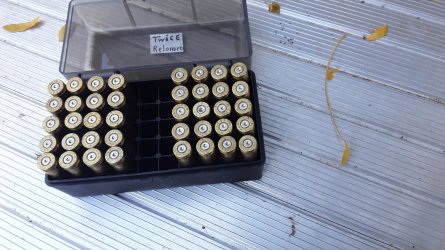
Also for the curious,

Column 10 was hornady loads w/ 25.1- 25.3 grains
Column 9 was 24.4-24.7
Column 7 was 24.6 & #8 was 24.7 grains

That leads me to think over/under pressure can be ruled out,
as well as the firing pin spring. Firing pin channel was nice and clean upon examination too.
 

Attachments

  • 20260930_170740.jpg
    20260930_170740.jpg
    504.9 KB · Views: 0
Back
Top