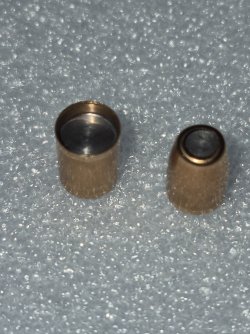
I got tired of supply chain issues about 15 years ago and started swaging my own bullets, so once I have sufficient quantities of powder, primers, and brass, I can make what I want when I want. I have recently acquired some dies for one of my favorites, the 32acp. As others have said, you can always handload to better ballistics, but especially with less popular calibers like the 32acp, factory offerings can be scant, especially in variety of point types and bullet weights.
The dies I bought were for RN and FN bullet types. Of course, when you swage you own, you can made any weight you want and several different bullet types with the same dies.
Traditional RN bullets (lead cores seated in jackets on the left, then next to it the finished bullet made with that core)
Round Nose Soft Point
Round Nose Open Tip
Round Nose HP
Flat Nose Open Tip
Flat Nose HP
Flat Nose Soft Point
Variations Possible:
1. Almost infinite weight variation accurate to < 1 grain.
2. Soft Points, you can vary the amount of lead above the jacket to vary feeding charateristics and terminal ballistics.
Very little xposed lead will function like a FMJ, a full ogive soft point will expand more than FMJ, and penetrate better than JHP.
3. Open Tips, you can vary the space below the leading edge of the jacket. If you make lead to the tip, it will penetrate like a FMJ, but has a sharp edge that "bites" into bone, rather than ricocheting off or skirting around bones (like skulls, sternums, etc) hit at oblique angles. You can leave a large space between the leading edge of the jacket the lead core in the bottom of jacket. Especially in relatively short pistol jackets, You can make super light bullets that still seat in the case and feed in the gun, but have high velocity for calibers, more explosive expansion and jacket separation on soft targets like snakes and varmints, and less over penetration on barriers, like sheetrock, and less ricochet risk on rocks or pavement.
4. Hollowpoints are the mid range, more expansion than soft points, more penetration than light open tips of similar weight. Lead above the jacket is also variable, so you can have a fully exposed lead ogive HP, or a jacket covered HP or anywhere in between
5. Although not pictured, you can make FMJ's by simply putting the point on the closed end of the jacketed lead core rather than the open end.
6. You can also put a SWC style point on a jacketed bullet that will punch a caliber sized entry hole in soft targets for quicker exsanguination.
7. You can also fill part or all of the jacket with #12 lead shot to make a fully frangible, or partially frangible bullet. You can also fill jackets with tungsten powder to make a normal length bullet that is super heavy. Although probably not useful for the 32acp, it can be useful for "hinge busting", no ricochet, rounds for entry work in larger calibers.
8. You can add one or multiple cannelures, bullet knurling, polymer tips, creased jackets (like XTP bullets) and in a world where cartridge jackets become unobtanium, you can swage down and trim fired cartridge brass to use as bullet jackets.
While the variety of bullets you can make are not infinite, they are voluminous.
I really like being less tied to supply chains in the increasngly uncertain times, but the real benefit to swaging is the ability to make ammo custom fit for you gun and end application that is simply not available anywhere at any price. You came make more consistent and more accurate bullets at home than a factory can, and many bullets by many custom ammo makers are made with the same presses and dies you can use at home. Many BR records have been, and still are, set with homemade bullets.