





 September 16th, 2019
 17:33 runtime
At Cowtown USA Range in Peoria, Arizona, I recently sat down with my friend and colleague Freddie Blish, owner and president of the Robar Company and an instructor at Gunsite, to talk about a topic most shooters prefer to avoid: malfunctions.
Or, more accurately, stoppages.
Because, as Freddie likes to say, “Jam is something I put on my toast.”
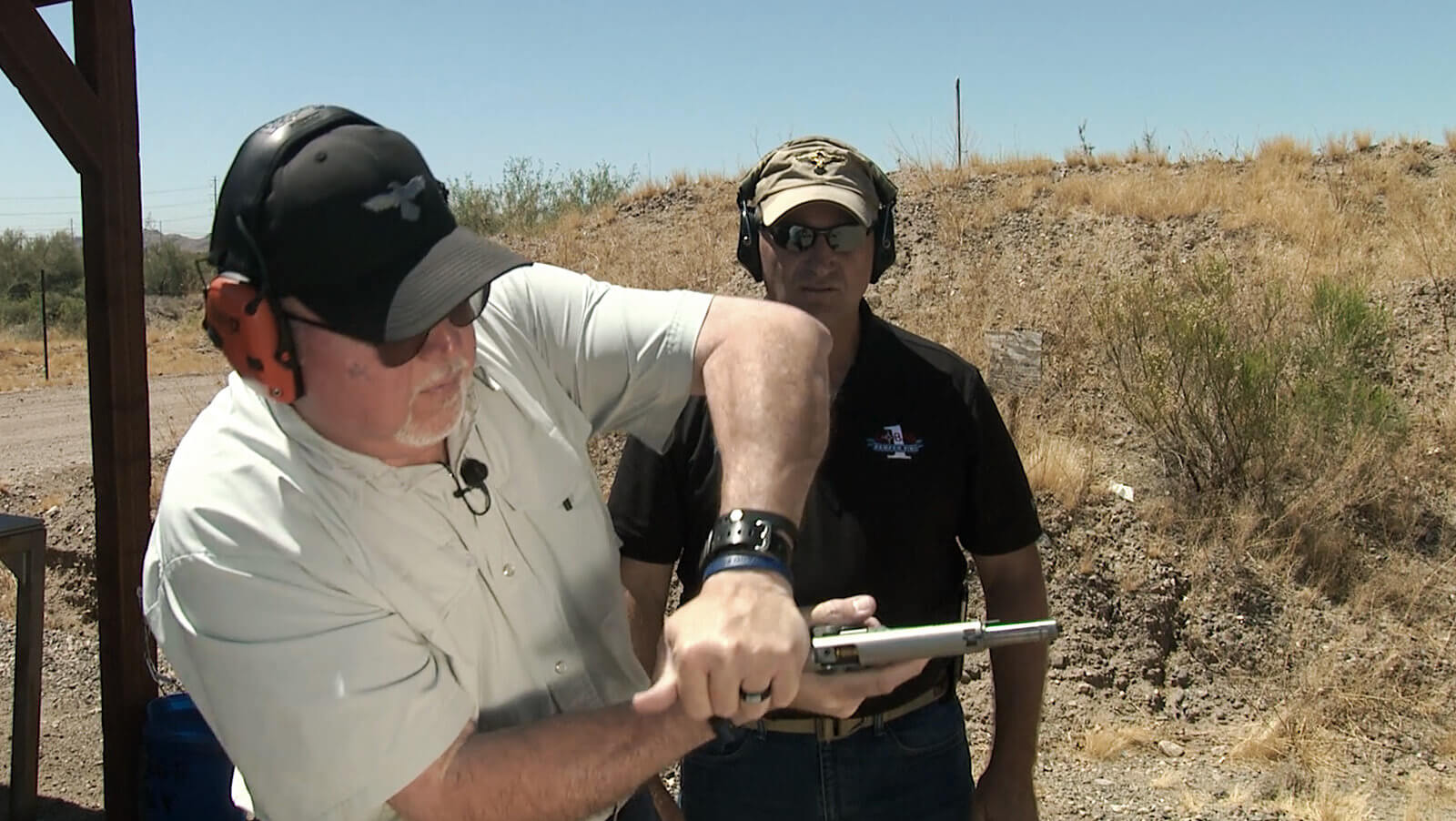
In the firearms world, words matter. A vague complaint like “my gun jams” does not explain what is actually happening. In military terminology, a stoppage is something the shooter can clear on their own, while a malfunction requires tools or armorer-level work. In the civilian training world, though, we often use malfunction as a catch-all, labeling them Type 1 through Type 4.
For today’s purposes, we will use that common terminology and focus on what really matters: remedial action. In other words, how to keep your pistol running when it does not do what you expect.
Type 1 Malfunction: Failure to Fire or Failure to Feed
This is the most common and the most dramatic: You press the trigger. The hammer or striker falls. Instead of a bang, you hear a click.
Freddie calls this the loudest sound in a gunfight.

A truly bad primer is rare with modern ammunition. Much more often, the problem is a failure to feed, meaning the round never fully entered the chamber. Common causes include:
- A magazine that is not fully seated
- An obstruction in the chamber
- Feed ramp issues
- Poorly executed administrative reloads
The Fix: Tap, Roll, Rack
The solution is fast and simple.
- Tap the magazine to ensure it is seated.
- Roll the pistol slightly so the ejection port faces down and let gravity help.
- Rack the slide forcefully.
- Get back on target and attempt to fire.
This single drill keeps you in the fight with minimal thought. Whether the cause was a bad feed or a light strike, this clears most Type 1 problems immediately.
Type 2 Malfunction: Failure to Eject or Stovepipe
A Type 2 occurs when the fired case does not fully exit the pistol. You might see a classic vertical stovepipe, a horizontal stovepipe, or a partially ejected case wedged between the slide and the barrel.
Years ago, some instructors taught swiping the brass off the slide with your hand. It works, but it also cuts skin and teaches a separate method for one specific problem.

Modern doctrine is better. Use one method that fixes them all.
The Fix: Tap, Roll, Rack
No matter the orientation of the stuck case, the solution is the same.
- Tap
- Roll
- Rack
Vertical, horizontal, or parallel to the barrel, the same technique clears them all.
Type 3 Malfunction: Failure to Extract
With pistols, a true double feed, meaning two live rounds competing for the same space, is rare. What usually happens is this:
- The fired case stays stuck in the chamber.
- The extractor slips off.
- A live round tries to feed behind it.

Now you have an empty case in front and a live round pushing from behind. In low light or high stress, you will not diagnose this by sight. You will diagnose it by feel. You try Tap, Roll, Rack and it does not work. That tells you that you are dealing with a Type 3.
The Fix: Lock, Strip, Rack, Reload
- Lock the slide to the rear to remove pressure.
- Strip the magazine out. Retain it under your arm if needed or discard it.
- Rack the slide three times to clear any stuck brass.
- Insert a fresh magazine.
- Tap, Roll, Rack again.
- Get back into the fight.
Why rack three times? Experience shows that one rack gives you only a moderate chance of success, two racks are much better, and the third is cheap insurance. It takes only a moment more and ensures the chamber is truly clear.
Type 4 Malfunction: Out of Battery
This one is subtle and often misunderstood.
The slide is almost in battery but not quite. Causes include slightly out-of-spec ammunition, a weak recoil spring, or a minor obstruction. The slide is just a fraction of an inch short of fully forward.

The Fix: Tap the Slide
Often, the solution is simple.
- Give the rear of the slide a firm tap forward.
If that does not solve it, do not keep forcing it. Go back to Tap, Roll, Rack. Forcing a stubborn slide can make the problem worse.
One System, Many Problems
What stands out in all four malfunctions is this.
- Tap, Roll, Rack solves the vast majority of stoppages.
- When it does not, you escalate to the Type 3 clearance.
Rather than memorizing four completely different techniques, you build one primary response and one backup procedure.
That is how you survive under stress.
Final Thoughts
Malfunctions are not a sign of poor equipment. They are a reality of mechanical systems under stress. What matters is not whether they happen, but how fast and automatically you fix them.
- Train these procedures with dummy rounds.
- Practice them until they are reflexive.
- Remember that the goal is always the same. Stay in the fight.
Stay safe. Stay sharp.
Join the Discussion
Featured in this video

Share


Continue Reading


Did you enjoy this video?

 75
75
Springfield Armory® recommends you seek qualified and competent training from a
certified instructor prior to handling any firearm and be sure to read your owner’s manual. These
articles and videos are considered to be suggestions and not recommendations from Springfield Armory. The views
and opinions expressed on this website are those of the authors and do not necessarily reflect the
views and opinions of Springfield Armory.
Product prices mentioned in articles and videos are current as of the date of publication.

Yamil Sued
Yamil is a graduate of the prestigious Brooks Institute of Photographic Arts and Sciences in Santa Barbara, CA with a Major in Illustration Photography and Color Technology with over 34 years of professional experience. Yamil started his professional relationship with the Shooting Industry in 1995 and has since worked with companies like Springfield Armory, S&W, Glock, FNH USA, Remington, Bushmaster, Bushnell, Leupold, Aimpoint, PWS, Vortex Optics, Cor-Bon Ammunition, ERGO Grips, AmeriGlo Sights, Krause Publications, Comp Tac Victory Gear, The Beta Company, IDPA, MGM Targets, Rainier Ballistics, Rock Castle Shooting Center, SIG Sauer and was a Staff Photographer for Cabela’s in Sidney, NE. Yamil is also a Writer and Photographer for Guns & Ammo, Guns & Ammo SIP's and Gun Digest.