





 July 31st, 2019
 3:54 runtime
I am always looking for ways to pressure test my shooting skills beyond the comfortable rhythms of a control pair or a failure drill. Recently, I had the opportunity to work through the non-standard response drill. This drill is not about elegance or textbook pacing. It is about urgency, decisiveness, and solving a violent problem as fast as humanly possible.

The non-standard response exists for situations where the threat is close, aggressive, and armed with something that can end your life quickly. Think edged weapons, blunt force tools, or an attacker closing distance with intent. In those moments, there is no time for a carefully measured cadence. The goal is immediate incapacitation through rapid, accurate fire to the center mass.
Why Non-Standard Responses Matter
Most of us train for standard responses because they are clean, repeatable, and easy to score on paper. Control pairs, hammer pairs, and failure drills all have their place. But real life does not always cooperate with range theory.

The non-standard response is designed for a threat that is not wearing body armor and is advancing rapidly. A head shot is off the table here, not because it lacks value, but because it is a difficult target under stress. When someone is charging you with a knife, the priority becomes dumping enough energy into center mass to shut the system down immediately.
This is where four to six rounds delivered quickly and accurately can make all the difference.
Getting on the Range
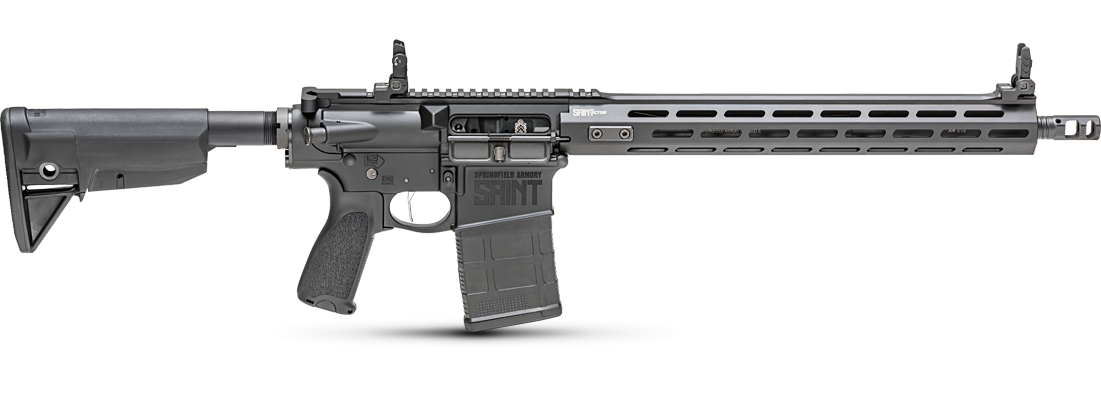
For this session, we were running the Springfield Armory SAINT Victor 308. This rifle brings recoil management and power into the same conversation, which makes it an excellent platform for learning this drill. If you can control a .308 Win (aka 7.62×51 mm NATO) under speed, everything else feels easier afterward.

The target was set at approximately ten yards. That distance is intentional. This drill is meant for close-range engagements where reaction time is measured in fractions of a second. You are not testing your optic at distance. You are testing your ability to fight with a rifle.
The foundation of the non-standard response is your stance. A balanced fighting stance is non-negotiable. Feet shoulder-width apart, knees slightly bent, and weight forward. I think of it as an athletic position, the same posture you would take if someone tried to shove you unexpectedly.
The rifle needs to be pulled aggressively into the shoulder. Not resting, not floating, but locked in. That tight shoulder weld is what allows you to control recoil and keep rounds in the center mass zone as the trigger cycles quickly.

When the rifle starts to feel loose, your shots start to walk. I saw this firsthand on my last round when the gun began to get away from me. That is valuable feedback, and it only shows up when you push speed.
Trigger Manipulation Under Speed
This drill immediately exposes harmful trigger habits. Slapping the trigger or losing reset will cause shots to scatter quickly. The goal is a smooth, continuous press that allows the rifle to recoil and return naturally.
I focus on riding the recoil instead of fighting it. The rifle lifts, settles, and I am already pressing again. There is no pause for confirmation. Your confirmation comes from repetition and trust in your fundamentals.
Four to six rounds should feel like one continuous action rather than individual shots.
Executing the Non-Standard Response
From the ready position, safety off, rifle tight to the shoulder, sights on center mass. Once the decision to fire is made, commit fully. Hesitation defeats the purpose of this drill.

I drove the rifle into my shoulder, pressed the trigger rapidly, and stayed visually locked on the target. The cadence was fast but controlled. The sound of the rifle cycling blended into a single aggressive burst.
When it was over, the hits told the story. Most rounds were solidly in the center mass, with one drifting toward the edge. That final shot was the reminder that discipline must remain until the very last round.
Learning From the Misses
The non-standard response is unforgiving, and that is why it is so valuable. Any loss of control shows up instantly. In my case, the last round crept out as my grip and shoulder pressure softened slightly.
That moment reinforced a key lesson. The drill does not end until the gun stops firing. You must stay aggressive through every round. Pull the rifle in, stay forward, and keep driving the sights.
Mistakes here are not failures. They are data.

This drill demands discipline. Because it involves rapid fire, it should only be practiced on ranges that allow it and with strict adherence to safety protocols. Start slow. Build your stance and recoil control before increasing speed.
Dry practice at home can help immensely. Work on stance, shoulder pressure, and trigger press without ammunition. Visualize the sequence and build consistency before going live.
When you do take it to the range, keep round counts low and focus on quality. Four to six rounds is enough to expose weaknesses without burning ammo or reinforcing bad habits.
Final Thoughts on Non-Standard Responses
The non-standard response drill is not about looking good on paper. It is about surviving an ugly, fast, violent encounter. It strips shooting down to its raw essentials and forces you to manage recoil, stress, and urgency all at once.
I walked away from this session with a deeper respect for how quickly things can unravel when fundamentals slip, and how powerful solid technique becomes when pressure is applied.
If you are serious about defensive rifle work, this drill deserves a place in your training rotation. It is uncomfortable, demanding, and honest. And those are exactly the kinds of drills that make us better when it matters most.
Join the Discussion
Featured in this video
Share


Continue Reading


Did you enjoy this video?

 16
16
Springfield Armory® recommends you seek qualified and competent training from a
certified instructor prior to handling any firearm and be sure to read your owner’s manual. These
articles and videos are considered to be suggestions and not recommendations from Springfield Armory. The views
and opinions expressed on this website are those of the authors and do not necessarily reflect the
views and opinions of Springfield Armory.
Product prices mentioned in articles and videos are current as of the date of publication.

Yamil Sued
Yamil is a graduate of the prestigious Brooks Institute of Photographic Arts and Sciences in Santa Barbara, CA with a Major in Illustration Photography and Color Technology with over 34 years of professional experience. Yamil started his professional relationship with the Shooting Industry in 1995 and has since worked with companies like Springfield Armory, S&W, Glock, FNH USA, Remington, Bushmaster, Bushnell, Leupold, Aimpoint, PWS, Vortex Optics, Cor-Bon Ammunition, ERGO Grips, AmeriGlo Sights, Krause Publications, Comp Tac Victory Gear, The Beta Company, IDPA, MGM Targets, Rainier Ballistics, Rock Castle Shooting Center, SIG Sauer and was a Staff Photographer for Cabela’s in Sidney, NE. Yamil is also a Writer and Photographer for Guns & Ammo, Guns & Ammo SIP's and Gun Digest.