




Submachine Guns of World War II
 May 19th, 2020
 13 minute read
World War II changed everything about life on planet earth. During this time, 56 million people lost their lives, and spinoff technology from war-related projects revolutionized everything from engineering, material science and electronics to transportation and food. Those terrible six years also saw quantum advances in small arms development — and just one part of this was a veritable explosion of submachine gun development.
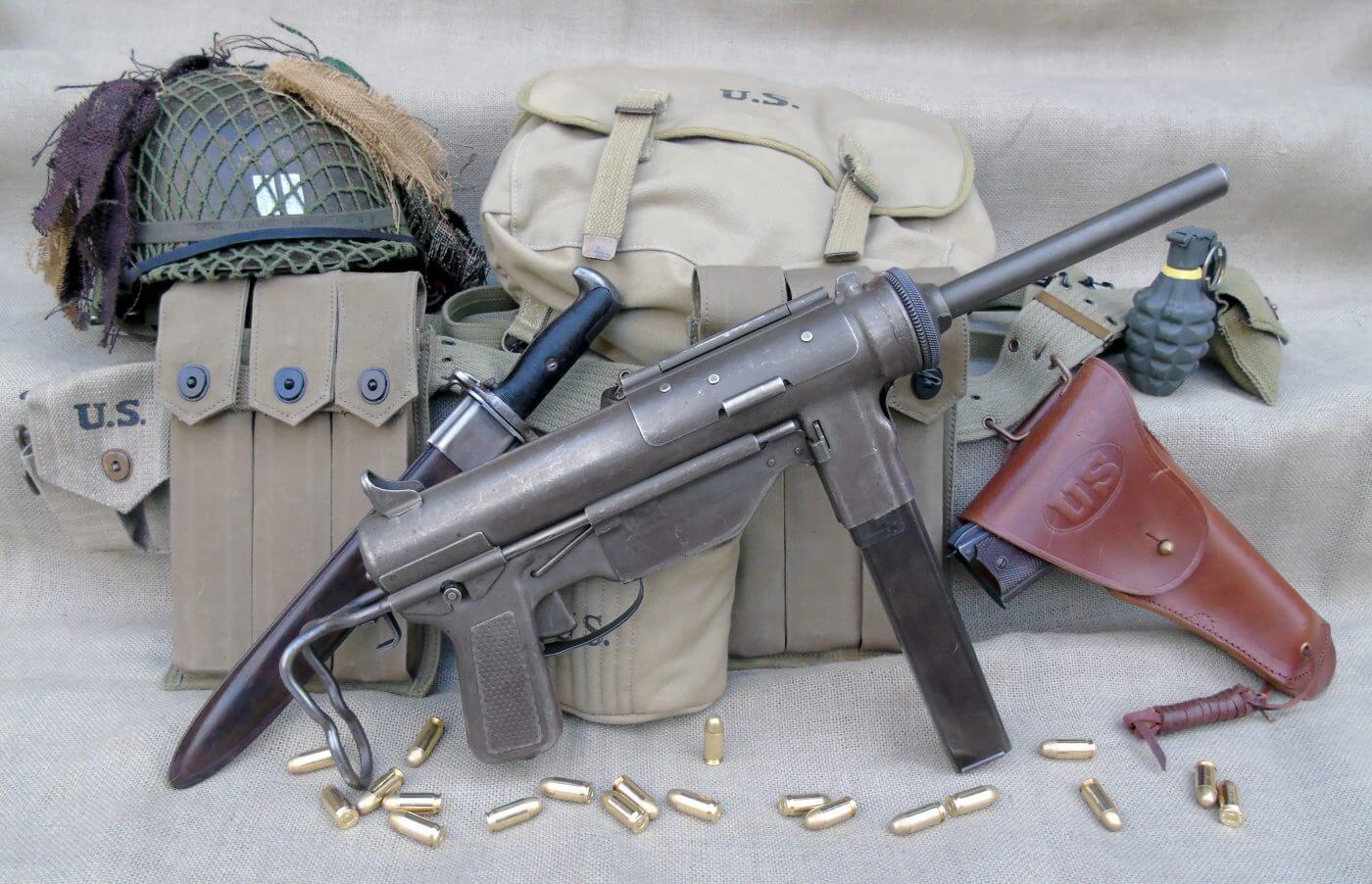
Submachine guns (SMG’s) are compact fully automatic shoulder arms that fire relatively low-powered pistol cartridges. In the days before widespread use of body armor, the SMG reigned supreme as the ultimate room-clearing tool and short-range weapon. Practically every major combatant nation of the war had them, and their influence remains evident even today.
Germany
German submachine guns of World War II, commonly designated as Maschinenpistolen, played a pivotal role in the Wehrmacht’s evolving small-arms doctrine for close-quarters combat. Weapons such as the MP 38 and MP 40 became iconic for mechanized infantry, armored crews, and paratroopers, emphasizing mobility, high rates of fire, and effectiveness in urban warfare.
Chambered primarily in 9×19mm Parabellum, these submachine guns featured simple blowback operation, increasing reliability and ease of mass production under wartime conditions. Their use of stamped steel components, ergonomic layouts, and controlled automatic fire influenced both battlefield tactics and the postwar development of modern submachine gun design.
MP 34
The MP 34 was a precision-manufactured submachine gun of Austrian origin, derived from the Steyr-Solothurn S1-100 and adopted by Germany in limited numbers during the early Second World War. Chambered primarily in 9×19mm Parabellum for German service, it was known for exceptional build quality, extensive milling, and tight tolerances. This level of craftsmanship made it reliable and accurate but also costly and time-consuming to produce.

In German use, the MP 34 was issued mainly to the Waffen-SS, Ordnungspolizei, and rear-echelon or security units rather than standard Wehrmacht infantry formations. It featured a wooden stock, a left-side mounted box magazine, and a controllable cyclic rate that aided sustained automatic fire. The weapon’s balance and smooth operation made it effective in close-quarters combat, urban fighting, and internal security roles.
Despite its strengths, the MP 34 was quickly overshadowed by more economical designs such as the MP 38 and MP 40. Stamped construction, simplified components, and faster mass production made later German submachine guns better suited to total war demands. As a result, the MP 34 remained a high-quality but transitional SMG, reflecting prewar design philosophy rather than wartime industrial efficiency.
Bergmann MP 35
The Bergmann MP 35 was a German submachine gun that originated in the interwar period and remained in limited service during World War II. It fired the 9×19mm Parabellum cartridge and operated via a simple blowback system with an open-bolt design. Unlike most contemporaries, it retained a wooden stock and conventional rifle-style ergonomics, reflecting its transitional design philosophy.
One of the MP 35’s most distinctive features was its side-mounted magazine well on the right, feeding ammunition from left to right. The charging handle was located at the rear of the receiver and functioned similarly to a bolt-action rifle, setting it apart from later SMG layouts. These unconventional controls made the weapon accurate and controllable but slower to reload compared to the MP 38 and MP 40.
During WWII, the MP 35 saw use primarily with the Waffen-SS, police units, and second-line formations rather than frontline Wehrmacht troops. Production was relatively limited due to higher manufacturing costs and the weapon’s reliance on machined components. As mass-produced stamped submachine guns became dominant, the MP 35 was gradually phased out despite its solid construction and reliable performance.
MP 40
While the Germans suffered from a deplorable lack of standardization during World War II, the most common German SMG of the war was the iconic 9mm MP 40.
The MP 40 was an evolutionary development of the previous MP 38. Where the MP 38 was crafted around an extruded steel tube machined with flutes for decreased weight and increased strength, the MP40 used an inexpensive stamped steel receiver. Both guns look very similar. The MP 38 can be identified at a glance by its longitudinal receiver grooves and a dime-sized hole in the magazine well.
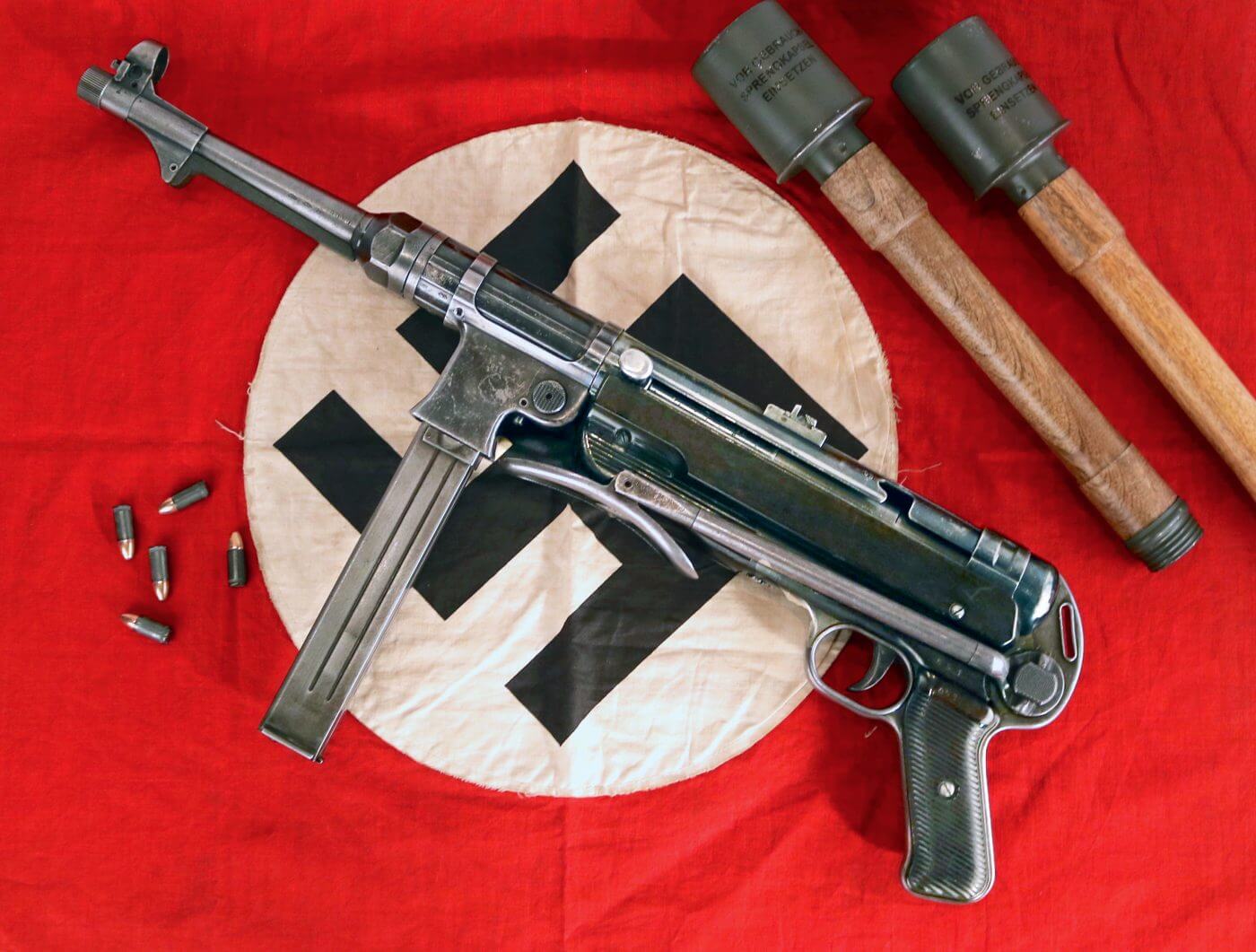
The full auto-only 9mm MP 40 was the first major military weapon to eschew wooden stocks. The furniture on the German gun was formed from synthetic Bakelite, and the rest of the weapon was optimized for mass production.
The MP 40 enjoyed a sedate 500 rpm rate of fire and was remarkably front heavy. This feature combined with its nine-pound weight and modest 9mm chambering made the gun exceptionally controllable. About 1.1 million copies were produced between 1940 and 1944 before it was supplanted by the 7.92mm MP 44 assault rifle (also known as the StG 44).
Britain
During the Second World War, the United Kingdom adopted submachine guns as essential infantry firearms for close-quarters combat, rapid assault, and urban warfare. Facing invasion threats and equipment shortages after Dunkirk, British forces prioritized compact automatic weapons such as the STEN, Lanchester, and the American Thompson to rapidly rearm the army, commandos, and Home Guard.
British submachine guns emphasized simplicity, mass production, and the widespread 9×19mm Parabellum cartridge, reflecting urgent wartime manufacturing demands. Though often criticized for crude construction and variable reliability, these automatic weapons proved decisive in airborne operations, raids, and mechanized infantry tactics, shaping British small-arms doctrine throughout the conflict.
Sten Gun
After Dunkirk, the United Kingdom found itself with an army essentially intact but bereft of weapons. With the Germans poised to strike across the channel, the British desperately needed an inexpensive combat firearm that could be produced en masse using rudimentary equipment. Reginald Shepherd and Harold Turpin working at Enfield ultimately developed a truly revolutionary subgun — the Sten, named for the “S” and “T” of their names combined with the “en” of Enfield.
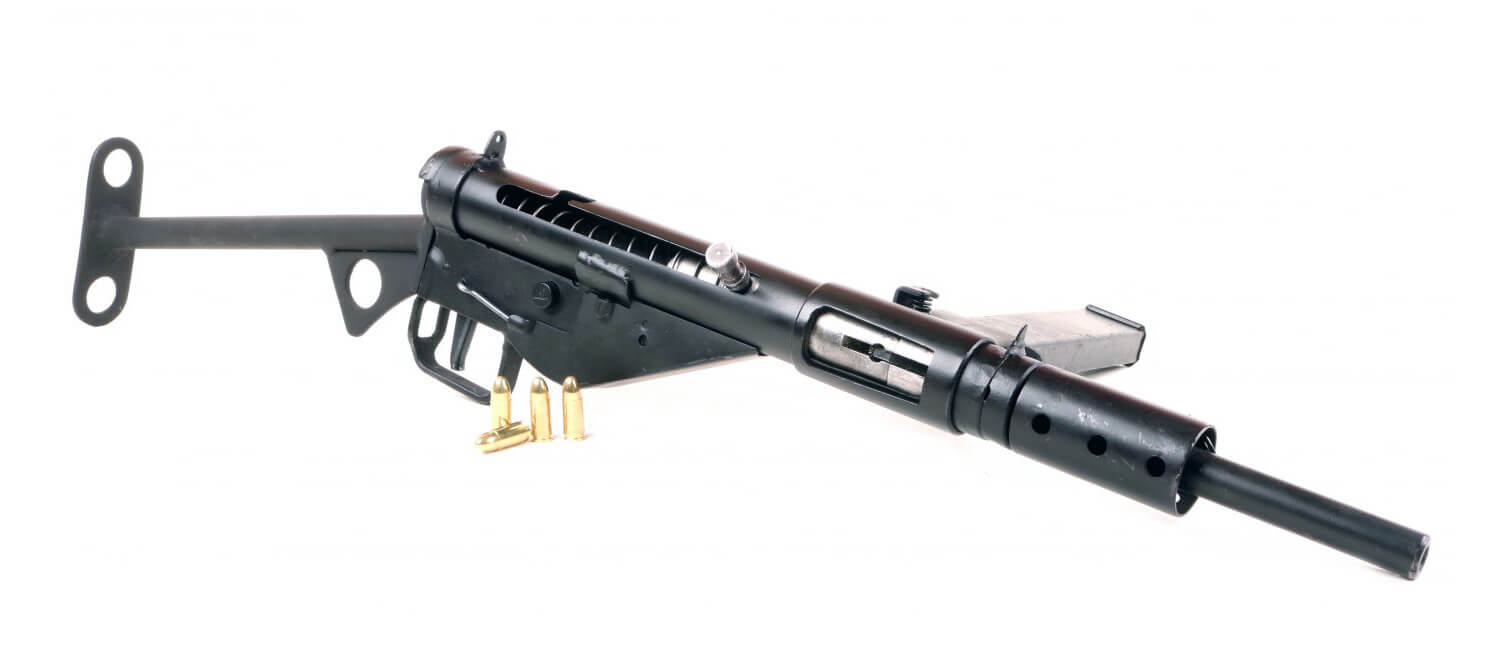
The selective-fire 9mm Sten in its simplest form consisted of a mere 47 parts and cost $9 to produce. That’s about $126 today. This pressed steel subgun cycles at around 500 rpm and feeds from a side-mounted double-stack, single-feed pressed steel 32-round magazine. The Sten breaks down easily into tidy components suitable for concealment and was widely distributed to underground forces in occupied Europe as a result.
The Sten gun was derided as the “Stench Gun” or “Plumber’s Nightmare” by its many detractors. The action was generally reliable, though the magazine fared poorly, particularly in dirty, sandy environments. The side-mounted magazine made operations from the prone convenient, something that doesn’t mean a great deal unless you’ve ever actually ducked incoming fire. The gun weighed a bit north of 7 pounds, and around 4.5 million copies were produced.
Lanchester SMG
The Lanchester submachine gun was a British 9×19mm Parabellum weapon adopted in 1941, heavily influenced by the German MP 28 design. It operated via simple blowback with selective fire, feeding from a 32-round double-column box magazine. Precision machining, a wooden stock, and robust steel construction made it notably heavier than later British SMGs.

Primarily issued to the Royal Navy and some RAF units, the Lanchester was intended for shipboard defense, boarding actions, and guard duties. Features such as a bayonet lug compatible with the Pattern 1907 bayonet and solid iron sights reflected its naval and close-quarters role. Its weight reduced portability but contributed to controllability and sustained fire accuracy.
Although reliable and durable, the Lanchester was expensive and slow to manufacture compared to wartime expedients. It was gradually supplanted by the Sten gun, which prioritized mass production and simplicity over refinement. Nonetheless, the Lanchester remains a significant step in British submachine gun evolution and influenced later postwar designs.
Soviet Union
More so than any other major combatant, the Russians faced an existential threat from the Nazis. Operation Barbarossa, the largest military invasion in human history, saw some three million Axis troops invade the Soviet Union in the summer of 1941 over an 1,800-mile front. With its national survival on the line, the Russians churned out submachine guns like their very lives depended upon it.
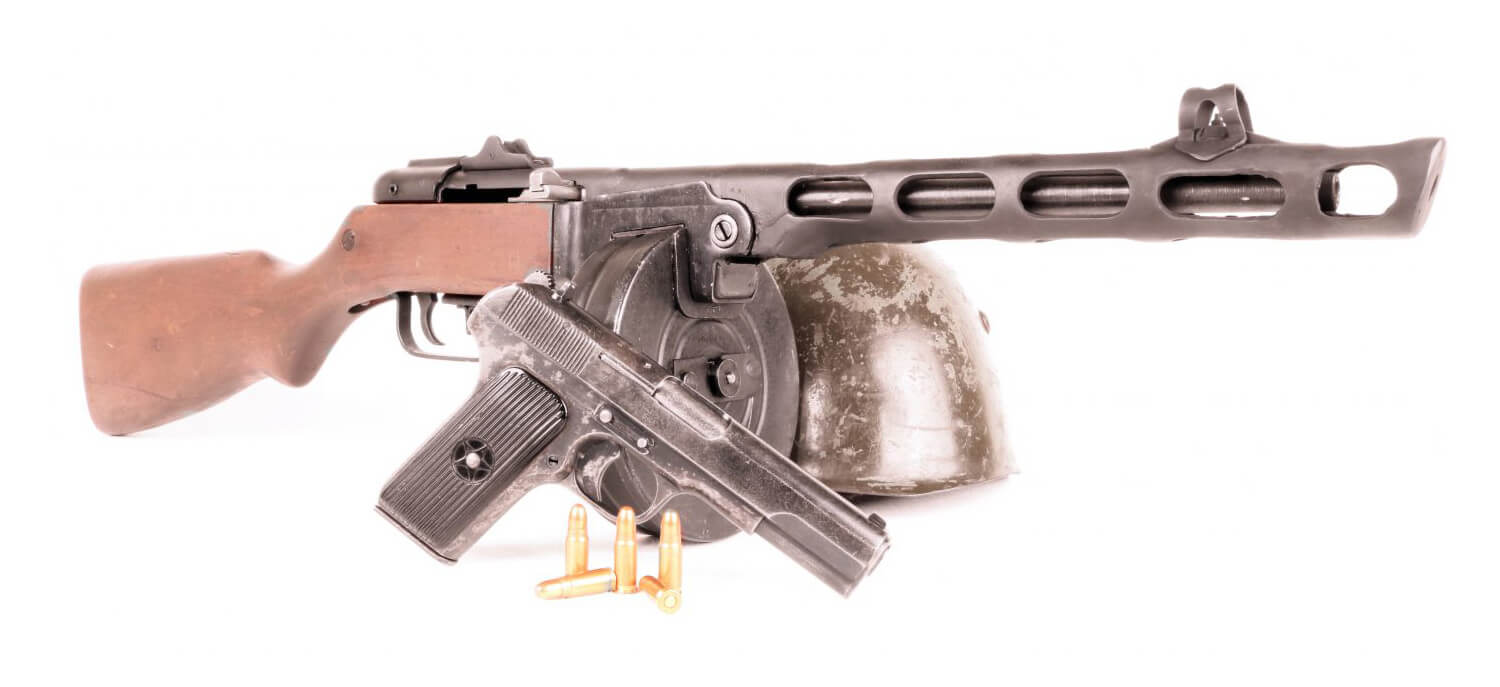
Though the Soviets ultimately used several SMGs, it was the PPSh-41 SMG that became a national icon. Designed by Russian small arms designer Georgy Shpagin, this 7.62x25mm bullet hose was called the “papasha” by those who used it. This loosely translates as “Daddy.”
The selective-fire PPSh-41 orbited around a simple pressed steel receiver and one-piece wooden buttstock. The gun fed from either a curved 35-round stick magazine or a 71-round drum. The Soviets eventually equipped entire battalions with this fast-firing weapon. With a cyclic rate of around 900 rpm, the PPSh was a fearsome close-quarters tool.
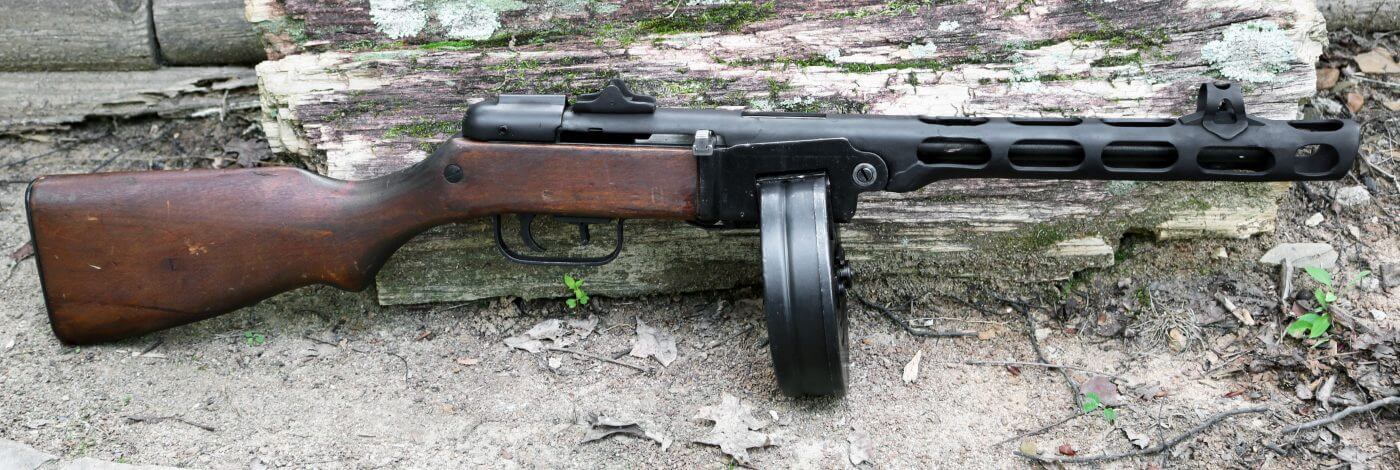
The Soviets produced around six million copies, and the gun remained in service in some of your less well-funded war zones well into the 1970s. The PPSh is awkward to carry and, in my opinion, unpleasant to shoot. I find the rate of fire to be a bit fast for my tastes, and the gun is notorious for ejecting straight up and dropping empties on top of your head.
United States
The United States entered World War II with whatever it had handy. As regards submachine guns, that meant the .45 ACP M1928A1 Thompson. Heavy, cumbersome, and expensive, the Thompson was obsolete before the first bomb fell at Pearl Harbor.
The M1928A1 was nearly identical to the M1921 John Dillinger used to terrorize the countryside during Prohibition. Built around a heavy milled receiver, the M1928A1 cost $209 in 1939. That’s about $2,900 today. The gun took 50-round L-drums as well as 20 or 30-round double-stack, double-feed stick magazines.

Live The Armory Life. The latest content straight to your inbox plus an automatic entry to each of our monthly gun giveaways!
In 1942 the M1928A1 was extensively redesigned to make it cheaper to manufacture. The new design binned the Cutts compensator, finned barrel, controversial Blish lock, and internal felt oiler. It also moved the actuator from the top to the side. This is the easiest way to tell the two guns apart at a glance. By 1945 the price of a Thompson had dropped to $45, or $630 in today’s money.
The .45ACP selective-fire Thompson is ergonomically wretched and sinfully heavy. The line of recoil is substantially above the buttstock, and the gun is severely back heavy. However, at 10 pounds empty the gun remains controllable with proper technique. The M1928 runs at around 600 rpm, while the later M1A1 cycles closer to 800. We produced about 1.5 million Thompsons of all varieties.
M3A1 Grease Gun
The same practical exigencies that drove the British to produce the Sten also spawned the American M3 “Grease Gun.” A rugged, cheap, pressed-steel design, the full auto-only .45 ACP M3 fed from a double-stack, single-feed 30-round magazine and cycled at a sedate 450 rpm. The Grease Gun moniker arose from the weapon’s similarity to that ubiquitous mechanic’s tool. The M3 cost $15, or around $225 today.
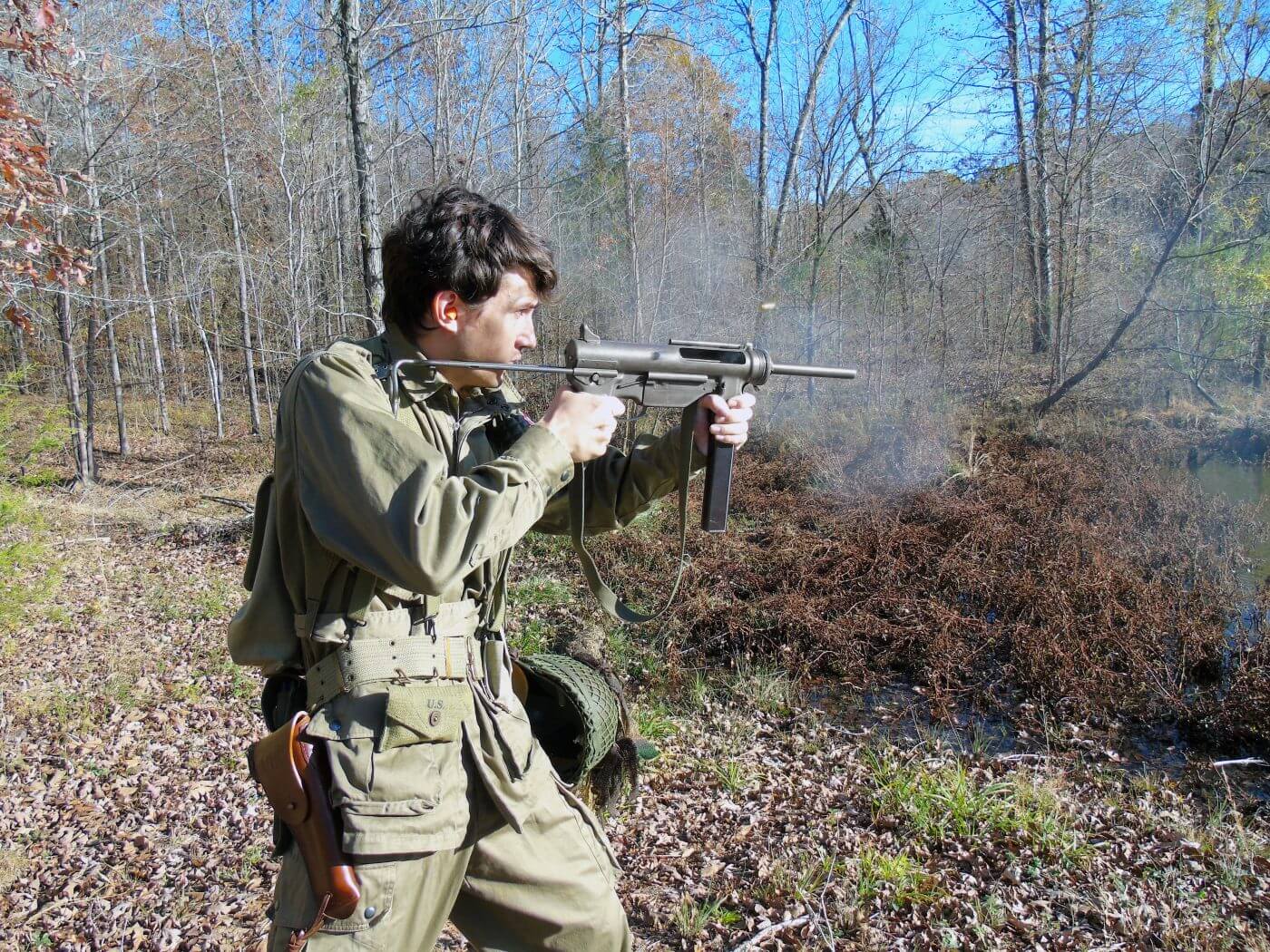
The first combat use of the M3 in Europe was during the Normandy invasion. The M3 included a flimsy ratcheting cocking device that was prone to break under hard use. The Army did not stock spare parts for the Greaser, preferring to simply discard broken weapons and replace them. The subsequent simplified M3A1 saw limited service at the very end of the war. This gun did away with the ratcheting charging mechanism in favor of a simple divot in the bolt to accept a standard human finger.
The Grease Gun’s grip is uncomfortably large, but it is a nonetheless effective close-range weapon. The gun carries well and will continue to function despite the most egregious abuse. The M3A1 Grease Gun remained in service with U.S. Army tank crews well into the 1990s.
Japan
Unique tactical doctrine, industrial limitations, and the operational demands of the Pacific Theater shaped Japan’s experience with submachine guns during World War II. Unlike many Western armies, the Imperial Japanese Army placed less emphasis on automatic pistol-caliber weapons, resulting in limited development and deployment of submachine guns.
The primary Japanese submachine gun of the era, the Type 100, chambered in 8mm Nambu, saw restricted production and frontline use compared to contemporaries like the MP40 or Thompson. As a result, Japanese submachine guns played a minor but noteworthy role in close-quarters combat, reflecting Japan’s evolving infantry requirements amid the broader context of WWII small-arms development.
Type 100 Submachine Gun
Developed for the Imperial Japanese Army, the Type 100 submachine gun was Japan’s primary SMG of World War II, formally adopted in 1940. Despite the growing importance of close-quarters automatic weapons, production remained limited, making the Type 100 far less common than Allied or German counterparts. As a result, Japanese infantry units continued to rely heavily on bolt-action rifles throughout the Pacific War.

Chambered in 8×22mm Nambu, the Type 100 operated via a simple blowback action and fed from a 30-round detachable box magazine. Early models featured a wooden stock and even a bayonet lug, reflecting traditional Japanese infantry doctrine rather than modern SMG tactics. The weapon offered controllable automatic fire but suffered from modest stopping power and sensitivity to dirt and humidity.
Two main variants were fielded: the early Type 100/40 and the later simplified Type 100/44, the latter reflecting wartime material shortages. Compared to weapons like the MP40 or Thompson, the Type 100 had minimal tactical influence due to scarcity and conservative deployment. Today, it remains a notable example of Japan’s limited but evolving approach to submachine gun design during World War II.
Australia
During World War II, the Australian Army embraced the submachine gun as a critical infantry weapon for close-quarters combat across the Pacific theater. Facing dense jungle warfare, amphibious operations, and urban fighting, Australia prioritized compact automatic firearms that delivered high rates of fire, controllability, and rugged reliability.
Australian service featured a mix of domestic designs and Allied imports, most notably the Owen Gun and Austen submachine gun alongside the American Thompson. Chambered primarily in 9×19mm Parabellum and .45 ACP, these weapons emphasized reliability, ease of manufacture, and battlefield durability, shaping Commonwealth small-arms doctrine and frontline tactics.
Owen Gun
The Owen Gun submachine gun was an Australian-designed, blowback-operated SMG that entered service in 1942, chambered initially in .45 ACP and later standardized to 9×19mm Parabellum. It fired from an open bolt and fed from a distinctive top-mounted box magazine, which aided reliability by keeping debris out of the action. Domestic production was carried out in Australia, supporting wartime self-sufficiency.

Renowned for extreme ruggedness, the Owen SMG performed exceptionally well in tropical and jungle warfare, particularly in the Southwest Pacific Area. Its sealed receiver, generous tolerances, and simple mechanical layout allowed it to function reliably in mud, sand, and heavy rain. Although heavier than many contemporary submachine guns, its balance and controllability made it effective in close-quarters combat.
The Owen Gun was widely issued to Australian infantry, commandos, and armored units during World War II and saw extensive combat against Japanese forces. Its distinctive silhouette, offset iron sights, and high rate of fire set it apart from European SMGs like the Sten and MP 40. Continued postwar service in Korea and Vietnam further cemented its reputation as one of the most reliable WWII-era submachine guns.
Finland
During World War II, Finland emerged as a pivotal innovator in submachine gun employment, shaped by the Winter War and the Continuation War against the Soviet Union. Finnish doctrine emphasized compact automatic weapons for close-quarters combat in forests, snowbound terrain, and fortified defensive zones, redefining infantry firepower.
Iconic models such as the Suomi KP/-31 combined a high rate of fire, large-capacity magazines, and exceptional reliability, influencing battlefield tactics from ambush warfare to mobile defense. These Finnish submachine guns left a lasting imprint on small-arms development, manufacturing philosophy, and tactical integration across the Eastern Front.
Suomi KP/-31 SMG
The Suomi KP/-31 was a Finnish-designed submachine gun chambered in 9×19mm Parabellum, notable for its exceptional accuracy and robust milled-steel construction. It fired from an open bolt with a high cyclic rate, often approaching 900 rounds per minute, giving it strong close-quarters lethality. The weapon proved especially effective in forested terrain and subzero conditions during the Winter War and Continuation War.

Magazine options included 20- and 36-round box magazines as well as the iconic 40- and 71-round drum magazines, the latter offering sustained automatic fire unmatched by most contemporaries. Its long barrel and quality manufacturing contributed to superior controllability and effective range compared to many WWII-era SMGs. These traits made it well suited for ski troops, ambush tactics, and short-range fire superiority.
Despite its battlefield performance, the Suomi KP/-31 was heavy, expensive, and slow to manufacture due to extensive machining. These drawbacks limited large-scale production and prompted Finland to seek simpler alternatives later in the war. Nevertheless, its design directly influenced other submachine guns, most notably the Soviet PPSh-41, cementing its legacy in World War II small-arms development.
Italy
During World War II, Italy fielded a distinctive lineup of submachine guns that reflected the Regio Esercito’s emphasis on controllable automatic fire for close-quarters combat. Italian designers blended prewar innovation with wartime pragmatism, producing reliable pistol-caliber weapons optimized for urban fighting, mechanized units, and elite formations.
Iconic models such as the Beretta M38 series earned a reputation for accuracy, robust machining, and effective use of the 9×19mm Parabellum cartridge across multiple theaters. Together, these Italian SMGs illustrate how doctrine, industrial capacity, and battlefield conditions shaped the evolution of compact automatic arms within the broader context of WWII infantry weapons.
Beretta Model 38
The Beretta Model 38 was a precision-oriented submachine gun chambered in 9×19mm Parabellum, operating via simple blowback from an open bolt. It featured a solid wooden stock, long barrel, and a distinctive dual-trigger system that separated semi-automatic and full-automatic fire. Feed was typically from 20- or 40-round detachable box magazines, contributing to its controllability and sustained fire capability.

Renowned for its exceptional accuracy and smooth recoil impulse, the Model 38 delivered a moderate cyclic rate that enhanced hit probability in short bursts. Its effective range surpassed many contemporary SMGs, making it well-suited for both urban combat and defensive roles. Italian troops valued its reliability, while German forces later adopted it under their own designation due to its battlefield performance.
Multiple wartime variants, including the M38A and simplified M38/42 series, reflected efforts to streamline production without sacrificing lethality. The weapon saw extensive service with Italian regulars, paratroopers, and fascist units, as well as widespread use by the Wehrmacht. As a World War II submachine gun, the Beretta Model 38 stands out for combining robust craftsmanship with tactical versatility.
Special thanks to www.worldwarsupply.com for the cool replica gear used in our photographs.
Editor’s Note: Be sure to check out The Armory Life Forum, where you can comment about our daily articles, as well as just talk guns and gear. Click the “Go To Forum Thread” link below to jump in!
Join the Discussion
Share


Continue Reading

Did you enjoy this article?

 425
425
Springfield Armory® recommends you seek qualified and competent training from a
certified instructor prior to handling any firearm and be sure to read your owner’s manual. These
articles and videos are considered to be suggestions and not recommendations from Springfield Armory. The views
and opinions expressed on this website are those of the authors and do not necessarily reflect the
views and opinions of Springfield Armory.
Product prices mentioned in articles and videos are current as of the date of publication.

Will Dabbs, MD
Will was raised in the Mississippi Delta and has a degree in Mechanical Engineering. After eight years flying Army helicopters, he left the military as a Major to attend medical school. Will operates an Urgent Care clinic in his small Southern town and works as the plant physician for the local Winchester ammunition plant. He is married to his high school sweetheart, has three adult children, and has written for the gun press for a quarter century.