





 June 27th, 2019
 3:15 runtime
I don’t throw around the phrase “game changer” lightly—especially in the firearms space where every new accessory claims to reinvent the wheel. Most of the time, it’s just incremental improvement wrapped in marketing language.
But every now and then, something comes along that solves a real, persistent problem in a way that makes you stop and think, why hasn’t this been done before?
That’s exactly where I landed with this Maxim Defense M-Rax review.

If you’ve spent any time running M-LOK accessories—whether mounting a bipod, rail section, or light—you already know the frustration. It’s not that M-LOK is weak or poorly designed. In fact, it’s solid. But installing accessories can be tedious, especially when you’re working on a fully assembled rifle or don’t want to pull the handguard.
The M-Rax system from Maxim Defense addresses that issue directly. After running it myself, I can tell you—it’s not just convenient. It’s genuinely better.
Quick Summary
Strengths:
- Extremely fast M-LOK installation (seconds, not minutes)
- No need to access the backside of the handguard
- Solid lock-up with zero play under load
- Durable aluminum construction
- Thoughtful engineering that solves a real user problem
Limitations:
- Slightly higher cost than basic rail sections
- Limited to users already invested in M-LOK platforms
- Not a necessity for every setup (but very useful for frequent changes)
Verdict:
If you regularly mount or reposition accessories on M-LOK handguards, the M-Rax is one of the most practical upgrades you can make. It’s simple, effective, and worth the price.
What the Maxim Defense M-Rax Is
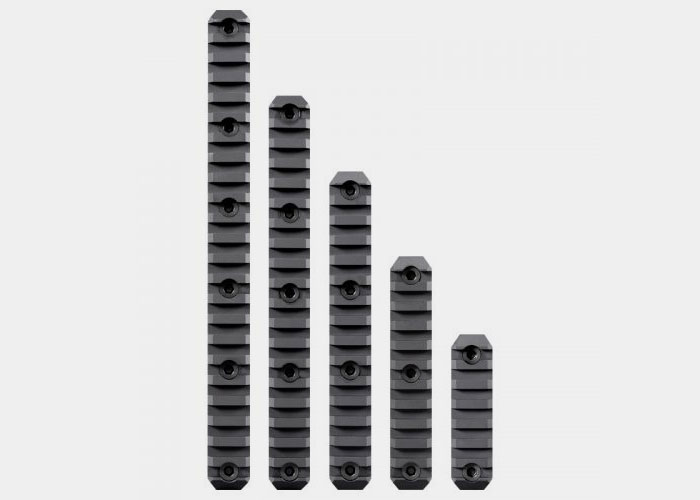
At its core, the Maxim Defense M-Rax is an M-LOK-compatible rail section—but that description doesn’t really capture what makes it different.

This isn’t just another aluminum rail segment like the ones you’ve seen from Magpul or other manufacturers. It’s a re-engineered mounting system designed to eliminate the most annoying part of M-LOK: aligning and tightening T-nuts from behind the rail.
Instead of the traditional rotating T-nut system that requires precise positioning and often some finger gymnastics inside the handguard, the M-Rax uses a spring-loaded engagement mechanism that locks into place from the outside.
In practical terms, that means:
- No fishing around inside your handguard
- No magnets, dental picks, or improvised tools
- No partial disassembly just to mount a bipod
It’s a small change in concept—but a big change in usability.
Key Features and Components
Here’s what stands out when you look at the M-Rax design:
Core Features
- Push-to-lock mounting system
- Tool-assisted engagement using hex key
- Precision-machined aluminum construction
- Full M-LOK compatibility
- Multiple slot lengths available
- Anti-rotation design for stability under load
Feature Breakdown
| Feature | Benefit |
|---|---|
| Spring-loaded locking mechanism | Eliminates need to access inside of handguard |
| One-sided installation | Faster mounting, especially in the field |
| Aluminum construction | More durable than polymer alternatives |
| Wide clamping surface | Improves stability under recoil or pressure |
| Simplified alignment | Reduces installation errors |
One thing I noticed right away is how robust the hardware feels. The hex interface is larger and more substantial than what you typically see on budget rail sections, which gives you better torque control.
How It Works / How I Use It
The real value of the M-Rax shows up the first time you install it.
Traditional M-LOK Experience
If you’ve done this before, you know the drill:
- Insert the T-nuts into the slot
- Try to align them correctly
- Reach inside the handguard (if possible)
- Hold the nut in place while tightening
- Realize it rotated wrong
- Start over

That’s fine on a bench. It’s frustrating anywhere else. For more information, be sure to check out our article that covers M-Lok vs. Picatinny.
M-Rax Installation Process
Here’s how the M-Rax changes that:
- Position the rail section where you want it
- Insert your hex key into the mounting screw
- Press inward to engage the locking mechanism
- Turn to secure
- Tighten down
That’s it.
No internal access. No guesswork. No fiddling.
The entire process takes about 30 seconds, even on a fully assembled rifle.
Real-World Example
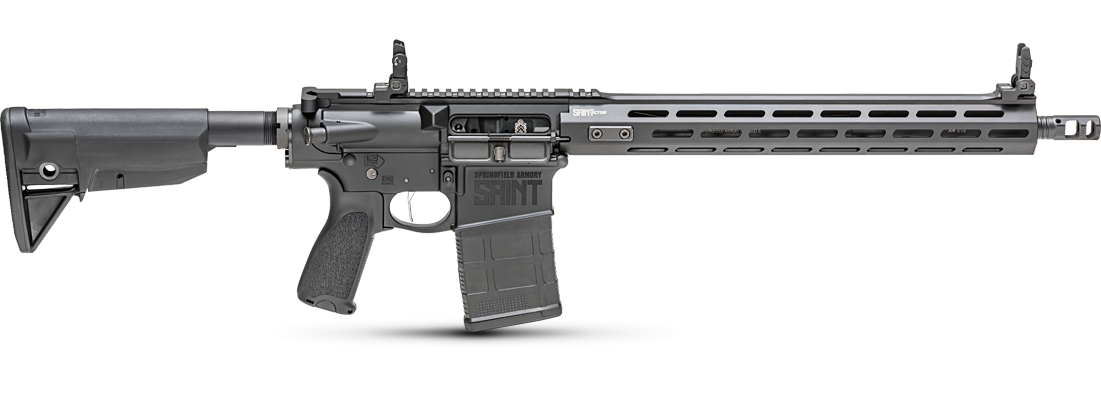
I mounted mine on a .308 platform for bipod use—exactly the kind of setup where stability matters.
Once installed:
- No wiggle
- No shift under forward pressure
- No loosening after repeated use
That’s critical if you’re using a bipod for accuracy testing or prone shooting. Any movement at the mounting point translates directly into inconsistency downrange.

Practical Use Cases
This is where the M-Rax really earns its place.
1. Precision Rifle Setup
If you’re running:
- A scoped AR-10
- A DMR-style AR-15
- A bolt gun with M-LOK handguard
You’re likely using a bipod.
The M-Rax makes it easy to:
- Install quickly
- Reposition for balance
- Remove without hassle
2. Frequent Configuration Changes
If you rotate between:
- Range setups
- Home defense configurations
- Training builds
You’ll appreciate how fast this system is.
Instead of committing to one setup, you can adapt your rifle without frustration.
3. Field Adjustments
Let’s be honest—most people aren’t mounting accessories in the field.
But if you ever need to:
- Adjust placement
- Swap accessories
- Fix a loose mount

The M-Rax makes that realistic without a full teardown.
4. Testing and Evaluation
For those of us who run multiple accessories across different platforms, this is where it shines.
I’ve used it when:
- Testing bipods
- Comparing accessories
- Swapping setups between rifles
It saves time—and more importantly, reduces annoyance.
Pros and Cons
Pros
- Fast installation – dramatically quicker than traditional M-LOK
- No internal access required – huge advantage on fixed handguards
- Solid lock-up – holds under pressure and recoil
- Durable materials – better longevity than polymer rails
- User-friendly design – intuitive even if you’ve never used it before
Cons
- Price point (~$37–$40) – higher than basic rail sections
- Not essential for static setups – if you never change anything, you may not need it
- Limited awareness – still relatively unknown compared to bigger brands
Comparison to Alternatives
Standard M-LOK Rail Sections (Magpul, BCM, etc.)
Pros:
- Affordable
- Widely available
- Proven design
Cons:
- Slower installation
- Requires backside access
- More prone to user error during mounting
Bottom line:
They work—but they’re not convenient.
Polymer Rail Sections
Pros:
- Lightweight
- Inexpensive
Cons:
- Less durable
- Can flex under load
- Not ideal for bipods or heavy accessories
Bottom line:
Fine for lights or grips—not ideal for precision applications.
Maxim Defense M-Rax
Pros:
- Fastest installation on the market (in my experience)
- Strong and stable
- Thoughtful engineering
Cons:
- Slightly higher cost
Bottom line:
You’re paying for usability—and it delivers.
Who This Is Best For
The M-Rax isn’t for everyone—but it’s extremely valuable for the right user.
Ideal Users
- Precision shooters running bipods on M-LOK platforms
- Gun owners who frequently reconfigure setups
- Professionals or enthusiasts who value efficiency
- Anyone tired of fighting M-LOK hardware
Less Ideal For
- Set-it-and-forget-it rifle owners
- Budget-focused buyers who rarely change accessories
- Users not running M-LOK systems
Final Verdict
After spending time with it, I can say this without hesitation:
The Maxim Defense M-Rax solves a real, everyday problem in a way that’s simple, effective, and well-executed.
It doesn’t try to reinvent the entire M-LOK system—it just fixes the part that frustrates people the most.
And that’s exactly why it works.
For around $40, you’re not just buying a rail section—you’re buying time, convenience, and a more streamlined experience every time you touch your rifle.
If you’ve ever spent 10 minutes trying to get a T-nut to seat correctly, you’ll understand the value immediately.
I don’t call many things “must-have” accessories. This isn’t mandatory—but it’s one of those upgrades that, once you use it, you won’t want to go back.
Join the Discussion
Featured in this video
Share


Continue Reading


Did you enjoy this video?

 14
14
Springfield Armory® recommends you seek qualified and competent training from a certified instructor prior to handling any firearm, and to be sure to read your owner's manual. The views and opinions expressed on this website are those of the authors and do not represent the views and opinions of Springfield Armory.
Product prices mentioned in articles and videos are current as of the date of publication.

Clay Martin
Clay Martin is a former USMC Infantryman, Reconnaissance Marine, and Scout/Sniper. Cross decking to the US Army in 2003, he retired as a Special Forces Intelligence Sergeant from 3rd SFG (A). Clay has been a competitive shooter in USPSA, 3 Gun, and PRS disciplines, as well as a contract instructor for marksmanship and Close Quarters Battle. Aside from being a gunslinger, Clay is the author of Last Son of the War God, and the soon to be published Sword of the Caliphate series. He currently lives in the Pacific Northwest with his wife, sons, and pack of feral dogs.