





Accuracy Test: Springfield Model 2020 Target
 July 6th, 2026
 6 minute read
I always found the quote from Col. Townsend Whelen “Only accurate rifles are interesting” to be not only true, but also emphasizes what one should prioritize if they are thinking of acquiring a rifle for the purpose of shooting. Whether it be at paper or game with any intent, any other quality — whether it is craftmanship, innovation, ergonomics or aesthetics — comes second.

Entering this discussion are rifles chambered for .22 LR, America’s favorite cartridge in terms of sheer numbers. I lament what seems to be a pervasive lack of consideration for the little .22 LR rimfire cartridge. Its affordability has oriented ammo development generally (but not exclusively) toward economic offerings and it has limited power compared to centerfire ammunition, and these two factors have ensured the Rodney Dangerfield of cartridges “don’t get no respect”.
[Don’t miss our Model 2020 Target review.]
However, some see the rimfire cartridge for what it is: a small cartridge with surprising power for its size as well as strong potential for accuracy despite the limitations of its original design — without forgetting about the financial side of the equation.

A case in point is the remarkably affordable Springfield Armory Model 2020 Rimfire line of rifles chambered in .22 LR. They come with a three-shot, 1’’ or less accuracy guarantee at 50 yards “in the hand of a skilled shooter” and “using quality match grade factory ammunition”.
One note I would make is that the accuracy guarantee requirement of match grade ammunition is no magic pill to make the rifle more accurate: it’s simply to eliminate the wide-ranging variations in off-the-shelf ammo that can make .22 LR-chambered rifles particularly sensitive to ammunition.
As a result, I decided to challenge the rifle and see how accurate it can be with a variety of affordable off-the-shelf ammunition and what this rifle prefers, if anything.
Model 2020 Target
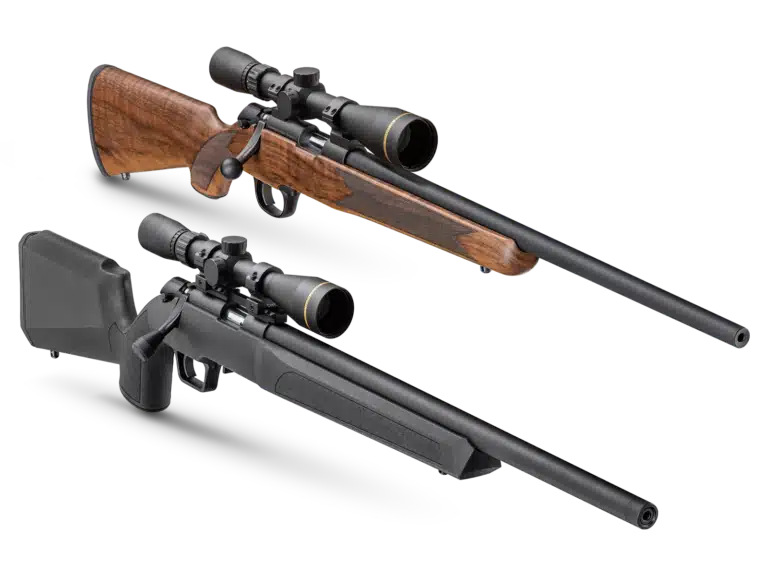
Well, a good starting point is the rifle itself. While it is offered in a “Classic” model variant with an attractive walnut stock, I chose to go with the more basic “Target” model with a heavier barrel and rugged, target-style polymer stock. MSRP starts at a very reasonable $434 for these.

It became clear upon unboxing the rifle that Springfield Armory is taking the potential of the .22 LR cartridge seriously. I will enthusiastically join the cohort of gun writers exclaiming that the Model 2020 Rimfire Target feels like a centerfire rifle. It’s solid without any of the rattling or flex often found in affordable rimfire or centerfire rifles of similar price, and the only giveaway of its rimfire chambering is the petite ejection window and short bolt pull.
This boded well for this article. In typical Springfield fashion, they are simply not content with simply churning out a new gun concept for the sake of it. It is evident they put a lot of thought and engineering into delivering a product that surpasses expectations.

Live The Armory Life. The latest content straight to your inbox plus an automatic entry to each of our monthly gun giveaways!
In preparation for the test, I gave the rifle barrel a thorough (read here: OCD) cleaning to rid it of any shipping preservative treatment. I then installed an Athlon Neos 6-18×44 scope I had on hand on the receiver’s Picatinny rail. This scope has glass clarity well above what its somewhat affordable price point would suggest, and the parallax adjustment knob allows a perfectly crisp sight picture at all practical ranges and magnifications.
The Test
To really wring out the rifle, I decided to fire five 10-shot groups at 50 yards with each loading. Additionally, I tallied how many of the 50 shots landed within a 1” circle, and how many of the individual 10-shot groups were smaller than 1”.
I reviewed my ammunition stores and mustered every type of .22 LR ammunition I had on hand for the test: CCI Standard Velocity, CCI MiniMag Target, CCI Velocitor, Winchester Wild Cat and Federal Champion Range Pack. Furthermore, I was very kindly sent generous amounts of ammunition by The Kinetic Group, for which they have my utmost gratitude. This included Federal Champion Value Pack, CCI MiniMag Segmented and the hard-to-find CCI Green Tag.

The rifle was sighted in using CCI Standard velocity, which also served the purpose to foul out the barrel before the formal test. All shots were fired resting on sandbags at an elevation of 700 feet, with an average temperature of 60°F, and all under an oppressive 90+% humidity that day.
I scanned and digitized every group and aggregated them into a composite 50-shot cluster showing the points of impacts for each ammunition using the CorelDraw X8 software suite. The velocity was recorded for each shot with an Athlon RangeCraft Velocity Pro radar chronograph, and notes were taken regarding the relationship between the shots’ velocity and impact and any other relevant observations. The velocity statistics were calculated using the current version of Microsoft Excel.
Results
For the sake of the length of this article and to avoid any headache for the reader, all the data compiled and calculated for this test is presented the chart below:

Four loads out of eight shot 10-shot group averages below one inch: CCI Standard Velocity, CCI Green Tag, CCI MiniMag Target and CCI MiniMag Segmented. Out of the 20 individual groups printed by these loads, 14 were smaller than one inch. CCI Standard Velocity and MiniMag Target printed four out of five groups smaller than one inch, and CCI Green Tag and CCI MiniMag Segmented three out of five. In total, for these four loads, 160 out of 200 shots (80%) landed within a one-inch circle, with the furthest of the “misses” just 0.26’’ away from the circle.

The overall most accurate load was the MiniMag Target, with a 10-shot group average of 0.84’’, with 86% of the shots landing within one inch circle. Despite falling within the transonic range on their way to the target, all of the 50 shots landed in a 1’’x1’’ square.
Close behind is CCI Standard Velocity, with 0.88’’ and 82% of the shots landing within a 1’’ circle, followed by the CCI MiniMag Segmented (0.90’’ and 74%) and the CCI Green Tag (0.97’’ and 78%).
My Takeaway
Wide velocity inconsistencies found in off-the-shelf ammunition are the biggest factor in this test. In the Model 2020 Target, all the 50 shot clusters from the best four loadings would shrink below one inch if the shots measured with the five extreme velocities were removed.

Ultimately, the Model 2020 Target is a .22 LR rifle that does not seem to be aware of its very reasonable price tag and is extremely accurate with off-the-shelf ammunition. Looks like a winner to me!
Editor’s Note: Please be sure to check out The Armory Life Forum, where you can comment about our daily articles, as well as just talk guns and gear. Click the “Go To Forum Thread” link below to jump in and discuss this article and much more!
Join the Discussion
Featured in this article




Share


Continue Reading

Did you enjoy this article?

 23
23
Springfield Armory® recommends you seek qualified and competent training from a certified instructor prior to handling any firearm, and to be sure to read your owner's manual. The views and opinions expressed on this website are those of the authors and do not represent the views and opinions of Springfield Armory.
Product prices mentioned in articles and videos are current as of the date of publication.

Greg Frebourg
Greg Frebourg was born in Geneva, Switzerland. He moved to Texas for work in 2010 after his PhD. He is an avid outdoorsman, hunter, conservationist, shooter and proud patriot. Greg seized the opportunity of making his lifelong passion in shooting and firearms his job after over two decades of research in geology. He lives in the Great State of Texas where white tail deer and feral hogs have now learned to hide from him as best as they can. It sometimes works.